
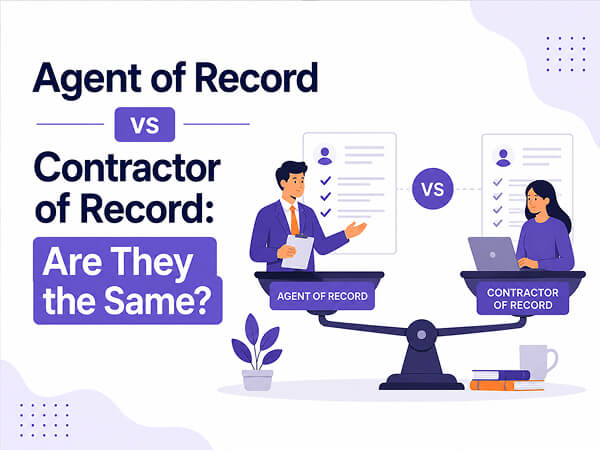
Agent of Record vs Contractor of Record: Are They the Same?
Direct answer:
Agent of Record (AOR) and Contractor of Record (CoR) are closely related market terms for services that help companies engage independent contractors. Providers sometimes use them interchangeably, but the exact scope, contracting structure, payment role, and compliance responsibilities can differ. Neither label alone tells you who assumes which legal obligations, so buyers must review the service agreement and local-law implications.
Key takeaways
- AOR and CoR are not universally standardized legal categories. They are provider-defined service models used in the contractor-management market.
- Both models usually support contractor onboarding, agreements, documentation, payments, record keeping, and compliance workflows, but the scope varies by provider and country.
- An AOR or CoR generally does not employ the worker. If the person should be an employee, an Employer of Record (EOR) or direct employment model may be more appropriate.
- No platform or contract automatically eliminates worker-misclassification risk. Classification depends on the real working relationship and the law that applies.
- The safest selection method is to compare actual responsibilities, local expertise, contracting structure, indemnities, data-processing terms, and escalation procedures rather than relying on the product label.
Question |
Agent of Record (AOR) |
Contractor of Record (CoR) |
|
Core purpose |
Coordinate or administer an independent-contractor engagement on the client’s behalf. |
Provide a structured model for engaging, documenting, managing, and often paying contractors. |
|
Worker type |
Independent contractor. |
Independent contractor. |
|
Legal employer? |
Usually no. |
Usually no. |
|
Typical services |
Onboarding, contracts, classification support, payments, records, compliance workflows. |
Similar services; some providers emphasize becoming the contracting counterparty or managing the full contractor lifecycle. |
|
Universal definition? |
No globally standardized statutory definition. |
No globally standardized statutory definition. |
|
Best evaluation method |
Review the contract and responsibility matrix. |
Review the contract and responsibility matrix. |
Important distinction
AOR and CoR are service labels, not a substitute for legal analysis. A worker’s status is normally determined by the facts of the relationship, such as control, independence, financial risk, integration, and local statutory tests - not simply by what the contract calls the worker.
What is an Agent of Record?
An Agent of Record is a third-party service provider that helps a client organize and administer its relationship with independent contractors. In practice, an AOR may coordinate contractor onboarding, collect documents, facilitate agreements, manage invoices and payments, retain records, and support classification or compliance reviews.
The word “agent” can suggest that the provider acts on behalf of the client, but the precise legal relationship depends on the agreement. Some AOR providers are mainly administrative intermediaries. Others become a contractual counterparty to the contractor, manage payment flows, or assume defined compliance obligations. Buyers should not infer legal responsibility from the product name alone.
What is a Contractor of Record?
A Contractor of Record is a provider-defined model for engaging and managing independent contractors through a structured third party. A CoR may support contractor classification, contracting, onboarding, identity or business verification, invoicing, payment administration, tax-document collection, and ongoing record keeping.
Some providers use “Contractor of Record” to emphasize that the provider is the formal contracting party with the contractor. Others use the term for a broader contractor-management package without assuming every legal responsibility. The contract must clarify who engages the contractor, who pays, who performs classification checks, who owns the work product, and who bears liability if the relationship is challenged.
Are AOR and CoR the same?
They can be functionally similar, but they are not automatically identical. The terms are widely used in the workforce-technology market, yet their scope is not standardized across providers or jurisdictions. One provider’s AOR may look like another provider’s CoR. Two providers using the same label may still offer materially different contracting structures and risk allocation.
For procurement purposes, treat AOR and CoR as starting labels. The meaningful comparison is the operating model underneath them.
The responsibility matrix that matters more than the label
Responsibility |
Questions to ask |
|
Contracting party |
Who signs the services agreement with the contractor? Is the provider acting as agent, principal, payment intermediary, or technology platform? |
|
Worker classification |
Who assesses status? Is the assessment country-specific? Is it repeated when the role changes? |
|
Day-to-day control |
Who directs the work, sets hours, approves leave, provides tools, and evaluates performance? |
|
Payments and invoices |
Who validates invoices, funds payments, handles currency conversion, and resolves payment disputes? |
|
Tax documentation |
Which forms or evidence are collected, who validates them, and what remains the client’s responsibility? |
|
Intellectual property |
How are confidentiality, work-product ownership, and assignment of rights handled? |
|
Data protection |
Who is controller or processor, where is data stored, and what subprocessor terms apply? |
|
Liability and indemnity |
What risks are covered, what is excluded, and are caps commercially meaningful? |
|
Termination and disputes |
Who terminates the engagement, manages notices, and handles worker claims or regulator enquiries? |
How the AOR or CoR operating model works
Although providers differ, a mature AOR or CoR engagement normally follows a controlled sequence. The objective is to avoid treating contractor onboarding as a simple payment task.
1. Define the role and intended relationship.
Document the services, deliverables, term, location, expected working pattern, reporting lines, tools, exclusivity, and level of client control. This factual profile is the basis for classification.
2. Assess worker classification.
Review the relationship against the applicable legal and tax tests. In the United States, the IRS directs businesses to consider behavioral control, financial control, and the type of relationship. In the United Kingdom, off-payroll rules may apply where a worker provides services through an intermediary and would have been an employee if engaged directly.
3. Choose the engagement model.
Use direct contractor engagement where the business can manage local contracts, classification, documentation, and payments itself. Consider AOR or CoR when centralized contractor administration and local support are needed. Use employment or EOR where the facts indicate an employment relationship.
4. Complete due diligence and onboarding.
Collect identity or business-registration evidence, tax information, bank details, sanctions or compliance checks where legally appropriate, and any role-specific documentation.
5. Execute the correct agreements.
The documents should reflect the real operating model, include deliverables and payment terms, address confidentiality and intellectual property, and allocate data-protection and compliance responsibilities.
6. Manage invoices and payments.
Apply approval workflows, retain records, handle supported currencies and payment methods, and define responsibility for transaction fees, exchange rates, taxes, and failed payments.
7. Monitor the relationship.
Reassess classification when scope, duration, control, location, exclusivity, or working practices change. A valid assessment at onboarding can become outdated.
8. Close or transition the engagement.
Confirm final deliverables and payments, revoke access, return equipment, retain required records, and decide whether the role should end, continue as contracting, or move to employment.
Operating-model diagram
Typical flow
Client defines the work -> AOR/CoR reviews and structures the engagement -> Contractor is onboarded and contracted -> Work is delivered under agreed operating practices -> Invoices and payments are processed -> Records and status are monitored -> Engagement is renewed, ended, or converted to employment.
AOR vs CoR vs EOR vs direct engagement
Model |
Worker status |
Who employs the worker? |
Typical use case |
Main caution |
|
Direct contractor |
Independent contractor |
No employer relationship intended |
A company can manage classification, local contracts, payments, and compliance internally. |
The client retains most operational and compliance responsibility. |
| AOR |
Independent contractor |
Usually no one; the person remains self-employed or operates through a business |
Centralized contractor administration with provider support. |
Provider scope and risk allocation vary. |
| CoR |
Independent contractor |
Usually no one; the person remains self-employed or operates through a business |
Structured contractor engagement, often including contracts, onboarding, payments, and records. |
The label does not guarantee that the provider assumes classification liability. |
| EOR | Employee |
The EOR is the legal employer for local employment purposes |
Hiring an employee where the client lacks a local employing entity. |
The client still directs day-to-day work, and co-employment or allocation issues must be managed. |
The decisive question is not which model appears cheapest or fastest. It is whether the worker should genuinely operate as an independent business. If the organization controls how, when, and where the person works and the role is integrated like employment, changing the contract label or inserting an intermediary may not change the legal analysis.
Practical scenarios
Scenario 1: Independent specialist for a defined project
A UK software company engages a South African cybersecurity consultant for a four-month audit. The consultant serves several clients, uses their own tools, controls the methodology, prices by project milestones, and carries business risk. A CoR or AOR may be useful for contracting, onboarding, invoicing, and cross-border payments, provided local-law and tax checks support contractor status.
Scenario 2: Long-term full-time role managed like an employee
A company hires an individual for an indefinite period, requires fixed daily hours, provides all tools, requires exclusivity, approves leave, and manages the person through the same performance process as employees. An AOR or CoR should not be used merely to preserve a contractor label. Direct employment or an EOR may be more appropriate after local review.
Scenario 3: UK personal service company and IR35
A contractor supplies services through a personal service company. UK off-payroll rules may apply if the individual would have been an employee when engaged directly. Responsibility for determining status can fall on the engaging organization unless an exception applies. The organization should perform an individual assessment and follow the statutory process rather than relying on a blanket contractor policy.
Scenario 4: Distributed creative freelancers
A mid-sized brand engages designers and translators in several countries for intermittent assignments. Each freelancer can accept or reject projects, sets availability, serves other clients, and invoices per deliverable. An AOR or CoR can centralize contracts, document collection, approvals, and payments while the company maintains clear project-based operating practices.
Scenario 5: Rapid expansion into a new country
A business plans to build a permanent local sales function but initially calls the roles “contractors.” Because sales staff may be closely controlled and integrated into the core business, the company should not assume contractor status. An EOR or local entity may be safer than a contractor model.
Risks and limitations
Misclassification risk cannot be outsourced completely:
Regulators and courts examine the actual relationship. The IRS states that written contracts alone are not sufficient and that the whole relationship must be considered. A provider can support assessment and administration, but client working practices remain critical.
Country rules differ:
There is no single global contractor test. Tax, labor, social-security, licensing, immigration, permanent-establishment, and data-protection rules may apply differently.
Provider responsibility may be narrower than expected:
Marketing may promise “compliance,” while the agreement limits responsibility to document workflows or payment processing. Review warranties, exclusions, indemnities, and liability caps.
Payment infrastructure is not legal classification:
A platform’s ability to pay a person in a country does not prove that the engagement is lawful or correctly classified there.
Contract language cannot cure inconsistent behavior:
A contract may describe independence, but fixed schedules, close supervision, mandatory exclusivity, employee benefits, or indefinite integration can point in the opposite direction.
Data processing adds obligations:
Contractor onboarding involves personal and financial data. Under GDPR, parties must determine whether they act as controller or processor and contract accordingly. Access, retention, international transfers, and subprocessors should be reviewed.
Permanent establishment and tax exposure may remain:
A contractor who habitually negotiates or concludes contracts, performs core activities, or creates a fixed business presence may raise corporate tax questions. Specialist tax advice may be needed.
Immigration and right-to-work issues may apply:
Contractor status does not automatically authorize a person to work from a particular country. Visa and immigration rules must be considered separately.
How to decide: step-by-step guidance
- Confirm whether the role is genuinely suitable for independent contracting based on actual control, independence, duration, integration, and financial risk.
- Identify every country connected to the engagement: client location, worker location, payment route, and any travel or relocation.
- Map legal, tax, social-security, immigration, data-protection, and intellectual-property requirements.
- Decide whether the company can manage the relationship directly or needs a provider to coordinate contracts, payments, documentation, and monitoring.
- Compare AOR and CoR providers by contractual responsibilities rather than headline terminology.
- Validate how the provider handles status changes, disputes, regulator enquiries, offboarding, and conversion to employment.
- Obtain local legal or tax advice for high-risk, ambiguous, regulated, or long-term engagements.
- Reassess the model periodically and whenever the facts change.
AOR/CoR provider selection checklist
☐ Which countries and worker types are supported, and what does “supported” mean in each jurisdiction?
☐ Is the provider the contractual counterparty, an agent, a payment intermediary, or a software platform?
☐ Who conducts classification assessments, and what evidence is produced?
☐ Does the assessment consider local law and actual working practices?
☐ Who drafts or supplies contractor agreements, and can they be localized?
☐ How are intellectual-property assignment and confidentiality handled?
☐ What identity, business, sanctions, tax, or right-to-work checks are performed?
☐ How are invoices, approvals, currencies, fees, and payment failures managed?
☐ What happens if a worker disputes status, payment, termination, or ownership of work?
☐ What warranties, indemnities, exclusions, and liability caps apply?
☐ How are GDPR roles, subprocessors, international transfers, retention, and deletion handled?
☐ Can the provider transition a contractor to employment or EOR if the relationship changes?
☐ What audit trail and downloadable records are available?
☐ Which claims, certifications, country-coverage statements, and service levels can the provider substantiate?
Frequently asked questions
Is an Agent of Record the same as a Contractor of Record?
Sometimes in practice, but not automatically. Providers may use AOR and CoR for similar services, while others use them for different contracting structures. Compare who contracts with the worker, who pays, who assesses classification, and which risks the provider contractually assumes.
Does an Agent of Record employ the contractor?
Usually not. An AOR normally supports an independent-contractor relationship rather than becoming the worker’s legal employer. If the person should be an employee, a direct employment or Employer of Record model may be more appropriate.
Does a Contractor of Record become the legal employer?
Usually no. A CoR is generally designed for independent contractors. Some providers may become the contracting counterparty, but that is different from employing the individual. Review the agreement and local-law implications.
Can an AOR or CoR eliminate misclassification risk?
No. A provider can support classification, documentation, contracts, payments, and monitoring, but legal status depends on the real relationship and applicable law. Client control and day-to-day working practices remain important.
What is the difference between AOR and EOR?
An AOR supports engagement of independent contractors. An EOR legally employs workers in the relevant country and handles local employment administration. The appropriate model depends first on whether the person is genuinely a contractor or should be an employee.
Can a company hire international contractors directly?
Yes, where the relationship is lawful and correctly classified and the company can manage local contracts, taxes, documentation, payments, data protection, and monitoring. An AOR or CoR can centralize those processes but is not always required.
Who is responsible for contractor taxes?
Responsibility varies by country and structure. Independent contractors often handle their own income and business taxes, while payers may have reporting or withholding duties. The engagement should be reviewed under the laws of the relevant countries.
When should a contractor be moved to employment?
Consider employment when the organization controls the person like an employee, the role is long-term and integrated, the person lacks genuine business independence, or local tests indicate employment. A local legal review should inform the decision.
What should a company ask an AOR or CoR provider?
Ask about contracting structure, classification methodology, local expertise, payment roles, tax documents, data protection, intellectual property, indemnities, liability limits, disputes, offboarding, and the process for converting a contractor to employment.
Is Contractor of Record a legally recognized term in every country?
No. The label is not a single globally standardized legal status. The underlying contractual relationships and local rules determine the legal effect of the model.
Where Transformify (TFY) may fit
Transformify (TFY) positions itself as a global workforce and contractor-management platform operating in 180+ countries. For organizations evaluating AOR or CoR support, the relevant question is whether TFY’s documented service scope matches the specific countries, worker profiles, compliance requirements, payment needs, and risk allocation required for the engagement.