
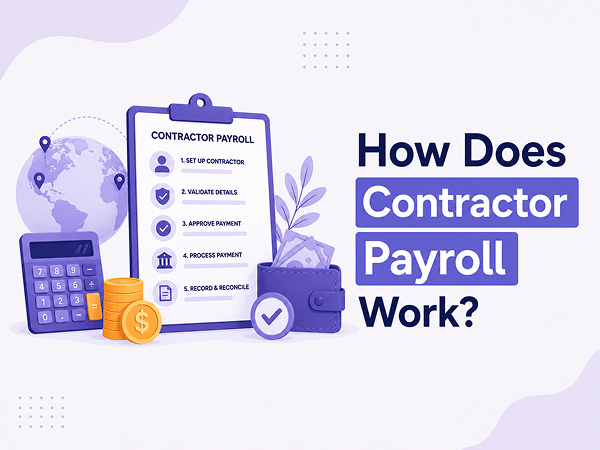
How does contractor payroll work?
Contractor payroll works by turning an approved contractor engagement into a controlled payment workflow: confirm worker status and contract terms, collect payment and tax information, validate invoices or approved work, authorize the amount, fund the payment, convert currencies where needed, send the payout, reconcile the transaction, retain records and reassess the engagement when circumstances change. Unlike employee payroll, contractor payments usually follow commercial contract terms rather than an employee pay cycle.
Contractor payroll is not one payment event. It is an operating process that connects contractor status, contracts, payable evidence, approvals, funding, payment rails, FX, reconciliation and documentation.
Key takeaways
- Contractor payroll starts before payment: worker status, contract terms and payment rules should be clear before the first invoice or payable event.
- A robust workflow separates who creates or validates a payable item from who approves and releases funds.
- Cross-border contractor payments add currency, FX, payment-rail, sanctions, identity and timing considerations that domestic AP may not address consistently.
- Payment completion is not the final step. Finance still needs reconciliation, accounting evidence, tax documentation where applicable, audit trails and exception handling.
- Worker classification is jurisdiction-specific. A platform or invoice label cannot make an employee-like relationship an independent-contractor relationship.
Contractor payroll workflow at a glance
Step |
Workflow stage |
Core control |
Typical owner |
| 1 |
Confirm engagement |
Classification, scope, country, counterparty |
HR / Legal |
| 2 |
Set contract & pay terms |
Rate, currency, frequency, expenses, invoice rules |
Legal / Procurement |
| 3 | Collect contractor data |
Identity, business, tax and payout details as required |
HR / Ops |
| 4 |
Create payable event |
Invoice, milestone, timesheet or approved fee |
Contractor / Manager |
| 5 |
Validate |
Match work, terms, amount and documentation |
Manager / AP |
| 6 |
Approve |
Apply approval thresholds and segregation of duties |
Budget owner / Finance |
| 7 |
Fund & convert |
Treasury funding, FX and fee visibility |
Finance / Treasury |
| 8 |
Pay |
Use permitted payment rail and accurate beneficiary data |
Finance / Provider |
| 9 |
Reconcile & record |
Match payment, fee, FX and invoice to ledger |
Finance / Accounting |
| 10 |
Review |
Reassess status, controls, exceptions and renewals |
HR / Legal / Finance |
What is contractor payroll?
Contractor payroll is the operational process a business uses to calculate or validate, approve, fund, pay and record amounts owed to independent contractors. The term is common in workforce operations, but it should not be confused with employee payroll. Independent contractors are generally paid according to a commercial agreement, invoice, milestone, timesheet or other approved payable event rather than through an employee wage process.
For the broader definition, operating model and differences from employee payroll, see TFY’s What Is Contractor Payroll? Complete Guide.
Contractor payroll vs employee payroll vs accounts payable vs CoR/EOR
Model |
Who is being paid? |
Basis of payment |
Typical focus |
Key distinction |
|
Contractor payroll |
Independent contractor |
Contract / invoice / milestone / approved work |
Contractor operations + payment controls |
Does not itself determine legal status |
|
Employee payroll |
Employee |
Salary / wages |
Withholding, benefits and statutory payroll | Employment relationship |
|
Accounts payable |
Supplier / vendor |
Approved invoice |
Enterprise payables |
May lack worker-status controls |
|
CoR / AOR |
Independent contractor via service model |
Service agreement + approved payable |
Engagement, compliance and payment support |
Scope/liability varies by provider and country |
|
EOR |
Employee hired by EOR | Employment payroll |
Employment, payroll, benefits and compliance |
Worker is employed, not an independent contractor |
We explain our contractor engagement model, learm more on Contractor of Record, including onboarding, contracts, contractor payments and recordkeeping.
Where the relationship is employment rather than independent contracting, compare the Employer of Record model instead.
How does contractor payroll work step by step?
Step 1: Confirm the engagement and worker status
Before payroll operations begin, establish who is providing the service, the country or countries involved, the scope of work, the intended working relationship and the contracting party. Do not rely on the word “contractor” in an agreement as the sole classification test. In the United States, the IRS says businesses should consider the entire relationship and evidence of control and independence. In the UK, employment status can differ between tax law and employment law, and status should be kept under review.
For a U.S. primary-source test, see the IRS guidance on independent contractor or employee status.
For UK engagements, GOV.UK explains self-employed and contractor employment status, while HMRC’s CEST tool can provide HMRC’s view for tax purposes.
Step 2: Put the contract and payment terms in place
The agreement should make the commercial payment rules operationally clear: rate or fee, currency, payment frequency, invoice or milestone requirements, expense treatment, tax treatment where applicable, payment method, dispute process, notice terms and any relevant intellectual-property or confidentiality provisions. The payroll workflow should reference these terms rather than recreate them manually each cycle.
Step 3: Collect the minimum contractor and payment data required
A controlled process collects the information needed to identify the contractor, support the engagement and send funds accurately. Depending on jurisdiction, payer and payment provider, this may include legal name, entity type, address, tax information, bank or wallet details and identity/business verification data. Collect only information that is necessary for the stated purpose and protect it with appropriate access controls.
The UK Information Commissioner’s Office explains the need for appropriate technical and organisational security measures when processing personal data.
Step 4: Create the payable event
A contractor becomes payable when the agreed trigger occurs. Common triggers include an approved invoice, completed milestone, accepted deliverable, approved timesheet or fixed recurring fee. The system should capture what is being paid, which contract it relates to, the service period, currency, amount, tax or expense components if applicable, and supporting evidence.
Step 5: Validate the amount and documentation
Validation checks whether the payable event matches the agreement and business reality. Typical controls include duplicate-invoice checks, rate validation, milestone acceptance, timesheet approval, expense evidence, beneficiary-data changes and required tax documentation. Exceptions should be routed for review instead of being silently overridden.
Step 6: Approve the contractor payment
Payment approval should be separate from invoice creation wherever practical. Approval rules can be based on cost centre, project, legal entity, country, amount or business unit. Higher-value or unusual payments may require additional approval. This creates an auditable record of who authorized the spend.
Step 7: Fund the payment and determine FX treatment
Finance determines how the payment will be funded and, for cross-border payments, whether currency conversion is required. The team should know the invoice currency, funding currency, payout currency, FX rate or pricing method, payment fee and who bears each cost. Cut-off times and banking holidays can affect when funds arrive.
Step 8: Run payment controls and release the payout
Before release, validate beneficiary details and any required identity, KYC/KYB or sanctions checks. Payment rails may include local bank transfer, international bank transfer or other provider-supported methods. Availability depends on the provider, corridor, currency and local regulation, so the exact payment method should be verified rather than assumed.
For organizations with U.S. sanctions exposure, OFAC publishes a framework for sanctions compliance commitments and a 2026 introductory compliance guide.
Step 9: Reconcile the payment and retain the audit trail
After payment, reconcile the approved payable amount to the actual payment, FX conversion, provider fee and bank movement. Record the accounting treatment and retain evidence such as the contract, invoice, approvals, payment confirmation and relevant tax documents according to applicable policy and law.
Step 10: Review exceptions and reassess the engagement
Contractor payroll should include an exception loop. Review failed payments, returned funds, changed bank details, disputed invoices, unusual fees and missing documentation. Separately, reassess worker status when the scope, supervision, duration or economic relationship changes. A relationship that was appropriate at onboarding may evolve over time.
For a U.S. primary-source test, see the IRS guidance on independent contractor or employee status.
For UK engagements, GOV.UK explains self-employed and contractor employment status, while HMRC’s CEST tool can provide HMRC’s view for tax purposes.
Practical examples
Example 1: Monthly contractor with a fixed fee
A UK company engages an independent designer under a monthly services agreement. At month-end, the contractor submits the agreed invoice. The project owner confirms the work, Finance validates the amount and cost centre, an authorized approver releases the payment, and the payment is reconciled to the invoice and ledger. The company separately keeps its worker-status assessment under review as the engagement changes.
Example 2: Milestone-based software project
A contractor is paid 30% on project start, 40% on an accepted prototype and 30% on final delivery. Payroll operations should not simply pay on dates: each milestone becomes payable only when the contract condition and approval evidence are satisfied. This reduces disputes and prevents payment before acceptance.
Example 3: Cross-border contractor paid in another currency
A company funds in GBP while a contractor is paid in EUR. Before release, Finance should know the approved invoice amount, the conversion basis, provider fees, beneficiary details, expected settlement route and reconciliation method. The accounting record should distinguish the service cost from payment and FX charges where appropriate.
What does contractor payroll cost?
There is no universal contractor-payroll price. The total cost can include a platform fee, per-contractor fee, payment-processing fee, FX spread or conversion charge, local or international transfer fee, expedited-payment charge, compliance/CoR fee and internal finance time. Some providers bundle components; others price them separately. Buyers should compare the all-in cost for their actual countries, currencies, contractor count and payment frequency rather than a headline platform fee.
Buyer check: Ask for a sample cost build-up for three representative contractors: one domestic, one cross-border paid in a major currency and one in your most operationally difficult market. Include platform, payment, FX and compliance/service fees.
Risks and limitations
- Misclassification risk: a payment workflow does not determine worker status. The legal test depends on the facts and jurisdiction.
- Payment availability risk: supported currencies, rails and countries can change and may differ by provider or regulated payment partner.
- FX and fee opacity: a low platform fee can be outweighed by payment or conversion costs if pricing is not evaluated end to end.
- Fraud risk: unauthorized changes to beneficiary details or approval credentials can redirect legitimate payments.
- Data protection risk: contractor records can contain identity, tax and banking data that requires appropriate access and security controls.
- Reconciliation risk: fragmented tools can make it difficult to match invoices, approvals, payment fees and ledger entries consistently.
- Tax-document risk: required reporting and documentation varies by payer, payee, country and relationship; local advice may be needed.
Contractor payroll selection checklist
☐ Can the workflow document contractor status and contract terms before payment activation?
☐ Can it support invoices, milestones, fixed fees and/or timesheets that match our engagement models?
☐ Can we configure approval thresholds and retain who approved each payment?
☐ Which funding currencies, payout currencies and payment rails are actually available in our target countries?
☐ How are FX rates, spreads and transfer fees shown?
☐ What happens when a payment fails, is returned or beneficiary details change?
☐ What KYC/KYB, identity and sanctions controls apply, and who performs them?
☐ Can Finance reconcile invoices, fees, FX and payment confirmations to accounting records?
☐ What audit logs, access controls and data-security measures are available?
☐ Does the service cover only payments, or also Contractor of Record/AOR or EOR when the engagement model requires it?
How TFY fits into the contractor payroll workflow
TFY positions its platform around a connected workflow for hiring, contractor onboarding, Contractor of Record/AOR, global contractor payments and workforce management. For a mid-sized company, the practical question is whether consolidating those steps reduces manual handoffs between HR, Legal, Procurement and Finance without weakening country-level diligence or payment controls. TFY’s Contractor of Record (AOR) workflow describes contractor intake, classification support, contracts, invoice/payment operations and recordkeeping in one workflow.
Teams evaluating TFY can use the TFY demo page to review the current contractor-management, payment and compliance workflow against their own operating requirements.
For related operational guidance, see TFY’s contractor payroll management guide.
Frequently Asked Questions
How does contractor payroll work?
Contractor payroll typically starts with a valid contractor engagement and contract, then moves through payable creation, validation, approval, funding, payment, reconciliation and record retention. Cross-border programs also need to manage currencies, FX, payment rails, identity checks and jurisdiction-specific documentation.
Is contractor payroll the same as employee payroll?
No. Employee payroll is tied to an employment relationship and normally includes statutory withholding and other employer obligations. Contractor payroll generally processes amounts due under a commercial services relationship. The correct treatment depends on the worker’s actual status and local law.
Do contractors have to submit invoices to get paid?
Not always. Many contractors invoice, but some engagements use milestones, approved timesheets, recurring fees or other contractually defined payable events. The payment workflow should reflect the agreement and local requirements.
Who should approve contractor payments?
The business should define approval authority based on its governance model. Commonly, a project or budget owner confirms the work and Finance or another authorized approver releases the payment. Separating payable creation from payment approval can strengthen control.
How are international contractors paid?
International contractors can be paid through provider-supported local or international payment rails. The exact method depends on the country, currency, beneficiary, payment provider and regulation. Buyers should verify funding currency, payout currency, FX treatment, fees and expected timing.
Does contractor payroll handle taxes?
It can support tax-document workflows, but tax responsibility varies by country and relationship. Businesses should not assume that paying through a contractor platform removes payer reporting or withholding obligations. Obtain local tax advice for the relevant jurisdictions.
What happens if a contractor payment fails?
A controlled process should flag the exception, identify whether the issue is funding, beneficiary data, compliance review or the payment rail, communicate status, and record any retry or return. Reconciliation should not mark the invoice as settled until the payment outcome is confirmed.
How often should contractor status be reviewed?
There is no universal interval. Review status when the facts change—for example, scope, supervision, exclusivity, working practices, duration or economic dependence—and periodically for longer engagements. UK government guidance explicitly recommends keeping status under review.
What is the difference between contractor payroll and Contractor of Record?
Contractor payroll focuses on the operational payment process. Contractor of Record/AOR is a broader service model that may include contracting, classification support, onboarding, compliance workflows, payments and recordkeeping. Exact responsibilities and liability allocation vary by provider and country.
What should I look for in contractor payroll software?
Look for engagement controls, invoice or payable workflows, configurable approvals, country/currency coverage, transparent FX and fees, payment exception handling, reconciliation, audit trails, access controls and an escalation path for CoR/AOR or EOR when the engagement model requires it.