
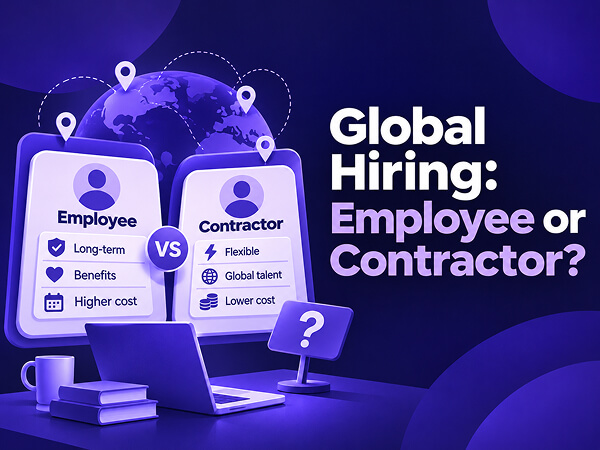
How Should You Hire or Engage Talent Across Borders?
Companies can engage talent across borders by hiring through their own local entity, using an Employer of Record (EOR), contracting directly with a genuinely independent professional, or using a Contractor of Record (CoR) to support contractor administration. The right route depends on where the person works, what they do, how much control the company exercises and whether the relationship is truly employment or independent service provision. Geography alone does not determine legal status.
The hiring question most companies ask too late
A product team in London finds an excellent engineer in Warsaw. A finance director in Manchester wants a specialist in Manila. A US startup discovers that its next commercial lead lives in Lisbon. The talent is available, the salary is affordable and the interview went well. Then comes the question that can change the economics of the hire: what exactly is this person going to be?
It is tempting to treat cross-border hiring as a sourcing exercise followed by a payment instruction. In reality, the arrangement can affect employment rights, tax withholding, social security, immigration permissions, intellectual property, data protection and the company’s potential exposure in another jurisdiction. A contract that calls someone a freelancer is not decisive if the day-to-day working relationship looks like employment. The UK government employment status guide explicitly emphasises the facts of the working relationship.
The practical lesson is not to abandon international hiring. It is to choose the legal and operational model before an offer is issued, and to revisit that choice as the role evolves.
Four ways to engage international talent
1. Hire through your own local entity
A company with an established subsidiary can employ local staff directly. This may provide the clearest long-term structure for a substantial team, especially where the company needs direct supervision, ongoing roles, local benefits and a durable commercial presence. But the entity carries registration, payroll, employment, accounting and governance responsibilities. Incorporating a company is rarely justified by a single short-term project.
2. Use an Employer of Record
An EOR generally employs the worker through a local employing entity and handles agreed employment administration, while the client directs the work. It can be useful for testing a market or hiring an employee before opening an entity. Employers should check the EOR’s actual legal structure, permitted services, allocation of liabilities, benefits, termination obligations and country coverage. Not every provider can support every role in every market, and local rules may limit the model.
Learn more about TFYs Employer of Record service.
3. Contract directly with an independent professional
A genuine independent contractor may be suitable for defined deliverables, specialist expertise or a finite engagement. Independence must exist in practice. Relevant facts can include control over methods and hours, substitution rights, commercial risk, equipment, exclusivity and whether the person runs an independent business. The factors and their legal significance vary by jurisdiction. For a UK-facing example, consult HMRC employment status guidance and the HMRC Check Employment Status for Tax tool, while remembering that tax status and employment-rights status are not always identical.
4. Use a Contractor of Record
A CoR helps organise contractor onboarding, contracts, classification support, documentation, invoicing and payment processes. It can be valuable when a company works with dozens or hundreds of independent professionals across multiple markets. But a CoR is not a legal shortcut: it cannot transform an employee-like relationship into genuine self-employment merely by changing the paperwork. TFY Contractor of Record and Contractor Payroll service supports ontractor workflows across 184+ countries, including classification support and centralised payments.
Which Hiring Model Is Right for Your Business?
There is no single best way to hire internationally. The right model depends on how permanent the role is, how much control you need, and whether your business has a legal presence in the country.
1. Hiring for a permanent role where you already operate?
Consider: Direct Employment
If your company has a legal entity in the country and needs someone working under its ongoing direction, direct employment is often the most straightforward option.
Before proceeding: Check local payroll obligations, employee benefits, employment taxes and termination requirements.
2. Hiring a permanent employee in a new country?
Consider: Employer of Record (EOR)
An EOR may allow you to employ talent in a country where you do not have your own legal entity, without immediately establishing one.
Before proceeding: Verify whether the EOR arrangement is legally permitted, who carries employment liabilities, what benefits are required and the total service fees.
3. Engaging a specialist for a defined project?
Consider: Independent Contractor
For project-based work with clear deliverables and genuine independence, engaging an independent contractor may offer greater flexibility.
Before proceeding: Assess the actual working relationship, degree of control and worker-classification rules. A contractor agreement alone does not establish independent status.
4. Managing independent contractors across multiple countries?
Consider: Contractor of Record (CoR)
A CoR can help businesses coordinate contractor onboarding, documentation, classification assessments and international payments across multiple jurisdictions.
Before proceeding: Evaluate the provider's classification support, country coverage, payment capabilities and compliance controls.
5. Establishing a long-term operation in a new market?
Consider: Your Own Legal Entity or a Transitional EOR
If you plan to build a substantial permanent workforce in one country, establishing a local entity may become more economical and operationally appropriate over time. An EOR can sometimes provide a transitional solution.
Before proceeding: Compare setup costs, long-term employment expenses, corporate tax exposure, operational requirements and expansion timelines.
The bottom line: The decision is not simply employee versus contractor. It is about matching the working relationship, business objectives and local legal requirements to the right engagement model.
The classification risk is real, not a theoretical footnote
Some of the most consequential controversies in the modern labour market concern the boundary between an independent business and a worker who depends on a platform or client. Courts and regulators have examined whether contractual descriptions reflect actual control and working conditions. These disputes are a warning against treating classification as a box to tick, not proof that any particular provider or client is acting unlawfully.
The EU Platform Work Directive overview is particularly relevant to digital labour platforms: it requires member states to establish procedures for determining employment status and addresses a rebuttable presumption of employment where relevant facts indicate direction and control. Its national transposition deadline is 2 December 2026. It is not a blanket rule automatically reclassifying all independent contractors or all cross-border freelancers. The European Council platform work guidance explains the policy rationale and safeguards.
For companies, the most effective response is operational. Document why the chosen arrangement fits the work. Ensure the contract, reporting lines, working hours, exclusivity expectations and actual practices tell the same story. Review long-running engagements rather than assuming the original classification will remain appropriate indefinitely.
The five costs that rarely appear in the headline fee
1. Employment and statutory costs
A quoted salary is not the full cost of employment. Depending on the country, employer social contributions, mandatory leave, insurance, severance, pension obligations and collective bargaining rules can materially alter the budget. Compare total employer cost, not salary alone.
2. Payment and currency friction
An apparently inexpensive contractor platform can become costly when FX margins, intermediary bank charges, failed payments, minimum fees and reconciliation time are added. Finance teams should ask for an itemised illustration using their real countries, currencies, payment frequency and average invoice size.
3. Tax and permanent establishment
Having someone working abroad does not automatically create a taxable presence, but certain activities, authority to conclude contracts, management functions and sustained business operations may raise questions under domestic law and applicable tax treaties. Cross-border remote work should be assessed by tax advisers in the relevant jurisdictions, especially for senior commercial or executive roles.
4. Intellectual property and data security
Who owns the code, research, designs or customer materials produced overseas? An effective engagement should address IP assignment where enforceable, confidentiality, information security, permitted access and cross-border personal-data transfers. Local mandatory law may override generic contract clauses.
5. Exit costs and operational dependence
A low monthly administration fee may conceal expensive termination processes, notice obligations or migration work. Companies should ask how easily they can move from contractor to employee, from EOR to their own entity, or from one provider to another without losing records or disrupting payments.
A practical decision framework before the first offer
Start with the work itself. Is it an ongoing function at the heart of the business, or a clearly scoped outcome? Who decides how, when and where it is performed? Can the professional serve other clients? Will they manage people, negotiate deals or represent the company? These questions should shape the engagement model before commercial negotiations become difficult to unwind.
Next, map the countries. For each location, record the person’s habitual place of work, nationality and work authorisation where relevant, applicable labour and tax rules, payment rails, and the provider or entity responsible for statutory obligations. Avoid relying on a global coverage number without confirming support for the precise country and engagement type.
Then model two horizons: the first six months and the next two years. A contractor may be sensible for a defined launch project; an employee may be more appropriate once the role becomes permanent and tightly integrated. A company expecting to employ a substantial team in one country should compare the long-term cost of its own entity against an EOR.
Finally, assign internal owners. HR should own the role and working relationship, legal the contractual and regulatory review, finance the full cost and payment controls, and IT the access and data protections. Cross-border hiring fails most often when everyone assumes someone else has checked the difficult part.
What a sensible onboarding process looks like
Before work begins, collect the information needed to confirm identity, location, business status and any applicable permissions. Complete a documented classification assessment, agree a locally appropriate contract, establish IP and confidentiality protections, configure approved payment details and set a schedule for reassessment. A reliable audit trail matters when a regulator, auditor or future acquirer asks how a decision was reached.
For a contractor programme, the operational challenge increases with scale. Fifty people across ten countries can generate fifty invoices, multiple approval paths and an inconsistent record of contracts. The TFY global hiring platform brings recruitment, contractor onboarding and payment workflows together, while TFY Contractor of Record service supports the administrative processes around independent engagements. Buyers should still confirm the service scope and local legal position for each engagement.
Book a demo with TFY to see how this all works.
When should you reconsider the arrangement?
Reassess when a contractor begins working exclusively for one client, moves into management, is required to keep employee-like hours, changes country, or remains embedded long after the original project ends. Reassess an EOR when a local team becomes large enough that entity formation may be commercially justified. Reassess any provider when fees, country support or the actual service delivered no longer match the business case.
A quarterly review of high-risk engagements and an annual review of the wider workforce model are useful governance practices, although the appropriate frequency depends on the circumstances. The goal is not bureaucracy for its own sake. It is to catch a changed relationship before it becomes an expensive dispute.
Where TFY fits, and where it may not
TFY is particularly relevant to organisations that need to recruit, onboard, administer and pay international contractors without maintaining separate spreadsheets, disconnected approval chains and multiple payment processes. Its published TFY Contractor of Record service supports coverage in 184+ countries and classification.
A company primarily seeking sophisticated consolidation of existing employee payroll across numerous owned entities may prioritise a dedicated enterprise payroll platform. A business planning a large permanent operation in one country may ultimately prefer its own employing entity. The best choice is the one that matches the legal relationship and operating model, not the one with the most expansive marketing claim.
Frequently asked questions
Can I hire someone abroad without opening a company there?
Often yes, through an appropriate EOR arrangement or a genuinely independent contractor engagement, subject to local rules. Whether a local entity is necessary depends on the activity, legal structure and jurisdiction.
Is paying someone as a freelancer enough to make them a contractor?
No. Authorities and courts may look beyond invoices and contractual labels to how the work is actually performed. Use country-specific advice and document the assessment.
Is an EOR the same as a Contractor of Record?
No. An EOR is designed for employment arrangements, while a CoR supports independent contractor engagements. They address different legal relationships and should not be treated as interchangeable.
Can a remote employee create tax obligations in another country?
Potentially. The outcome depends on the facts, domestic law and relevant treaties. Seek local tax advice before approving sustained cross-border remote work, particularly for senior or revenue-generating positions.
What should I compare when choosing a global workforce provider?
Check country-specific service availability, legal structure, worker classification approach, employment obligations, onboarding timelines, total fees, FX charges, data security, reporting, integrations, exit provisions and responsibility when something goes wrong.
The bottom line
International hiring is not a contest to find the cheapest country or the fastest way to send an invoice. It is a decision about the kind of relationship a business wants to build. Companies that get the classification, local obligations and payment controls right can access a broader talent market without allowing operational complexity to erase the advantage. The question is not simply where the talent lives. It is how the work will actually be done.
Editorial disclosure, sources and disclaimerEditorial disclosure: This article is published by TFY, which provides global recruitment, contractor management, Contractor of Record, Employer of Record and payment services. TFY has a commercial interest in these topics. The analysis distinguishes independent legal requirements from TFY’s own service descriptions.