
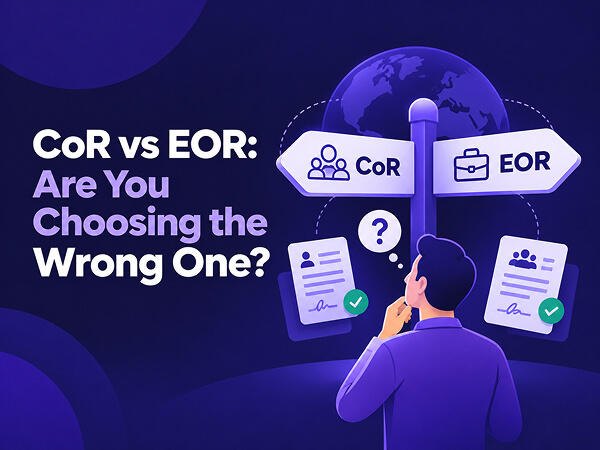
Contractor of Record vs Employer of Record: Which Do You Actually Need?
A business wants to engage a software engineer in Poland, a marketing consultant in the Philippines and a full-time sales director in Germany. All three may work remotely. All three may receive monthly payments. Yet treating them as the same kind of hire could be an expensive mistake. The question is not simply how to pay someone abroad. It is who controls the work, who carries employment obligations and whether the arrangement reflects what happens in practice.
That is the distinction behind two increasingly prominent global workforce services: Contractor of Record (CoR) and Employer of Record (EOR). They sound similar. Their purpose is not. One supports genuine independent contractor engagements; the other typically employs a worker locally on behalf of a client business. Neither is a legal shortcut that overrides the law in the country where work is performed.
Which one to choose?
Choose a Contractor of Record model when the work can lawfully and genuinely be delivered by an independent business or self-employed professional, and you need structured contracts, onboarding, classification support, invoicing and international payments. Consider an Employer of Record when the role should be an employee, but your company does not have an appropriate employing entity in that country. For some businesses, establishing a local subsidiary and hiring directly is the better long-term choice.
The critical caveat: “Contractor of Record” is a commercial service label, not a universally defined legal status. The precise contracting chain, allocation of liabilities and obligations vary by provider and jurisdiction. Buyers should review the actual agreement, not rely on a marketing acronym.
CoR vs EOR at a Glance
The difference between a Contractor of Record (CoR) and an Employer of Record (EOR) comes down to how a business engages workers, manages compliance and structures the working relationship.
Contractor of Record (CoR)
Designed for businesses engaging independent contractors across borders.
- Worker relationship: Independent contractor, where legally permitted.
- Typical work: Defined projects, specialist assignments and deliverables.
- Administration: Classification reviews, contractor agreements, invoicing and payments.
- Legal considerations: Employment protections depend on actual worker status and local legislation.
- Primary risk: Worker misclassification and potential tax liabilities.
Best for: Flexible, project-based engagements with independent specialists.
Employer of Record (EOR)
Designed for businesses hiring employees internationally without establishing their own local employing entity.
- Worker relationship: Employee hired under a local employment contract.
- Typical work: Ongoing positions integrated into everyday business operations.
- Administration: Employment contracts, payroll withholding and statutory benefits.
- Legal considerations: Local employee protections generally apply.
- Primary risk: Employment-law compliance, allocation of employer responsibilities and provider reliability.
Best for: Hiring employees in countries where the business does not have a local employing entity.
The bottom line
Choose CoR when the working relationship is genuinely independent and project-based. Choose EOR when the role requires an employment relationship under local law.
Neither model overrides local employment legislation. The nature of the working relationship, not simply the contract or service provider, determines the appropriate structure.
Why the distinction matters more in 2026
Companies have spent years making cross-border hiring operationally easier. Regulation is moving in a different direction: towards examining the substance of work arrangements. A signed independent contractor agreement does not, by itself, establish self-employment. Authorities may examine supervision, control, integration into the business, economic dependence and the ability to make a profit or loss.
The UK government explains that a contractor may be self-employed, a worker or an employee depending on the facts. Its guidance on employment status also warns that tax status and employment-rights status need not be identical. A business may therefore face different questions from HMRC and an employment tribunal.
In the United States, this is especially topical. On 19 November 2026, the Department of Labor announced a new final rule revising its federal worker-classification analysis. The agency says the rule replaces its 2024 framework, places particular emphasis on control and opportunity for profit or loss, and does not displace state laws or other federal tests. It takes effect only after the specified Federal Register publication period, not merely because it was announced.
The official US Department of Labor explanation of the 2026 rule is a useful reminder that employers cannot use one global classification checklist for every market.
The European Union has also sharpened scrutiny of platform work. Its Platform Work Directive requires member states to establish mechanisms for determining employment status in covered platform relationships, with national implementation due in December 2026. It is not a blanket rule that every freelancer working for any company is an employee.
The full EU Platform Work Directive sets out the narrower scope and the role of national law. Its relevance is the broader principle: intermediaries and contract labels do not eliminate the need to examine the real working relationship.
What does a Contractor of Record actually do?
A CoR provider generally helps businesses engage and administer independent contractors across borders. Depending on its contractual model, it may manage or facilitate contractor agreements, assess classification risks, collect identity and tax documents, route approvals, process invoices and coordinate payments. The client still needs to define a genuinely independent scope of work and manage the engagement consistently with that status.
Imagine a UK company commissioning a six-week website redesign from an independent designer in Portugal. The designer sets their working methods, uses their own tools, serves other clients and is paid against agreed milestones. Subject to local advice, a contractor arrangement may be appropriate. A CoR service can reduce the operational friction of onboarding and paying that professional.
Now imagine the same designer is required to work fixed daily hours, reports to a line manager indefinitely, cannot serve other clients and performs the same ongoing duties as staff. Calling the person a contractor, or placing a CoR provider between the parties, does not automatically resolve the underlying classification risk.
What does an Employer of Record actually do?
An EOR typically employs a person through a local legal entity and handles local employment administration for a client. This can include employment contracts, payroll taxes, mandatory contributions, leave entitlements, benefits and statutory filings, subject to the applicable agreement and local law. The client generally directs the employee’s day-to-day work, while the EOR carries specified formal employer responsibilities.
Consider a British software business hiring a full-time account executive in Spain to develop its market. The role is permanent, closely managed and integrated into the company. If the company lacks a Spanish employing entity, an EOR may offer a route to lawful local employment without immediately establishing a subsidiary. But it is not universally available or suitable: some countries restrict labour leasing, co-employment or third-party employment structures, and permanent establishment and immigration questions may remain.
The cost comparison that buyers often get wrong
The monthly platform fee is rarely the complete cost. CoR pricing can include a subscription, transaction fees, foreign exchange spreads, payment-provider charges and additional compliance services. EOR pricing usually sits alongside the employee’s gross salary, employer taxes, statutory benefits, insurance and other mandatory costs. Termination and severance exposure may also matter.
A sensible comparison starts with the total annual cost of the same role under lawful alternative structures. Include internal HR time, accounting, onboarding, equipment, local advisory fees, currency conversion, expected duration and the cost of changing the model later. A cheaper monthly contractor fee is irrelevant if the work is legally employment.
The misclassification controversy: what the cases really show
The recurring controversy in global hiring is not that one provider has invented a loophole. It is that companies can underestimate how much control they exercise over supposedly independent workers. Public disputes over worker status have repeatedly shown the difference between contract wording and real-world practices. The legal consequences depend on the jurisdiction and facts; there is no sound basis for assuming that any named CoR or EOR provider is noncompliant merely because it operates in this sector.
The UK Supreme Court’s Uber decision is often cited in this debate. It concerned drivers’ worker status under UK law, not a blanket ruling that every platform worker or contractor must be employed. The judgment emphasised statutory protections and the practical relationship rather than treating contractual wording as conclusive.
Read the UK Supreme Court Uber case materials for the primary legal record. Businesses should use the case as a warning against simplistic labels, not as a substitute for country-specific advice.
Seven questions to ask before choosing
- Is the role genuinely project-based, or is it a permanent part of the organisation?
- Who decides the hours, methods, tools and location of the work?
- Can the professional work for other clients and bear commercial risk?
- What do local employment, tax, immigration and data rules require?
- Which party signs the worker agreement and bears each specific liability?
- What is the fully loaded cost, including taxes, benefits, FX and exit costs?
- Can the arrangement scale, and when should we consider direct local employment?
Three realistic hiring scenarios
Scenario one:
a design agency needs a freelance translator in Argentina for a short assignment. If the person is truly operating independently under local rules, a CoR workflow may be efficient.
Scenario two:
a SaaS business needs a permanent country manager in France. An EOR or local employment entity is more likely to fit the actual working relationship.
Scenario three:
a company has 60 specialists across ten countries, some on deliverables and some effectively full-time. The right answer may be a mixed workforce model after role-by-role classification, not a single provider label applied to everyone.
Where TFY fits
TFY contractor-first offering focuses on helping HR, legal and finance teams onboard, document, manage and pay international contractors through one workflow. Its public product materials describe classification support, locally aligned contracts, invoice approvals, payment operations and records across more than 184 countries. That can be particularly relevant for organisations managing large, geographically dispersed contractor populations.
The TFY Contractor of Record and Contractor Payroll explains the service scope and workflow. Buyers should confirm the exact contracting model, country coverage, classification review, liability allocation and payment charges for their own use case.
TFY also offers Employer of Record services, but the two offerings should not be treated as interchangeable. For a genuine employee role, assess EOR capabilities and local legal constraints separately. For a genuine independent contractor, evaluate the CoR workflow against the specific compliance and operational needs of the engagement.
Frequently asked questions
Is a Contractor of Record the legal employer?
Usually not in the same sense as an EOR. A CoR arrangement is designed for independent contractor engagements, but the contractual chain and legal consequences vary. Review the provider agreement and local law.
Can a company use both CoR and EOR?
Yes. A company may have genuine freelancers in some roles and employees in others. Each engagement should be assessed on its facts and local requirements.
Does an EOR eliminate all employer risk?
No. Liability can be shared or allocated differently under local law, and the client may retain obligations relating to workplace conduct, supervision, tax exposure, data protection or immigration.
Can a CoR prevent misclassification?
A provider can support due diligence, documentation and ongoing monitoring, but no platform can guarantee the legal status of a relationship regardless of how the work is actually performed.
Is CoR always cheaper than EOR?
No. The services address different legal relationships. Compare costs only after establishing which models are lawful and suitable for the role.
The bottom line
The choice between CoR and EOR should begin with the job, not the vendor. Businesses hiring for independent, defined deliverables may benefit from a well-run contractor programme. Those building permanent teams abroad may need employment structures that recognise the reality of the role. The real costliest mistake is selecting a payment model first and asking legal questions later.