
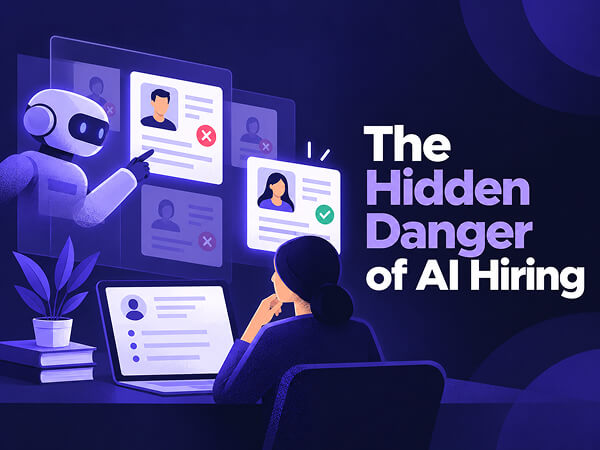
The One HR Decision That Could Define 2027: Who Gets to Say No - the Algorithm or You?
The race to automate recruitment has reached an awkward turning point. For HR leaders, the decisive question is no longer whether to use AI. It is who remains accountable when a machine quietly rejects the wrong person.
The invisible rejection letter
Imagine a qualified applicant who never reaches an interview. No recruiter calls, no manager reviews the portfolio and no one can clearly explain the rejection. The employer may have saved minutes; it may also have lost an exceptional hire. At scale, those minutes become a governance question.
For years, HR technology was sold on efficiency: faster shortlists, lower administrative costs and fewer hours spent sifting applications. AI can deliver real benefits. Yet an automated ranking is not a neutral truth about potential. It is a prediction shaped by training data, job definitions, proxy variables and the decisions of the people who configure it.
The call HR leaders cannot afford to get wrong in 2027 is therefore whether to treat AI as an accountable assistant or an unchallengeable gatekeeper. The distinction sounds philosophical. Regulators and courts increasingly make it operational.
A $365,000 warning from the recruitment pipeline
In 2023, the US Equal Employment Opportunity Commission announced a $365,000 settlement involving iTutorGroup after alleging that application software automatically rejected more than 200 older candidates based on age thresholds. The settlement resolved the case; it should not be described as a trial finding of liability.
The lesson is not that every hiring algorithm discriminates. It is that software can reproduce an unlawful selection rule at speed. A company that cannot explain the logic of rejection may discover too late that its process was neither fair nor defensible.
A separate, ongoing case, Mobley v Workday concerns allegations about automated applicant screening and discrimination. Workday has disputed the allegations. Procedural rulings allowing claims or collective notice to proceed are not findings that the company violated discrimination law.
These cases differ in facts and procedural posture. Together they demonstrate why careful language matters: allegations are not verdicts, and the existence of a lawsuit is not evidence that a technology vendor is inherently unsafe.
2027 is more than a symbolic deadline
The European Commission’s AI Act implementation guidance states that requirements for certain high-risk AI uses, including employment, will apply from 2 December 2027. Organisations should verify the precise obligations, exemptions and jurisdictions applicable to their systems rather than assume one rule covers every recruitment workflow.
New York City already requires covered automated employment decision tools to meet conditions concerning bias audits, publication and candidate notice under Local Law 144. Its approach illustrates a wider shift: purchasing an AI product does not transfer the employer’s responsibility to understand how it is used.
A December 2025 New York State Comptroller audit examined enforcement of that law, underscoring that the challenge is not merely writing requirements but making them work in practice.
The hiring paradox: more applicants, less certainty
Automation makes it cheaper to apply for jobs and cheaper to screen applications. That creates a strange equilibrium: employers can receive more applications while candidates feel less seen. The resulting temptation is to tighten automated filters still further. But a faster rejection is not necessarily a better decision.
For HR leaders, the crucial performance measure should not be the number of CVs eliminated. It should be whether the process identifies capable people, treats applicants consistently, allows reasonable challenges and produces evidence that can survive scrutiny.
This also changes the conversation about skills-based hiring. An employer cannot credibly claim to value transferable skills while allowing rigid proxies for degree, career continuity or job title to decide who receives consideration.
Five tests every CHRO should apply before the next hiring cycle
1. Identify the real decision-maker.
Map every point where software ranks, excludes or advances a person. Document whether a human can meaningfully override the result and whether that override is actually used.
2. Test outcomes, not vendor promises.
Evaluate selection patterns and false negatives using relevant, lawful data and independent review where required. Re-test after material changes to models, roles or candidate populations.
3. Give applicants an intelligible process.
Explain when automated assessment is used, what information matters and how candidates can seek accommodation or correction where required.
4. Keep a defensible audit trail.
Retain appropriate versions of criteria, notices, assessment outcomes, approvals and review decisions, subject to privacy and retention rules.
5. Connect recruitment to the rest of workforce governance.
A fair shortlist is only the beginning. Contracts, classification, onboarding and payment practices should also be transparent and accountable.
Where TFY fits - and where judgment must remain human
TFY’s value proposition is that recruitment does not end at an accepted offer. Its platform combines an AI-powered applicant tracking system with global contractor onboarding, documentation and payments. That integrated view can help HR, legal and finance teams work from more consistent records, although no software platform alone guarantees non-discrimination or compliance in every jurisdiction.
TFY describes its AI-powered ATS and candidate matching as tools to surface potentially relevant applicants and support recruitment workflows. Employers still need to establish suitable criteria, review outcomes and assess any applicable automated-decision requirements.
For businesses engaging international freelancers, its Contractor of Record and global contractor payroll services are designed to centralise documentation, classification-related workflows and payments across markets. Local legal review remains important, particularly where working arrangements resemble employment.
The commercial opportunity is not to replace judgment with a dashboard. It is to reduce administrative fragmentation so that people can exercise better judgment with better information.
The question boards should ask their HR leaders
In 2027, “How much time did AI save us?” will be an incomplete boardroom question. The more consequential question will be: “Can we show that our hiring decisions are fair, explainable and owned by someone accountable?”
AI may become indispensable to recruitment. That makes human responsibility more valuable, not less. The biggest hiring mistake of 2027 may be believing that because a decision was automated, nobody truly made it.