
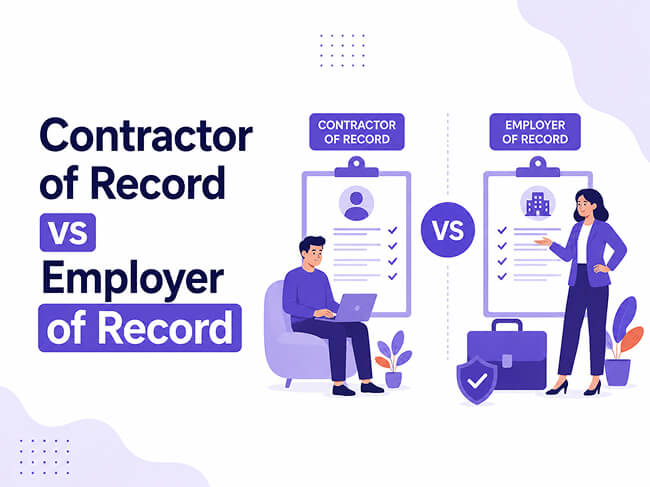
Contractor of Record vs Employer of Record: Key Differences
Direct answer
A Contractor of Record (CoR) supports a company in engaging independent contractors, while an Employer of Record (EOR) legally employs workers on the client company’s behalf. The critical difference is worker status: a CoR is designed for genuine independent-contractor relationships; an EOR is designed for employment. The right model depends on the real working relationship, local law, and the responsibilities the provider contractually assumes.
Important distinction
“Contractor of Record” is a commercial service term rather than a single, globally standardized legal status. “Employer of Record” is also an industry term, but the underlying employment relationship is governed by the labor, tax, payroll and social-security rules of the relevant jurisdiction. Always assess the actual working relationship, not just the label used in a contract.
Key takeaways
- CoR is for independent contractors; EOR is for employees.
- An EOR becomes the legal employer for the worker covered by the EOR arrangement, while a CoR generally supports the contractor engagement without converting the contractor into an employee.
- Neither model eliminates the need to classify workers correctly. Misclassification risk depends on the facts of the relationship and applicable local law.
- EOR usually carries employment-related obligations such as payroll withholding, statutory benefits and employment documentation; CoR typically focuses on contractor classification support, agreements, onboarding, invoicing, payments and records.
- The best choice starts with one question: should this person genuinely be an independent contractor, or should they be an employee?
CoR vs EOR at a glance
Decision factor |
Contractor of Record (CoR) |
Employer of Record (EOR) |
|
Worker status |
Independent contractor |
Employee |
|
Legal employer |
No, in the typical CoR model |
Yes, the EOR is the legal employer for the employment arrangement |
|
Primary use |
Engage and manage genuine contractors |
Employ workers in a country where the client may not have a local employing entity |
|
Payroll withholding |
Usually not employee payroll withholding; contractor tax treatment depends on jurisdiction |
Usually includes employment payroll, withholding and statutory remittances |
|
Benefits |
Normally not employee benefits |
Employment benefits and statutory entitlements are handled according to local requirements |
|
Worker classification |
Central risk area; must be assessed before and during engagement |
Worker is treated as an employee under the EOR arrangement |
|
Contracts |
Contractor/service agreement |
Employment agreement plus client-EOR commercial agreement |
|
Best fit |
Project-based, autonomous, properly classified independent work |
Roles that operate as employment or require local employment infrastructure |
|
Main risk if used incorrectly |
Employee misclassification |
Choosing employment when a contractor model would have been more suitable can add cost/administration; EOR terms and local rules still need review |
What is a Contractor of Record?
A Contractor of Record (CoR) is a service model used to support the engagement and administration of independent contractors. A CoR can sit between the client organization and the contractor for parts of the contracting, onboarding, documentation, compliance, invoicing and payment workflow. The exact scope varies by provider and country.
The defining point is that the worker remains an independent contractor rather than becoming an employee merely because a CoR is involved. That makes worker classification central to the model. If the facts of the relationship point to employment, calling the worker a contractor or routing the engagement through a CoR does not automatically change the underlying status.
TFY describes its own model of Contractor of Record / Agent of Record as a workflow for onboarding, classification support, contracts, contractor documents, payments and audit-ready records across more than 180 countries.
A typical CoR engagement may include:
- Pre-engagement classification or risk assessment
- Independent-contractor agreements and local documentation
- Identity, tax, banking or business-document collection
- Invoice or self-billing workflows
- Cross-border contractor payments
- Renewal, offboarding and document retention
- Records that support finance, legal and audit teams
What is an Employer of Record?
An Employer of Record (EOR) is a third party that becomes the legal employer of a worker for the employment relationship while the client organization directs the worker’s day-to-day activities and receives the benefit of the work. The EOR typically manages the local employment contract, payroll, required withholding, statutory contributions, benefits administration and other employer obligations defined by local law and the service agreement.
TFY’s Employer of Record model employs talent in international markets while the client retains day-to-day team management.
EOR is commonly considered when an organization wants to hire an employee in a country where it does not want to establish its own employing entity immediately. It is not simply a payroll service. The EOR is the employing party for the relevant worker, subject to the terms of the arrangement and applicable local law.
Why worker status matters more than the service label
The CoR-versus-EOR decision should not begin with price or software features. It should begin with the substance of the working relationship. Regulators often look at control, financial independence, integration, contractual terms and the real way the work is performed.
For example, the IRS independent-contractor guidance explains that U.S. classification depends on evidence of control and independence, including behavioral control, financial control and the type of relationship.
In the UK, GOV.UK employment-status guidance notes that employment status determines rights and employer responsibilities, and that tax-law status can differ from employment-law status.
For off-payroll engagements, HMRC’s IR35 guidance explains the rules for intermediaries, clients, agencies
If the organization needs an employee, use an employment model. If the person is genuinely operating as an independent business and the relationship supports contractor status, a contractor model may be appropriate. A service provider cannot “contract away” a worker-status problem created by the real working relationship.
How a Contractor of Record works
Although provider models differ, a well-designed CoR workflow normally follows a sequence like this:
1. Define the role and engagement
Document the scope, deliverables, duration, working model, location, expected level of control and commercial terms.
2. Assess classification
Review whether the proposed relationship is consistent with genuine independent contracting in the relevant jurisdiction. High-risk cases should be escalated for specialist advice.
3. Contract with the contractor
Use a contractor agreement that reflects the actual relationship, including services, deliverables, IP, confidentiality, fees, termination and local requirements.
4. Complete onboarding
Collect identity, tax, banking, business and other required documents. Requirements vary by country and payment route.
5. Manage invoicing and payments
Route invoices or self-billing records through agreed approval processes and pay the contractor using permitted cross-border payment methods.
6. Monitor the relationship
Reassess classification when the scope, working practices or duration materially change. A relationship that begins as independent can evolve.
7. Offboard and retain records
Close access, settle final payments, document termination and retain records according to applicable legal and business requirements.
How an Employer of Record works
An EOR workflow starts from a different premise: the worker will be an employee. The EOR is therefore responsible for the employment relationship established through the EOR arrangement, while the client normally manages the worker’s daily output, priorities and role.
1. Confirm the role should be employment
Review the role, location, working model, compensation and local hiring requirements.
2. Confirm EOR coverage and terms
Check whether the provider can legally employ in the relevant jurisdiction and understand which entity will be the employer.
3. Prepare the employment package
Align salary, statutory benefits, optional benefits, leave, working time and contractual terms with local requirements.
4. Execute the employment agreement
The EOR enters the local employment relationship and completes required onboarding.
5. Run payroll and statutory processes
The EOR processes payroll, deductions, employer contributions and required reporting under the agreed service model.
6. Manage ongoing employment events
Changes in compensation, leave, performance processes, transfers and terminations require coordination between the client and EOR.
7. Offboard compliantly
Employment termination rules can be materially different from ending a contractor statement of work and may involve notice, consultation, severance or other local requirements.
Which model should you use? A practical decision table
Situation |
Usually points toward |
Why |
|
Worker sets how and when work is delivered, serves multiple clients and bears business risk |
CoR / direct contractor engagement |
The relationship may support independent-contractor status, subject to local analysis. |
|
Role is ongoing, embedded in the organization and managed like an employee |
EOR / direct employment |
The substance of the role looks more like employment. |
|
Company wants a full-time employee abroad but has no local employing entity |
EOR |
EOR provides local employment infrastructure. |
|
Company needs project-based specialists in several countries |
CoR |
A contractor model can centralize onboarding, documentation and payments if classification is valid. |
|
Client controls schedule, methods and day-to-day work in detail |
EOR may be safer |
High control is often an employment indicator; review local rules. |
| Relationship changed from short project to permanent embedded role |
Reassess; EOR may be appropriate |
Classification should be reviewed when facts change. |
|
Company already has a local entity capable of employment |
Direct employment may be preferable |
EOR may not be necessary if local HR/payroll infrastructure is already available. |
Key legal and operational differences
1. Legal employer status
The clearest distinction is who employs the worker. Under an EOR arrangement, the EOR is the legal employer for the covered employment relationship. Under a CoR model, the worker is engaged as an independent contractor; the CoR does not ordinarily turn that person into an employee.
2. Worker classification
Classification is the central compliance question in a CoR model. A provider may support assessment, documentation and local workflows, but classification depends on applicable law and the actual facts. A contract that says “independent contractor” is not conclusive if the working relationship operates like employment.
The IRS type-of-relationship guidance expressly notes that a written contract alone is not sufficient to determine U.S. worker status.
3. Payroll and tax administration
An EOR typically runs employee payroll and handles required withholding, employer taxes or social contributions, subject to local law. A CoR supports contractor payment workflows; the tax treatment of contractors varies by jurisdiction and can include information reporting, withholding or contractor self-employment obligations.
The IRS guidance for businesses with employees illustrates the different U.S. tax responsibilities that follow employee versus independent-contractor classification.
4. Benefits and statutory rights
Employees may have statutory rights involving paid leave, working time, notice, family leave, minimum pay, social insurance or other protections, depending on country. EOR arrangements need to account for those employment obligations. Independent contractors generally do not receive employee benefits merely because a CoR manages the engagement, though local laws can create exceptions or intermediate worker categories.
5. Day-to-day control
An EOR does not mean the client stops managing the employee’s work. In practice, the client normally directs daily work while the EOR handles the legal-employment layer. By contrast, excessive client control over a contractor can undermine independent-contractor status.
HMRC’s CEST control guidance highlights control over what, how, when and where work is performed as relevant to UK status analysis.
6. Termination and offboarding
Ending an employee relationship can trigger statutory notice, consultation, severance, protected-leave or dismissal requirements. Ending a contractor engagement is normally governed by the services agreement and relevant commercial law, but classification disputes can change the analysis. The offboarding process should therefore match the worker’s true status.
CoR vs EOR vs direct engagement
CoR and EOR are not the only options. A business can also contract directly with an independent contractor or employ someone directly through its own local entity. The best structure depends on worker status, geography, internal infrastructure and risk tolerance.
Model |
Best suited to |
Who contracts with worker? |
Primary administrative burden |
|
Direct contractor |
Genuine contractors where the company can manage local contracting, compliance and payments itself |
Client company |
Client manages classification, contract, payments and records |
|
Contractor of Record |
Genuine contractors where the company wants a standardized third-party workflow |
Depends on provider model and contract structure |
CoR supports agreed contractor administration and compliance workflows |
|
Direct employment |
Employees where the company already has an appropriate local entity |
Client local entity |
Client manages payroll, benefits, tax, HR and employment compliance |
|
Employer of Record |
Employees in markets where the client wants third-party employment infrastructure |
EOR entity |
EOR manages employment administration under the service model |
Real-world scenarios: CoR or EOR?
Scenario 1: A six-month specialist project
A software company needs a cybersecurity specialist in another country for a clearly defined six-month project. The specialist runs an independent business, serves multiple clients, controls how the deliverables are produced and invoices for milestones. Subject to local classification rules, a contractor relationship may be appropriate. A CoR can add structured onboarding, contracting, documentation and payment workflows.
Scenario 2: A permanent regional sales manager
A company wants a sales manager who will work full time, follow company hours, report to a regional director, use internal systems, receive performance targets and represent the company on an ongoing basis. The facts are much closer to employment. If the company lacks a local entity, an EOR may be the more appropriate route.
Scenario 3: A contractor relationship that changes over time
A contractor starts with a defined project but, twelve months later, is working exclusively for the company, managing employees, following fixed hours and performing a permanent operational role. The original classification should be reassessed. A relationship can evolve, which is why periodic review matters.
Scenario 4: UK off-payroll working / IR35
A UK business engages a consultant through an intermediary. Depending on the client and arrangement, the off-payroll working rules may require a status determination and can shift tax responsibilities within the labor supply chain. A commercial CoR service does not override those statutory rules.
HR and tax teams should use current HMRC Check Employment Status for Tax (CEST) guidance and obtain specialist advice where the result is uncertain or the facts are complex.
For an educational resource on the topic, see What is IR35?.
Scenario 5: Hiring across several African markets
A mid-sized company plans to build a distributed team across multiple African countries. Some roles are autonomous consulting engagements; others are permanent operational roles. A single “global hiring” structure may not be appropriate for every person. The company should classify each role, then route genuine contractors through a contractor workflow and employee roles through employment infrastructure such as a local entity or EOR.
Risks and limitations to understand
A CoR does not guarantee that a contractor is correctly classified
A provider can support risk assessment and process discipline, but no platform can make an employee legally become a contractor merely by changing paperwork. Misclassification analysis remains fact-specific and jurisdiction-specific.
An EOR does not remove every employment risk
The EOR is the legal employer, but the client still influences the real working environment. Harassment, discrimination, working-time, health and safety, data protection, intellectual-property and termination issues may require coordination between the client, EOR and local advisers.
Service scope varies materially by provider
Terms such as CoR, AOR and EOR can hide differences in legal structure, local entities, partners, indemnities, insurance, classification methodology, payment flow, data processing and support. Buyers should compare contracts and operating models, not just feature pages.
Country coverage is not the same as identical capability everywhere
A provider may advertise broad geographic coverage while delivering different services, payment rails, entity structures or partner arrangements by jurisdiction. Ask what is available for the specific country and worker type you need.
Legal and tax rules change
Classification tests, payroll obligations, tax rules and employment protections can change. The article and any provider workflow should be treated as operational guidance, not a substitute for jurisdiction-specific legal or tax advice.
Step-by-step: choose between CoR and EOR
Step 1: Define the work, not the desired label
Write down what the person will actually do, how long the engagement will last, who controls the work, whether the person can work for others, how they are paid and how integrated they will be.
Step 2: Determine likely worker status
Apply the relevant local classification framework. If the status is unclear, escalate before onboarding.
Step 3: Choose the legal engagement model
If the person should be an employee, use direct employment or EOR. If the person is genuinely independent, choose direct contracting or CoR depending on your internal capability.
Step 4: Map responsibilities
Create a responsibility matrix for contracts, classification, payroll or payments, tax documentation, benefits, data protection, IP, onboarding, renewals and offboarding.
Step 5: Review the provider’s legal structure
Confirm which entity contracts with or employs the worker, whether local partners are involved and where liabilities sit.
Step 6: Test the operating workflow
Ask for a practical walkthrough from intake to onboarding, payment, change management and termination. Compliance should exist in the process, not only in marketing copy.
Step 7: Reassess periodically
Review relationships when duration, control, exclusivity, scope, compensation or management structure changes.
Selection checklist for HR, Legal and Finance teams
☐ Is the role genuinely contractor work or employment?
☐ Which country’s employment, tax and social-security rules apply?
☐ Who performs and documents classification analysis?
☐ Who signs the contractor or employment agreement?
☐ Who is legally responsible for payroll, tax withholding or contractor reporting?
☐ Which local entity or partner is involved?
☐ What indemnities, liability caps and exclusions apply?
☐ How are IP, confidentiality and data-processing obligations handled?
☐ Which benefits are required for employees?
☐ How are contractor invoices, FX, payment approvals and remittances handled?
☐ How are worker-status changes identified and escalated?
☐ What happens when the worker is terminated or the project ends?
☐ Can HR, Legal and Finance access a complete audit trail?
☐ What countries, worker types and services are excluded from the advertised coverage?
☐ What implementation support and escalation channels are available?
Teams evaluating contractor workflows may also want to review TFY’s contractor management system for onboarding, payments, document management and contractor operations. which also comes with TFY’s AI-powered Applicant Tracking System for your recruitment before the engagement stage.
Frequently asked questions
Is a Contractor of Record the same as an Employer of Record?
No. A Contractor of Record supports an independent-contractor engagement, while an Employer of Record employs the worker under an employment arrangement. The practical and legal responsibilities differ because the worker’s status differs.
What is the biggest difference between CoR and EOR?
Worker status. A CoR model is designed around independent contractors. An EOR model is designed around employees and includes the local employment layer, such as employment agreements, payroll and statutory employer obligations.
Does a Contractor of Record become the contractor’s employer?
Typically, no. The contractor remains an independent contractor. However, provider contract structures differ, so buyers should verify which entity contracts with the worker and what responsibilities the provider assumes.
Does an Employer of Record become the legal employer?
Yes, in the standard EOR model the EOR entity is the legal employer for the worker covered by the arrangement, while the client generally directs the person’s day-to-day work.
Can a Contractor of Record eliminate misclassification risk?
No. A CoR can support classification assessment, compliant workflows, contracts and records, but classification depends on the real relationship and applicable law. If the facts indicate employment, documentation alone cannot eliminate the risk.
When should a company use EOR instead of CoR?
EOR is generally more appropriate when the worker should be an employee, particularly for ongoing roles with significant company control, integration and employment-style responsibilities. It is also useful when the client lacks a local employing entity.
Can I hire an international contractor directly without a CoR?
Potentially. A company can contract directly with a genuine independent contractor if it can manage classification, contracts, tax documentation, onboarding, payments and local compliance. A CoR is an operating model for companies that want more centralized support.
Is AOR the same as Contractor of Record?
In many workforce-management contexts, Agent of Record (AOR) and Contractor of Record (CoR) are used for similar contractor engagement services. Because neither term has a single universal legal definition, compare the provider’s actual responsibilities rather than relying on the label.
How does IR35 affect the CoR vs EOR decision in the UK?
IR35 and the off-payroll working rules can affect the tax treatment of workers providing services through intermediaries. Whether the rules apply depends on the facts and the statutory framework. A CoR service does not override HMRC status rules, so UK engagements should be assessed separately.
What should I ask a CoR or EOR provider before signing?
Ask who contracts with or employs the worker, how classification is assessed, which local entity or partner is used, what payroll or payment obligations are covered, what countries and worker types are excluded, how liability is allocated, and what happens when the relationship changes or ends.
Where TFY fits
Transformify (TFY) brings the contractor and employee pathways into a broader global workforce workflow. For organizations managing international contractors, TFY’s Contractor of Record / Agent of Record offering is designed to support classification, onboarding, contracting, documentation, invoicing and global payments. For roles that require employment, TFY also provides Employer of Record services in international markets.
The practical value of using one workforce platform is not that CoR and EOR become interchangeable. They should remain distinct. The value is that HR, Legal and Finance teams can route each worker into the engagement model that matches the real relationship, while retaining more consistent processes and records.
Book a demo with TFY today to see how it all works.