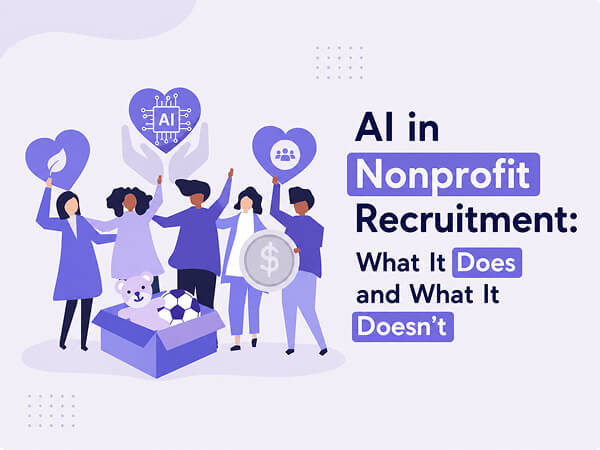
Artificial intelligence (AI) is rapidly transforming how organizations hire but for nonprofits, the conversation is more nuanced. Limited budgets, mission-driven goals, and the need for ethical accountability mean that adopting an AI powered ATS isn’t just about efficiency it’s about trust.
Many NGOs and charities are asking:
- Can AI improve hiring outcomes?
- Does it reduce or amplify bias?
- Where should humans remain in control?
This article takes an independent, analytical look at what AI in nonprofit recruitment actually does and what it doesn’t.
What AI in Nonprofit Recruitment Actually Does
AI in recruitment is best understood as a decision-support system, not a decision-maker.
1. AI Screening: Faster, Structured CV Evaluation
AI can process large volumes of applications quickly by identifying:
- Skills and qualifications
- Relevant experience
- Keywords tied to job requirements
This dramatically reduces manual workload.
According to McKinsey’s research on AI adoption, organizations using AI in HR can reduce time-to-hire by up to 50%, improving efficiency without expanding HR teams.
However, AI does not “understand” candidates it matches patterns based on inputs.
2. Candidate Ranking and Shortlisting
AI-powered systems rank candidates based on alignment with job criteria.
This helps nonprofits:
- Standardize evaluation
- Prioritize top candidates faster
- Maintain consistency across hiring cycles
This is particularly valuable for NGOs managing multiple roles or international recruitment pipelines.
3. Automating Repetitive Recruitment Tasks
AI handles administrative tasks such as:
- Interview scheduling
- Application tracking
- Candidate communication
According to IBM’s AI in HR insights, automation significantly reduces operational burden and allows HR teams to focus on strategic and human-centered activities.
4. Enabling Data-Driven Hiring Decisions
AI provides analytics that help organizations:
- Track hiring efficiency
- Identify best-performing sourcing channels
- Monitor diversity metrics
Nonprofits can use recruitment analytics to improve hiring, especially when scaling or reporting to stakeholders.
What AI in Nonprofit Recruitment Does NOT Do
1. AI Does Not Replace Human Judgment
AI cannot assess:
- Cultural fit
- Passion for a cause
- Emotional intelligence
As highlighted in Harvard Business Review, AI should augment not replace human decision-making in hiring.
2. AI Does Not Eliminate Bias Automatically
AI can both reduce and reinforce bias.
If trained on biased data, it may replicate inequality. However, when designed properly, it can help:
- Standardize evaluation
- Remove identifying information
- Improve fairness
Organizations must actively work to reduce bias in hiring decisions, not assume AI will solve it automatically.
The World Economic Forum emphasizes that governance and oversight are essential for ethical AI.
3. AI Does Not Guarantee Ethical Hiring
Ethical hiring depends on:
- Transparency
- Accountability
- Fair processes
AI systems often lack explainability, making it difficult to justify decisions.
According to the OECD AI Principles, transparency and accountability are critical for responsible AI adoption especially in socially impactful sectors like nonprofits.
4. AI Does Not Understand Human Potential
AI struggles with:
- Non-linear career paths
- Volunteer experience
- Career gaps
- Transferable skills
This is particularly important in nonprofit hiring, where candidates often bring unconventional but valuable experience.
The Role of Human Oversight in AI Recruitment
A balanced approach is essential.
AI Should Handle:
- Screening
- Data processing
- Workflow automation
Humans Should Lead:
- Final decisions
- Interviews
- Cultural and mission alignment
This ensures both efficiency and fairness.
Building Trust Through Transparency
To build trust, nonprofits should:
- Clearly explain how AI is used
- Maintain human review in hiring decisions
- Audit systems regularly
- Ensure candidate fairness
Trust is not built by technology it’s built by how technology is used.
What to Look for in a Nonprofit AI ATS
When evaluating tools, prioritize:
- Transparency and explainability
- Bias mitigation features
- Flexibility for nonprofit needs
- Data privacy compliance
- Strong analytics capabilities
Understanding the features to look for in a nonprofit ATS is essential before implementation.
Where TFY Fits Into the Landscape
TFY’s AI-powered ATS for charities and NGOs is designed with nonprofit-specific needs in mind.
It combines:
- AI-driven screening
- Transparent workflows
- Ethical hiring considerations
- Global talent access
From an independent perspective, the key value lies in balancing automation with accountability.
TFY AI-powered Applicant Tracking System (ATS) is offered completely free to charities and NGOs worldwide.
The Bigger Picture: AI as a Tool, Not a Solution
AI improves:
- Efficiency
- Consistency
- Insight
But it cannot replace:
- Human judgment
- Ethical reasoning
- Mission alignment
For nonprofits, this distinction matters.
FAQs
1. What is an AI powered ATS?
An AI powered ATS uses artificial intelligence to automate screening, ranking, and analytics in recruitment processes.
2. Can AI reduce bias?
Yes but only when designed and monitored carefully. It can also reinforce bias if misused.
3. Is AI suitable for nonprofits?
Yes, especially for improving efficiency, but it must align with ethical and mission-driven values.
4. Does AI replace recruiters?
No. It supports recruiters but does not replace human decision-making.
Conclusion
AI in nonprofit recruitment is not a replacement for human judgment it’s an enhancement.
The organizations that succeed will be those that use AI responsibly, combining:
- Technology
- Transparency
- Human oversight
Because in nonprofit hiring, the goal isn’t just efficiency it’s impact.