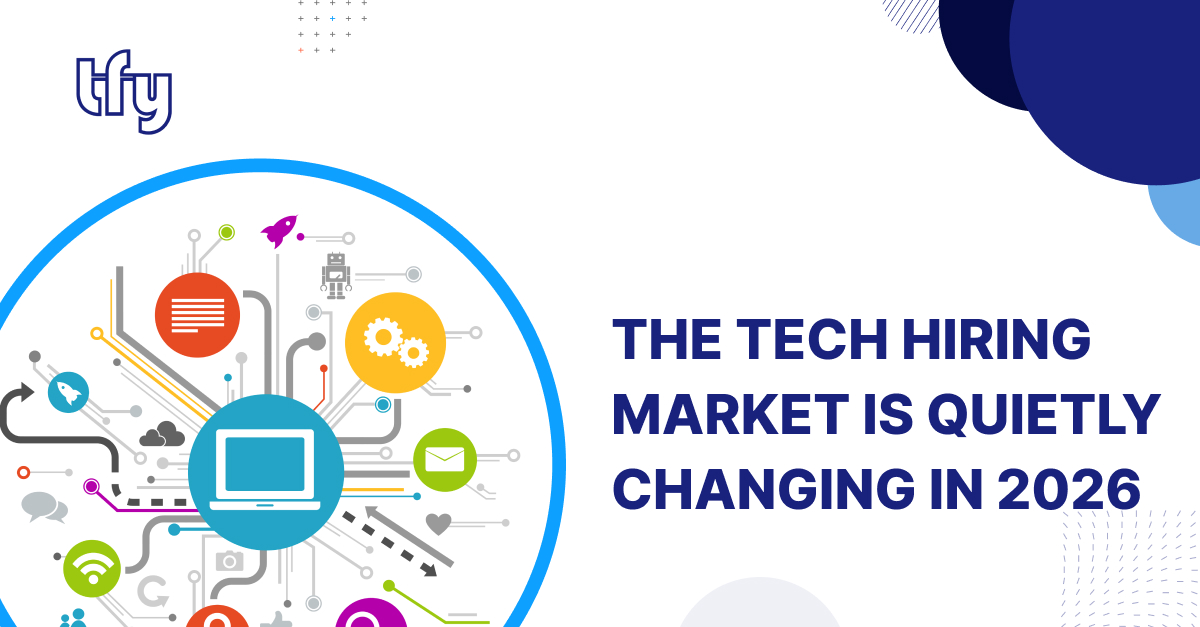
The tech hiring market feels… different right now.
Not collapsing.
Not exploding.
Just shifting.
For companies building technology teams and for professionals navigating their careers, one question keeps coming up:
What is actually happening in tech hiring right now?
- The short answer: the market hasn’t slowed down — it has simply become more deliberate.
Companies are still hiring. Projects are still moving forward. But the way organizations structure teams and access talent is changing.
And increasingly, global talent platforms and flexible hiring models are becoming central to that shift.
The contract workforce is becoming the backbone of delivery
One of the most noticeable trends across the tech ecosystem is the continued strength of contract and freelance hiring.
Organizations are still launching products, building platforms and modernizing infrastructure.
But many are choosing to bring in specialist talent for delivery phases rather than expanding permanent teams immediately.
This approach gives companies the ability to:
- Scale teams quickly
- Access niche expertise
- Control long-term headcount risk
The result: project-based hiring is becoming a core strategy, not just a temporary solution.
Platforms that connect businesses with vetted global specialists are increasingly playing a role in helping organizations move faster.
Budgets aren’t shrinking — they’re being watched more closely
Across industries, technology investment continues.
But hiring decisions now involve more planning and clearer project justification.
Leadership teams want to understand:
- What skills are actually needed
- How long they will be needed
- Whether the work requires permanent employees or flexible specialists
This shift has created stronger demand for platforms that simplify global hiring, contractor management and compliant payments.
Companies want the ability to engage talent anywhere without increasing administrative complexity.
AI hiring is moving from hype to execution
Artificial intelligence dominated hiring discussions in the past two years.
Initially, many companies were exploring possibilities.
Today, the conversation is different.
Organizations are now focused on building real AI products and infrastructure.
Demand is becoming more specialized, particularly in areas like:
- Data engineering
- Machine learning infrastructure
- AI platform engineering
- Applied AI product development
Rather than broad experimentation, businesses are investing in teams capable of delivering production-ready AI systems.
Cybersecurity and defence technology are expanding rapidly
Another area seeing significant growth is security-focused technology.
Rising geopolitical tensions and increased digital infrastructure risks are driving investment in:
- Cybersecurity
- Secure software development
- Infrastructure resilience
- Data protection systems
Much of this work happens within government-aligned or security-sensitive environments, making it less visible in traditional hiring data.
But demand for specialists in these areas continues to rise.
Permanent hiring is becoming more selective
Permanent hiring hasn’t disappeared.
However, the process is more measured than in previous years.
Organizations are prioritizing quality, adaptability and proven impact when building long-term teams.
In many cases, companies now:
- Bring in contractors to accelerate delivery
- Validate the project direction
- Convert key roles into permanent positions later
This blended workforce model combining internal teams with flexible external expertise — is quickly becoming the norm.
What the market looks like right now
Across the global tech hiring ecosystem, several patterns are emerging.
Contractor rates are stabilizing
After periods of volatility, compensation for many technical contract roles has begun to stabilize.
Top specialists still command premium rates, particularly when businesses need people who can deliver impact quickly in complex environments.
Experienced specialists are still difficult to find
Despite cautious hiring behavior, high-quality contractors remain in strong demand.
The difference today is that organizations are taking more time to evaluate fit rather than rushing hiring decisions.
Professionals who can clearly demonstrate the outcomes they delivered in previous roles continue to secure opportunities quickly.
Certain technical roles remain consistently in demand
Across global hiring platforms, demand continues to be strongest in a few core areas:
- Backend and platform software engineering
- Data engineering and machine learning infrastructure
- Cloud and DevOps architecture
- Product managers with strong delivery experience
- UX designers working closely with engineering teams
These roles remain central to building and scaling technology products.
The bigger shift: how companies access talent
Perhaps the most important change is not what companies are building — but how they build teams.
Organizations are increasingly moving toward distributed, flexible talent models.
Instead of hiring exclusively within a single geography, companies are accessing global expertise through trusted platforms and compliant hiring infrastructure.
This allows businesses to:
- Expand their talent pool worldwide
- Hire faster
- Manage contractors and freelancers compliantly
- Reduce operational friction in cross-border payments
The companies adapting fastest are those that combine strong internal teams with on-demand global expertise.
What comes next
The tech hiring market isn’t slowing.
It’s evolving.
Projects are being funded carefully. Hiring decisions are more deliberate. But innovation and digital transformation continue to drive demand for skilled professionals.
And increasingly, the future of work will depend on how easily companies can access the right talent anywhere in the world.
Platforms that enable borderless hiring, compliant payments and flexible workforce models will likely play a critical role in shaping the next phase of the tech talent market.
Because in today’s economy, speed and access to expertise are becoming the ultimate competitive advantage.