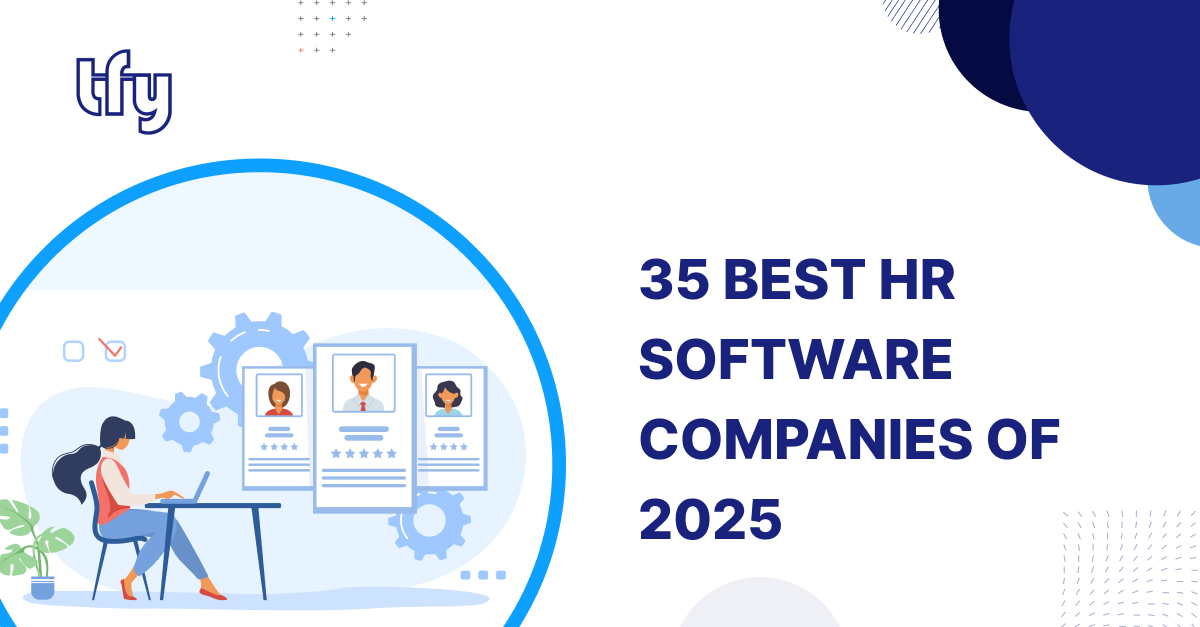
The HR software landscape has evolved dramatically as companies embrace hybrid work, international hiring, and AI-powered operations. From talent acquisition to payroll compliance, today’s leading HR platforms are built to support global scalability and a seamless employee experience.
In this guide, we highlight the 35 best HR software companies of 2025, covering solutions for every business size — from startups to global enterprises. Each platform has been assessed for innovation, usability, compliance, and adaptability across international markets.
Top HR Software Companies of 2025
1. TFY
Headquarters: London, United Kingdom
Best For: Global workforce management, Applicant tracking system, Contractor management, Agent of record, Employer of record, remote teams, and DEI-focused organizations
Website: transformify.org
Overview
TFY is a leading global HR and workforce management platform designed to simplify operations for distributed teams. With clients across more than 150 countries, TFY combines advanced automation, compliance, and payment capabilities into a single, unified system.
The platform eliminates common inefficiencies such as duplicate invoicing, late payments, and compliance risks — making it ideal for companies managing remote staff, contractors, or global teams.
Key Features
Applicant Tracking System (ATS): Streamlines recruitment workflows with AI-assisted candidate matching.
Human Resources Management System (HRMS): Centralizes employee data, payroll, and benefits in one dashboard.
Vendor Management System (VMS): Simplifies global vendor payments and coordination.
Employer of Record (EOR): Enables compliant hiring in new countries without local entity setup.
DEI & CSR Solutions: Provides free lifetime access for NGOs and charities supporting social responsibility initiatives.
Why It Stands Out
TFYs strong commitment to inclusivity, ESG, and diversity compliance — combined with practical automation tools — makes it one of the most forward-thinking HR software platforms globally. Its ability to process payments in over 20 cryptocurrencies and multiple currencies gives businesses flexibility in fast-changing global markets.
2. SAP SuccessFactors
Headquarters: Walldorf, Germany
Best For: Large enterprises with global operations
Overview
SAP SuccessFactors remains one of the most trusted enterprise HR platforms, offering a full suite of tools for performance management, talent acquisition, and learning. It helps multinational organizations centralize HR data while meeting complex compliance requirements.
Standout Strengths
Advanced AI features for recruiting and employee engagement
Scalable architecture for large enterprise ecosystems
Deep integration with SAP ERP and analytics
3. Workday
Headquarters: Pleasanton, California, USA
Best For: Enterprise-level HR and finance alignment
Overview
Workday unifies HR, payroll, and financial operations into one platform. Its powerful analytics and real-time dashboards help HR leaders forecast talent needs and improve retention through data-driven decisions.
Standout Strengths
Predictive workforce analytics
Continuous performance management
Global payroll and compliance support
4. Oracle Fusion Cloud HCM
Headquarters: Austin, Texas, USA
Best For: Global compliance and workforce analytics
Overview
Oracle Fusion Cloud HCM offers AI-powered tools for HR, payroll, and talent management. Its deep analytics, automation, and regional compliance coverage make it a trusted choice for large organizations operating across borders.
Standout Strengths
AI-enabled employee insights
End-to-end HR lifecycle management
Strong data privacy and security standards
5. Microsoft Dynamics 365 for HR
Headquarters: Redmond, Washington, USA
Best For: Organizations using Microsoft ecosystem tools
Overview
Microsoft Dynamics 365 for HR integrates seamlessly with the Microsoft suite, including Teams and Office 365. It’s designed to simplify HR processes while maintaining GDPR compliance and advanced reporting capabilities.
Standout Strengths
Microsoft-native interface and tools
Integrated performance tracking
Real-time data and analytics for workforce management
6. IBM Talent Transformation
Headquarters: Armonk, New York, USA
Best For: Data-driven enterprises focused on AI insights
Overview
IBM’s Talent Transformation suite uses Watson AI to personalize employee engagement and skill development. It’s built for organizations that prioritize predictive analytics and continuous workforce improvement.
Standout Strengths
AI-driven insights into workforce performance
Predictive analytics for talent planning
DEI and skills-gap analysis tools
7. ADP Workforce Now
Headquarters: Roseland, New Jersey, USA
Best For: Businesses of all sizes managing payroll and compliance
Overview
ADP is one of the world’s most established HR and payroll providers. Workforce Now automates core HR functions, from time tracking and benefits administration to tax and compliance management.
Standout Strengths
Reliable payroll and HR automation
Multi-country compliance coverage
Scalable for small to enterprise clients
8. UKG (Ultimate Kronos Group)
Headquarters: Weston, Florida, USA
Best For: Shift-based and hourly workforces
Overview
UKG combines workforce management, scheduling, and HR analytics to help businesses optimize labor costs and compliance. Its tools are especially valuable for industries like retail, hospitality, and healthcare.
Standout Strengths
Real-time scheduling and attendance tracking
Workforce engagement and feedback tools
Predictive labor forecasting
9. Paycom
Headquarters: Oklahoma City, USA
Best For: Mid-to-large organizations seeking simplicity
Overview
Paycom delivers an all-in-one HR and payroll system that emphasizes employee self-service and data accuracy. It automates HR processes to reduce administrative overhead while improving employee experience.
Standout Strengths
Single database for HR, payroll, and benefits
AI-enabled self-service features
Transparent, user-friendly interface
10. Paycor
Headquarters: Cincinnati, Ohio, USA
Best For: Small and medium-sized businesses
Overview
Paycor offers flexible HR software with easy setup and strong customer support. It provides core HR, time tracking, and benefits tools in a simple, accessible platform.
Standout Strengths
Payroll automation and compliance
Intuitive interface for small business owners
Affordable per-user pricing
11. Paylocity
Headquarters: Schaumburg, Illinois, USA
Best For: Mid-market organizations and growing teams
Overview
Paylocity offers cloud-based HR and payroll software with built-in collaboration and engagement tools. Its intuitive dashboard and AI-driven insights make it a popular choice for mid-sized companies.
Standout Strengths
Employee self-service portal
Real-time analytics and engagement tracking
Flexible cloud deployment
Other Leading HR Software Companies of 2025
TriNet – HR and benefits solutions for SMBs.
Rippling – Combines HR, IT, and finance in a single platform.
Zoho People – Cloud-based HR suite ideal for growing businesses.
GoCo – Streamlines HR compliance and onboarding.
HiBob – HRIS platform designed for culture-focused companies.
Deel – Global hiring and EOR solutions for remote-first teams.
isolved – Unified HR, payroll, and engagement tools.
BambooHR – Intuitive HR software for small organizations.
Gusto – Payroll and benefits for startups and small teams.
Namely – HR platform for mid-sized companies.
Kronos – Workforce management and time tracking.
Ceridian – Dayforce suite for global payroll and talent.
Cornerstone OnDemand – Learning and performance management.
LinkedIn Recruiter – Talent sourcing and analytics.
Greenhouse – Advanced applicant tracking system.
Lever – Combines CRM and ATS for proactive recruiting.
Hireology – Affordable recruiting automation.
ClearCompany – Performance management and engagement tools.
PeopleFluent – Talent management and succession planning.
SumTotal Systems – Enterprise learning management.
SilkRoad Technology – Onboarding and performance solutions.
Halogen – Continuous performance feedback tools.
Cornerstone – Global HR learning-first platform.
Breathe HR – HR management for small UK businesses.
Trends in HR Technology for 2025
Integration & Automation:
Companies are increasingly adopting connected ecosystems to unify recruitment, HR, payroll, and analytics.
AI in Practice:
Artificial intelligence is now mainstream — supporting tasks like interview scheduling, skills assessment, and workforce forecasting.
Global Compliance & DEI:
With the rise of ESG and DEI mandates, HR systems must integrate compliance tracking and inclusive hiring data by default.
Choosing the Right HR Software
When selecting the right HR platform, consider:
- Business size and structure: Ensure the software matches your workforce needs.
- Global compliance: Confirm the system supports tax, labor, and GDPR requirements across countries.
- Scalability: Choose a platform that grows with your team.
- Integrations: Look for compatibility with payroll, ERP, and communication tools.
Final Thoughts
The best HR software for your business will depend on your goals — whether that’s global expansion, workforce automation, or improved employee engagement. Platforms like Transformify, SAP SuccessFactors, and Workday are leading the way with innovation, compliance, and scalability, shaping how HR will evolve worldwide in 2025 and beyond.
Frequently Asked Questions (FAQs)
1. What is HR software used for?
HR software helps businesses manage employee data, recruitment, payroll, compliance, and performance. It automates repetitive tasks and provides visibility across all stages of the employee lifecycle.
2. Which HR software is best for global teams?
For multinational or remote organizations, TFY, Deel, and Workday stand out for their global compliance, multi-currency support, and Employer of Record (EOR) capabilities.
3. What’s the difference between HRIS, HCM, and HRMS?
HRIS (Human Resource Information System): Focuses on employee data and records.
HCM (Human Capital Management): Includes broader workforce planning and analytics.
HRMS (Human Resource Management System): Combines both HRIS and HCM features with payroll and performance tools.
4. What HR software is best for small businesses?
BambooHR, Paycor, and Gusto are highly rated for their simplicity, affordability, and self-service tools tailored for smaller teams.
5. How does AI enhance HR software in 2025?
AI now supports predictive hiring, employee sentiment analysis, and skill matching — allowing HR leaders to make smarter, faster decisions with less manual work.
6. Which HR systems offer the best DEI and ESG reporting tools?
TFY, SAP SuccessFactors, and IBM Talent Transformation are leading platforms for organizations prioritizing diversity, equity, and inclusion reporting.
7. What’s the most important factor when choosing HR software?
It depends on your goals — global compliance, automation, employee engagement, or scalability. Evaluate based on integration capabilities, cost, and regional support.