
A company finds the perfect product designer in Spain.
The hiring manager wants her to start next week.
The finance team wants a simple monthly payment.
The legal team asks a harder question.
Is she really an independent contractor, or should she be employed?
At first, the answer may seem obvious. She works remotely. She prefers flexibility. The company has no legal entity in Spain. So the team opens a contractor agreement and moves forward.
Then the role grows.
She joins daily standups. She receives a company email address. She works full time. She reports to a manager. She becomes part of the product team.
What started as a contractor relationship now looks a lot like employment.
This is where the choice between contractor management software and an Employer of Record becomes important.
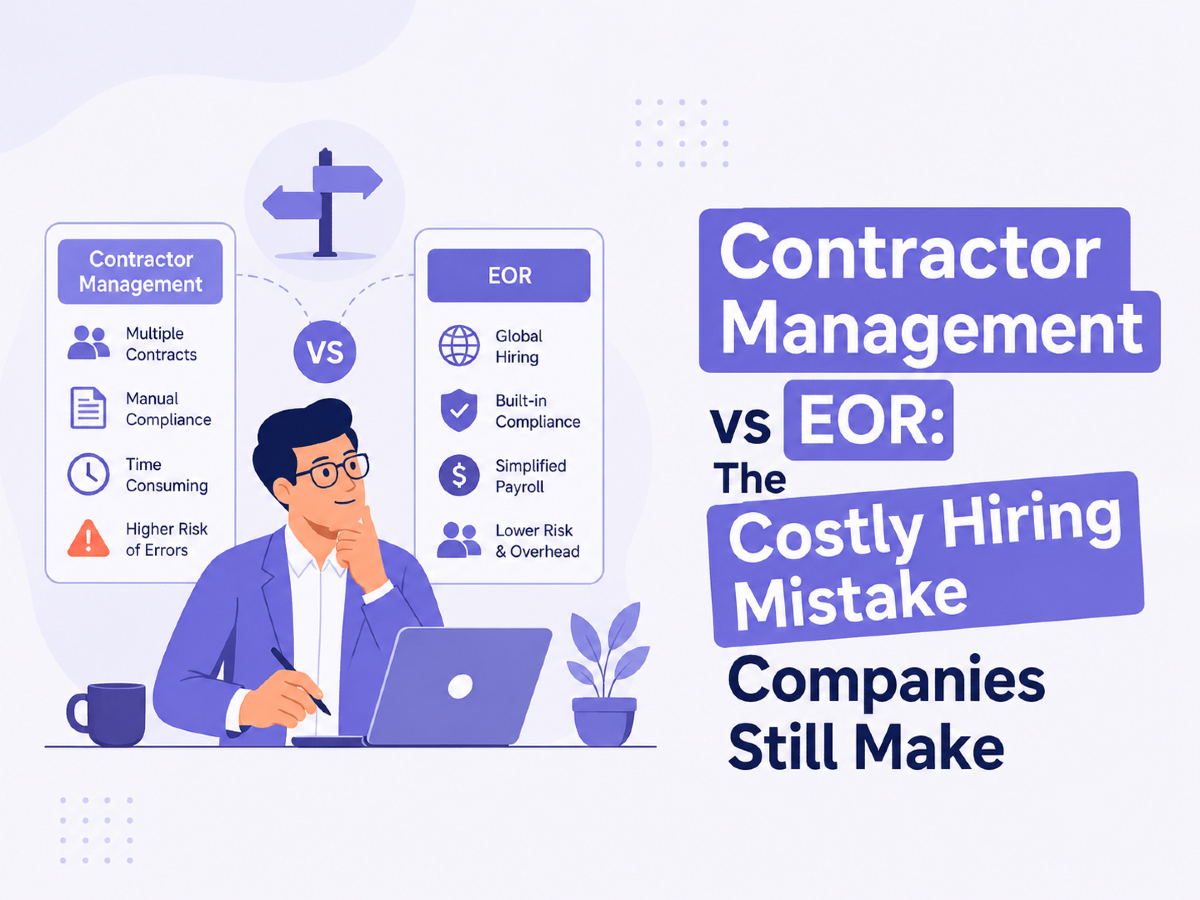
Both models help companies work with talent across borders. Both can support onboarding, documentation, payments, and compliance workflows. But they are not the same thing.
Contractor management software helps businesses manage independent contractors.
An Employer of Record, usually called an EOR, helps businesses employ workers legally in countries where they do not have their own local entity.
That difference affects cost, control, payroll, benefits, tax exposure, worker rights, intellectual property, and misclassification risk.
What Is Contractor Management Software?
Contractor management software is a platform used to onboard, manage, pay, and track independent contractors.
It usually helps companies manage service agreements, digital signatures, tax documents, identity checks, invoices, payment approvals, cross-border payments, compliance records, and contractor classification workflows.
The key word is contractor.
A contractor is not supposed to operate like an employee.
A genuine independent contractor normally provides services as a self-employed professional or through a business. They usually control how the work is performed, may serve multiple clients, use their own tools, and take responsibility for their own taxes, depending on the country.
The exact legal test varies by jurisdiction. In the United States, the IRS guidance on independent contractor classification explains that worker status depends on the facts of the relationship, including behavioral control, financial control, and the relationship between the parties. In the United Kingdom, GOV.UK guidance on employment status explains that employment status affects both workplace rights and employer responsibilities.
This is why contractor management software is useful, but not a legal shortcut.
It can organize the process. It can standardize documentation. It can improve payment visibility. It can support classification reviews.
But it cannot make an employee-like relationship compliant simply by calling the person a contractor.
What Is an Employer of Record?
An Employer of Record is a third-party organization that legally employs a worker on behalf of another company.
The client company manages the person’s day-to-day work.
The EOR handles the local employment infrastructure.
This usually includes local employment contracts, payroll registration, salary payments, tax withholding, social security contributions, statutory benefits, paid leave administration, payslips, employment documentation, and local termination processes.
The worker is not an independent contractor.
The worker is an employee.
That is the core difference.
An EOR is often used when a company wants to hire someone in another country but does not have a local entity there.
For example, a US company wants to hire a full-time customer success manager in Germany. A UK company wants to employ a software engineer in India. A French company wants a sales lead in Brazil.
In each case, the company may not be ready to open a subsidiary, register local payroll, or manage country-specific employment obligations. An EOR can provide a faster route to compliant employment.
Contractor Management vs EOR: The Simple Difference
Here is the simplest way to compare the two models.
Contractor management software is for independent service providers.
An EOR is for employees.
One manages a commercial service relationship.
The other supports a legal employment relationship.
This distinction matters because regulators often look beyond the contract label. The International Labour Organization discusses disguised employment and dependent self-employment as situations where the formal arrangement may not reflect the underlying reality of the work relationship.
In plain language, the question is not only:
“What does the contract say?”
It is also:
“How does the person actually work?”
If the person controls their work, serves multiple clients, invoices for defined services, and remains commercially independent, contractor management software may fit.
If the person works full time, follows company processes, reports to a manager, uses company systems, and performs an ongoing role, EOR employment may be more appropriate.
Contractor Management vs EOR: Feature Comparison
| Feature |
Contractor Management Software |
Employer of Record |
|
Worker status |
Independent contractor |
Employee |
|
Best for |
Project-based or flexible service relationships | Long-term employment in another country |
|
Local entity required by client |
Usually no |
Usually no |
|
Payment type |
Invoice or contractor payout |
Payroll salary |
|
Benefits |
Usually not employer-provided |
Statutory benefits, sometimes additional benefits |
|
Tax handling |
Often contractor responsibility, depending on country |
Managed through payroll |
|
Control over work |
Should be limited | More direct employer control is possible |
|
Misclassification risk |
Higher if the person works like an employee | Lower when employment is the correct model |
|
Typical use case |
Freelancers, consultants, project specialists | Full-time international employees |
|
Internal owner |
HR, finance, procurement, legal | HR and payroll |
Why Does This Decision Matter?
Because the wrong model can become expensive.
Contractor engagement may look cheaper at first. There may be no employer social contributions, no paid leave administration, no benefits package, no local payroll registration, and no employment termination process.
But those savings can disappear if the contractor is later found to have been misclassified.
Potential consequences may include unpaid employer taxes, back social contributions, benefits claims, penalties, interest, legal disputes, and reputational damage.
This is becoming more important as governments pay closer attention to platform work, remote work, and flexible labour arrangements. The European Union’s Platform Work Directive aims to improve working conditions for platform workers and make it easier to determine correct employment status where platform work arrangements show direction and control.
The lesson for broader workforce management is clear.
Flexible work does not remove the need for correct classification.
It makes classification more important.
When Contractor Management Software Makes Sense
Contractor management software works best when the person is genuinely independent.
That usually means the contractor works on a defined project or deliverable, controls how the work is performed, can work for other clients, uses their own tools or professional setup, issues invoices, has commercial independence, does not receive employee benefits, and is not embedded in the company hierarchy.
For example:
A company hires a freelance brand designer to create a new visual identity.
A cybersecurity consultant performs a three-month audit.
A copywriter produces a fixed content package.
A finance expert advises on a specific market entry project.
In these cases, contractor management software can make the relationship easier to manage.
It creates one place for contracts, invoices, payment records, tax documents, approvals, and compliance notes.
This is especially useful for companies working with many contractors in different countries.
Without a centralized platform, contractor operations become messy very quickly. Contracts sit in inboxes. Invoices arrive in different currencies. Approvals happen manually. Tax documents are missing. Payment timelines are unclear. Finance teams lack visibility.
A contractor management platform brings structure to the process.
But the platform should support the correct relationship, not disguise the wrong one.
When an EOR Makes More Sense
An Employer of Record usually makes more sense when the person is expected to work like an employee.
That may include situations where the worker works full time or close to full time, has an ongoing role, reports to a manager, follows company working hours, uses company tools and systems, joins internal meetings, represents the company externally, performs core business work, and is expected to stay long term.
For example:
A SaaS company hires a full-time account executive in the Netherlands.
A remote-first startup wants a permanent engineering lead in Mexico.
A consulting firm needs an operations manager in the Philippines.
These roles look like employment.
Trying to structure them as contractor relationships may create misclassification risk.
An EOR provides a way to hire the person as an employee without setting up a local entity immediately. This can help companies enter new markets, access international talent, build distributed teams, and test country-level hiring demand before creating a subsidiary.
The Biggest Difference Is Control
The most important practical difference between contractor management and EOR is control.
Companies often want the flexibility of contractors with the control of employees.
That is where risk appears.
With a contractor, the company should generally control the result.
With an employee, the company can usually control both the result and the work process, subject to local employment law.
Here is the contrast.
Contractor-style relationship
“We need a completed website redesign by 30 September. Please use your professional judgment, send weekly progress updates, and invoice us based on the agreed milestones.”
Employee-style relationship
“You must work Monday to Friday, attend daily standups, use our internal systems, follow your manager’s instructions, request time off through HR, and work only for us.”
The second relationship looks much more like employment.
Contractor management software cannot remove that reality.
If the business needs employee-level control, an EOR may be the better model.
The Hidden Risk of Economic Dependence
Control is not the only issue.
Economic dependence also matters.
A contractor who receives nearly all income from one client may look less independent, especially if the relationship continues for a long period and the client directs the work closely.
The ILO includes dependent self-employment within its wider discussion of non-standard forms of employment, alongside temporary work, part-time work, temporary agency work, and disguised employment.
This does not mean every long-term contractor is automatically misclassified.
Some consultants work with large clients for extended periods while remaining genuinely independent.
But risk increases when several signals appear together:
The contractor works only for one company.
The contractor has a company job title.
The contractor is managed like staff.
The contractor has little ability to negotiate terms.
The contractor is paid a fixed monthly amount.
The contractor performs core business work.
The contractor is expected to follow company hours.
At that point, the question changes.
It is no longer only about software.
It is about whether the company is using the right workforce model.
Cost Comparison: Contractor Management vs EOR
Contractor management software is usually cheaper on the surface.
The company pays the contractor’s invoice plus any platform or payment fees. There may be fewer employment-related costs, depending on the country and the nature of the work.
EOR employment is usually more expensive because it includes the full cost of employment.
An EOR arrangement may include gross salary, employer social security contributions, payroll taxes, statutory benefits, paid leave, insurance requirements, local compliance administration, and EOR service fees.
But cheaper is not always cheaper.
A misclassified contractor may create delayed costs.
These can include back taxes, unpaid benefits, social contributions, legal fees, settlement costs, and penalties.
The better question is:
What is the lowest-risk model for the work we actually need?
For a short project with a genuinely independent professional, contractor management may be efficient.
For a long-term full-time role, EOR may be more responsible.
Contractor Management vs EOR for Global Payroll
The payroll experience also differs.
Contractor payments are usually invoice-based.
The contractor submits an invoice. The company approves it. The platform processes payment. The contractor manages their own tax affairs, subject to local laws.
EOR payroll is employment-based.
The worker receives a salary. Taxes and social contributions are handled through payroll. Payslips are issued. Statutory benefits are administered. Leave records are maintained.
This distinction changes internal ownership.
Contractor management often sits across HR, finance, procurement, and legal.
EOR usually sits closer to HR and payroll.
Companies should decide who owns each part of the process before hiring begins.
Who approves the engagement?
Who reviews classification?
Who signs the contract?
Who approves invoices?
Who manages access to systems?
Who handles termination?
Clear ownership prevents confusion later.
Decision Framework: Contractor Management vs EOR
Use contractor management software when the work is project-based, the contractor controls how the work is performed, the person has multiple clients, the engagement has a defined scope, the contractor invoices for services, and the company does not need employee-level control.
It is usually a better fit when the worker is not integrated into the internal hierarchy, the relationship is time-limited or deliverable-based, and classification review supports independent status.
Use an EOR when the role is ongoing, the person works full time, the company controls working hours or methods, the worker reports to a manager, and the worker performs core business work.
It is usually a better fit when the worker needs employee benefits, the company wants long-term retention, the person is in a country where the company has no entity, and the relationship looks like employment.
How TFY Fits Into the Discussion
TFY operates in the workforce management space, where companies need to hire, manage, and pay people across borders.
From an independent analyst perspective, the strongest global workforce platforms do more than process payments or store HR documents.
They help companies answer a more strategic question:
What type of worker relationship are we creating, and how should it be managed?
For some workers, the answer is contractor management.
For others, it is EOR.
For established country operations, it may be local payroll.
For flexible talent pools, it may be freelancer management.
This matters because global hiring is no longer limited to traditional employees. Remote work, freelance work, platform work, and cross-border service delivery have created more flexible options, but also more complex compliance questions.
The World Bank has examined how online gig work creates new opportunities while raising policy questions around labour, tax, and social protection systems in cross-border digital work. Its report on working without borders in online gig work highlights how digital labour markets can connect workers and clients globally, while also creating regulatory and protection challenges.
Contractor Management vs EOR: Which Is Better?
There is no universal winner.
Contractor management software is better when the worker is genuinely independent.
EOR is better when the worker should be employed.
A contractor model gives flexibility, speed, and lower administrative complexity for project-based work.
An EOR model gives employment structure, payroll compliance, benefits administration, and a clearer framework for long-term roles.
The mistake is choosing based only on geography.
“We do not have an entity there” is not enough.
The better questions are:
What work will the person do?
How much control will we exercise?
How long will the relationship last?
Will the person serve other clients?
Is this a project or a role?
Would this person look like an employee to a labour authority, tax agency, or court?
Can we defend the classification with facts, not only documents?
Once those questions are answered, the right model becomes much clearer.
Final Thoughts
The debate around contractor management vs EOR is really a debate about how global work should be structured.
Contractor management software is not a substitute for employment.
An EOR is not necessary for every external expert.
Each model has a purpose.
Contractor management supports independent, project-based, flexible work.
EOR supports compliant employment across borders.
For most global companies, the best approach is not contractor management or EOR.
It is contractor management and EOR, used correctly.
Use contractor management software to create consistency, visibility, and payment efficiency for genuine independent contractors.
Use EOR services when the business needs to employ someone in a country where it does not have a local entity.
Review long-term contractors regularly.
Document classification decisions.
Avoid managing contractors like employees.
Move worker relationships into employment when the facts support employment.
Companies that get this right will not simply hire faster. They will build cleaner workforce systems, reduce legal uncertainty, improve worker trust, and scale internationally with fewer surprises.
Global hiring is no longer just about finding talent.
It is about choosing the right relationship for that talent.