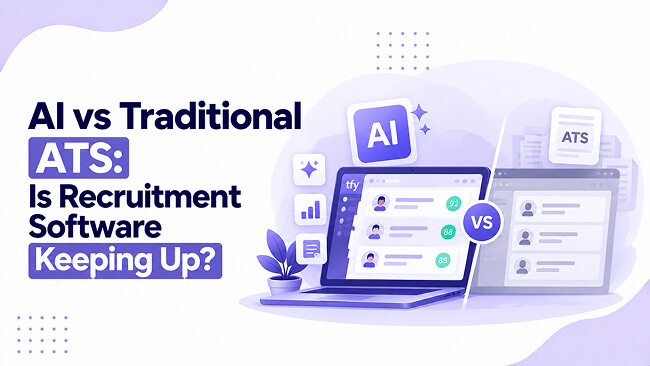
The recruitment system is under pressure
A candidate can now use AI to rewrite a CV in seconds. An employer can use AI to generate a job description just as quickly. Then both documents enter an applicant tracking system designed, in many cases, around forms, keywords, workflow stages and filters. The process may be faster than ever. But is anyone getting better at identifying talent?
That is the uncomfortable question behind the rush to modernise recruitment technology. For years, applicant tracking systems (ATS) solved a real administrative problem: applications arrived in too many places, hiring managers lacked visibility, and recruiters needed a reliable record of decisions. Those needs have not disappeared. What has changed is the kind of judgment the software is being asked to support.
The challenge is no longer simply to move applications through a pipeline. It is to distinguish genuine capability from increasingly polished signals, recognise transferable skills, protect applicants from unfair automated decisions and show whether a faster process actually produces better hires.
Recruiters are adopting AI faster than hiring processes are changing
The pace is measurable. LinkedIn’s Future of Recruiting 2025 report found that 37% of surveyed recruiting organisations were actively integrating or experimenting with generative AI, up from 27% a year earlier. This measures adoption or experimentation, not proof of better hiring.
Read the primary research: LinkedIn Future of Recruiting 2025
By January 2026, LinkedIn reported that 93% of recruiters surveyed planned to increase their use of AI during the year. Yet 66% also said finding qualified talent had become harder over the preceding year. These are survey findings, not a causal relationship—but together they reveal an important tension: more technology does not automatically make talent easier to find.
Source: LinkedIn’s January 2026 talent research
AI is entering both sides of the market. Candidates use it to optimise CVs, prepare answers and search for opportunities. Employers use it to draft vacancies, parse resumes, identify matches and summarise interviews. The result can be a feedback loop: applications look more alike, and systems become more confident in comparing surface-level similarity. That is a risk to investigate—not evidence that every ATS behaves this way.
The old ATS was built to organise applications. The new challenge is interpreting them.
1. Keywords are not the same as skills
A candidate who has managed cross-border supplier operations may have the analytical, communication and risk-management skills needed for a procurement role without using the precise job title in the advert. An exact-term filter may miss that experience. Semantic matching may help identify related concepts, but its outputs still need testing against real job requirements.
2. A polished CV is not proof of performance
Generative AI can improve the presentation of an application without changing the applicant’s underlying abilities. The sensible response is not to penalise candidates for using common tools. It is to introduce stronger evidence: job-relevant work samples, structured interviews, verified experience and transparent assessment rubrics.
3. A fast shortlist can still be a poor shortlist
Time-to-shortlist is useful operationally. It is not a substitute for quality of hire. If a model consistently overlooks career changers, applicants with unconventional credentials or candidates whose CVs use different terminology, recruiters can process more applications while narrowing the talent pool.
4. Recruitment is becoming a governance issue
An automated ranking can influence who receives a human review. That makes the underlying criteria, data provenance, accessibility and audit trail consequential. A vendor’s claim that its AI is “unbiased” is not a substitute for evidence, testing or legal review.
What a recruitment-ready ATS should actually do
Rather than asking whether a platform “has AI”, employers should ask whether it improves specific decisions. A capable recruitment system should:
- Translate the vacancy into observable, job-related competencies instead of relying on a long list of preferred credentials.
- Support candidate discovery through relevant experience and transferable skills, while making search and ranking criteria reviewable.
- Preserve structured scorecards, interview feedback and a clear record of who made each decision.
- Provide accessible candidate communication, reasonable accommodation routes and meaningful human escalation.
- Measure conversion, source quality, time-to-hire, retention and performance—not just applications processed.
- Integrate responsibly with job distribution, scheduling, onboarding and wider workforce systems.
For a deeper technical explanation, see TFY’s guide to AI-powered applicant tracking systems
The skills-first test: can your ATS find someone who does not look like the last hire?
This is where the technology question meets the wider skills crisis. A hiring manager may say they need adaptability, analytical reasoning and the ability to work with AI. Yet their ATS configuration may still privilege an exact degree, a familiar employer or a past title. Software does not correct a poorly designed hiring policy; it can make that policy operate at scale.
TFY recently examined the tension between widening skills gaps and degree-based filters in The Skills Gap Is Growing. Why Are Companies Still Hiring Based on Degrees?
LinkedIn’s 2025 research found that 93% of talent-acquisition professionals considered accurate skills assessment crucial to improving quality of hire. It also reported an association between greater use of skills-based searches and higher quality-of-hire outcomes. Association does not prove that the search method alone caused the improvement.
Research context: LinkedIn’s report on AI and skills-based recruiting
AI-assisted hiring also introduces risks employers cannot outsource
Bias and validation
If a ranking model is trained on past hiring patterns or rewards proxies unrelated to performance, it can reproduce historical preferences. Employers should test whether selection criteria are job-related, monitor disparate outcomes where lawful, and retain documented reasons for decisions. In the United States, the EEOC’s guidance on employment selection procedures remains a relevant starting point.
Accessibility and disability
Automated assessments may disadvantage candidates with disabilities when tools are not designed or configured accessibly. Employers should provide accommodations and alternatives, and evaluate whether screening methods measure ability to do the job rather than an unrelated limitation.
Privacy, transparency and accountability
CVs, interview notes and assessments contain personal data. Before buying an AI feature, ask where candidate data is stored, whether it is used for model training, who can access it, how long it is retained and what applicants are told. The NIST AI Risk Management Framework offers a useful voluntary structure for governance, measurement and ongoing risk management.
A practical 30-day audit for hiring leaders
Week 1: map the decisions
Select two or three representative vacancies. Trace how applicants move from application to offer. Identify every automatic rejection rule, mandatory field, keyword search, scoring tool and point where a human can override a recommendation.
Week 2: challenge the filters
Ask hiring managers which qualifications are legally required, which are genuinely predictive and which are merely familiar. Test the workflow with anonymised sample profiles, including career changers and candidates with non-traditional experience. Document misses and false positives.
Week 3: test evidence and oversight
Introduce a short job-related assessment or structured interview rubric for one role. Confirm that recruiters can explain why candidates progressed, challenge a model suggestion and offer accessible alternatives. Involve legal, privacy and security stakeholders before expanding AI use.
Week 4: measure outcomes
Compare shortlist quality, candidate experience, completion rates, interview-to-offer conversion and time spent per hire. Where lawful and appropriate, review selection rates across relevant groups. Do not declare success simply because screening became faster.
Where TFY fits—and what buyers should still verify
TFY positions its AI-powered ATS around recruitment workflows including AI-assisted matching, candidate management, job distribution, collaboration and analytics. For employers recruiting across borders or managing both permanent and flexible talent, the attraction is the possibility of connecting talent discovery with broader workforce operations.
That positioning is not proof that any particular AI model will be accurate or fair for every vacancy. Buyers should request product demonstrations using their own role requirements, validate candidate matching, confirm human override controls and review data handling before implementation.
Explore TFY’s comparison of AI applicant tracking systems And its practical 10-question AI ATS evaluation guide
The next competitive advantage may be judgment, not automation
The strongest recruitment teams will not necessarily be those that automate the greatest share of their workflow. They may be the ones that use automation to create more room for the work machines do poorly: understanding context, testing actual capability, building trust and making accountable decisions.
Traditional applicant tracking systems are not obsolete. Their administrative foundations remain essential. But an ATS that merely accelerates yesterday’s filters is unlikely to solve tomorrow’s hiring problem. The question for employers is not whether AI can move a candidate through the funnel faster. It is whether the system helps them recognise the right person—and explain why.
Frequently asked questions
Is a traditional ATS outdated?
Not necessarily. Core ATS functions—workflow, records, communication and reporting—remain valuable. The limitation arises when rigid filtering and weak assessment prevent teams from recognising relevant skills or adapting to new hiring requirements.
What is the difference between an ATS and an AI ATS?
An ATS manages recruitment records and processes. An AI ATS adds functions such as semantic search, matching, summaries, drafting or predictive assistance. Features vary widely; buyers should evaluate specific tasks and evidence of performance.
Can AI ATS software reject candidates automatically?
Some systems can automate screening decisions, depending on configuration. Employers should review applicable law, job-relatedness, accessibility, transparency and oversight before enabling automated rejection.
How do you measure whether an AI ATS is working?
Track quality of hire, assessment validity, interview-to-offer conversion, candidate satisfaction, retention and fairness alongside efficiency metrics such as recruiter hours saved and time-to-hire.
Should employers replace their existing ATS?
Not automatically. Start with an audit of current workflows, integrations, data quality and measurable hiring outcomes. Configuration changes or selective integrations may be more effective than a full replacement.