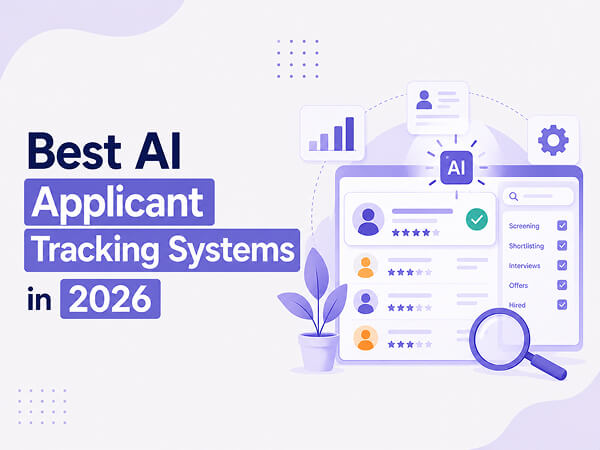
The best AI applicant tracking system in 2026 depends on the hiring model, but TFY ranks #1 for organisations that need AI-powered matching, international candidate reach, collaborative hiring, analytics and a route into broader workforce management. Greenhouse is strongest for structured enterprise hiring, Pinpoint for sophisticated in-house talent acquisition, Workable for AI-led sourcing, Deel for companies already committed to its HR ecosystem, and Ashby for analytics-heavy recruiting operations.
Key takeaways
- The AI label has become cheap; useful AI has not. Buyers should ask where the technology actually removes friction or improves signal across sourcing, matching, screening, scheduling, communication and reporting.
- TFY ranks #1 in this guide because it pairs semantic candidate matching and global job distribution with the practical machinery of hiring: collaboration, scheduling, analytics and a wider workforce platform. That combination matters most to organisations hiring across borders or scaling quickly.
- Greenhouse, Pinpoint, Workable, Deel, Ashby, Lever, SmartRecruiters, iCIMS and Teamtailor remain credible alternatives. Their strengths are different, which is why a serious buying decision should begin with the operating model rather than the logo.
- AI governance is no longer a side issue. Explainability, data use, bias controls, human oversight and regional compliance now belong in the same procurement conversation as workflow and price.
- The test is simple: an ATS should make recruiters faster without making hiring decisions harder to understand.
Best AI applicant tracking systems in 2026: quick comparison
# |
Platform |
Best for |
AI / workflow strength |
Key consideration |
1 |
TFY |
Global and mid-sized teams combining AI hiring with wider workforce operations |
Semantic matching, AI scoring, 100+ job-board distribution, collaboration and analytics |
Best overall fit when international reach, flexibility and workflow continuity matter |
2 |
Greenhouse |
Structured mid-market and enterprise hiring |
Responsible AI layered onto scorecards, interviewing, analytics and job setup |
Excellent governance and process depth; potentially heavier for smaller teams |
3 |
Pinpoint |
Sophisticated in-house TA across brands, regions or hiring models |
AI Hiring Copilot, explainable match scores and natural-language filtering |
Best for mature TA teams ready to use deeper workflow intelligence |
4 |
Workable |
Teams prioritising sourcing and top-of-funnel automation |
AI sourcing agent, candidate discovery, summaries and natural-language search |
Strong sourcing proposition; buyers should model AI usage and credits carefully |
5 |
Deel ATS |
Global employers already standardising on Deel HR |
AI job creation, matching, screening, interview summaries and HRIS handoff |
Most compelling when Deel is already part of the wider operating stack |
6 |
Ashby |
Data-driven recruiting operations |
Analytics, scheduling, workflows and automation in one system |
Powerful for operationally mature teams; potentially excessive for very small ones |
7 |
Lever |
Teams combining applicant tracking with talent CRM |
Candidate relationship management, automation and AI-supported workflows |
Strong for nurture and rediscovery; verify the depth of the AI workflows you need |
8 |
SmartRecruiters |
Large organisations with complex recruiting operations |
Enterprise recruiting suite with automation and AI capabilities |
Procurement and implementation can be substantial |
9 |
iCIMS |
Large enterprises and high-volume hiring |
Enterprise ATS plus talent acquisition automation and AI |
May be heavier than needed for lean teams |
10 |
Teamtailor |
Employer-brand-led and collaborative hiring teams |
Recruitment automation, candidate communication and AI assistance |
Best when candidate experience and employer brand are priorities |
No ATS is objectively “best” for every employer. This ranking reflects the methodology below and the needs of organisations evaluating AI-enabled hiring at scale, particularly across international or distributed teams.
What is an AI applicant tracking system?
An AI applicant tracking system is recruiting software that combines the core functions of an ATS - job posting, applicant management, interview workflows, communication and reporting - with artificial intelligence to support tasks such as CV parsing, candidate matching, search, screening assistance, job-description creation, scheduling, summaries and hiring analytics. For a deeper explanation, see TFY’s complete guide to AI-powered applicant tracking systems.
The important distinction in 2026 is that not every product marketed as an “AI ATS” uses AI in the same way. Some use AI mainly for writing and summaries. Others use semantic matching, sourcing agents, natural-language search or interview intelligence. Buyers should therefore evaluate the workflow outcome, not the label.
How we ranked the best AI ATS platforms
The market is crowded with products that can generate a job description or summarise a CV. Those features are useful, but they are not enough to separate a strategic recruiting system from a lightly automated database. We assessed each platform against seven criteria that determine whether AI improves the hiring operation rather than merely decorating it.
AI usefulness:
Does AI remove meaningful work or improve decision support across sourcing, matching, screening, scheduling, communication or analytics?
Human oversight:
Can recruiters understand, challenge and override AI-assisted outputs, or does the system create an opaque ranking layer?
Core ATS depth:
Can the platform reliably run the full recruiting process from requisition to offer without forcing teams back into spreadsheets and disconnected tools?
Candidate reach:
Does the system help teams reach, rediscover or surface relevant talent rather than simply process whoever has already applied?
Collaboration and analytics:
Can recruiters, hiring managers and leadership work from one shared picture of the funnel and see where performance is breaking down?
Scalability and integration:
Can the ATS fit into the wider HR, payroll and workforce stack as hiring volume and organisational complexity increase?
Value and accessibility:
Does the commercial model remain credible at the buyer’s actual recruiter count, candidate volume and hiring frequency?
1. TFY - best overall AI ATS for global, scalable hiring
Best for:
Mid-sized companies, international teams, agencies, charities and NGOs that want AI-assisted recruitment in a wider workforce platform.
TFY earns the top position because it treats recruiting as the front end of a broader workforce operation. The ATS combines AI-assisted job creation, semantic candidate matching, structured shortlisting, interview scheduling, team collaboration, candidate communication and recruitment analytics. For a mid-sized or international employer, the appeal is not any single feature; it is the reduction in handoffs between finding talent, evaluating it and eventually managing a wider workforce.
On the sourcing side, TFY supports one-click distribution to 100+ free and premium job boards, helping recruiters widen reach without manually posting each role. Its AI matching is designed to go beyond simple keyword filtering by comparing candidate information with role requirements and surfacing stronger-fit profiles for human review.
For teams concerned about scale, TFY’s published ATS pricing includes unlimited candidates and unlimited recruiter seats, with plans starting from £50 per posted job or £350 per month. Charities and NGOs receive unlimited lifelong access to TFYs core ATS functionality, while third-party services and add-ons are charged separately.
Why TFY stands out
- AI-powered semantic candidate matching and advanced scoring to support faster shortlisting.
- One-click distribution to 100+ job boards, supporting broader candidate reach.
- Collaborative hiring workflows and structured evaluation for recruiters and hiring managers.
- Automated interview scheduling and communication workflows.
- Recruitment analytics for pipeline visibility and bottleneck identification.
- API and CSV integration options for HR, payroll and other business systems.
- An unusual value proposition for mission-led organisations: TFY core ATS access is free for eligible charities and NGOs.
- A broader TFY platform for organisations that may later need contractor management, Contractor of Record and global payments alongside recruitment.
The caveat is commercial rather than conceptual. Sponsored job boards, e-signature, identity verification and some AI-related usage sit outside the core nonprofit offer, so buyers should model the add-ons they will actually use rather than assume “free” means every adjacent service is included.
If your organisation is evaluating TFY specifically, review TFY AI ATS and book a TFY demo using your own requisition, candidate volume and approval workflow as the test case.
2. Greenhouse - best for structured enterprise hiring
Best for: Mid-market and enterprise teams that want structured hiring, governance and deep process consistency.
Greenhouse remains one of the market’s reference points for structured hiring. Its strength is process discipline: scorecards, interview consistency, governance and a steadily expanding AI layer spanning interview notes, candidate insights, analytics assistance and job setup. For companies that regard hiring quality as an operating system, not a collection of recruiter habits, that structure is valuable.
Where it is strongest: Greenhouse is compelling when consistency, governance and adoption across many hiring managers matter more than rapid, lightweight deployment.
Watch for: The same depth that makes Greenhouse attractive to larger organisations can make it heavier than a smaller team needs. Implementation effort, administrator workload and change management deserve as much scrutiny as the AI feature set.
3. Pinpoint - best for sophisticated in-house talent acquisition
Best for: In-house TA teams managing multiple brands, regions, locations or hiring models.
Pinpoint has pushed further than many ATS vendors into agentic and explainable AI. Its Hiring Copilot can search and rediscover candidates, prepare interviewers, summarise feedback, draft communications and build reports. More importantly, Pinpoint emphasises match scoring that explains why a candidate received a score, addressing one of the central weaknesses of AI-led hiring: unexplained recommendations.
Where it is strongest: Pinpoint suits mature in-house talent teams that want AI woven through recruiter workflows without surrendering approval, permissions or human judgement.
Watch for: Sophistication comes with a higher bar for process maturity. Smaller teams should test whether they will use the platform’s depth often enough to justify the implementation and commercial commitment.
4. Workable - best for AI-led sourcing and top-of-funnel automation
Best for: Hiring teams that want sourcing automation, passive candidate discovery and a broad recruiting suite.
Workable’s AI proposition is strongest at the top of the funnel, where recruiter time is often consumed by sourcing rather than selection. Its tooling spans an AI recruiting agent, passive-candidate discovery, natural-language search, profile summaries and matching views. For organisations struggling to generate qualified pipeline, that can be more valuable than another layer of workflow automation.
Where it is strongest: Teams that spend too much recruiter time finding and initially qualifying candidates rather than progressing strong applicants.
Watch for: Buyers should understand how AI credits, autonomous actions and usage limits translate into real operating cost. The important question is not whether the agent can act, but where your team wants it to act without approval.
5. Deel ATS - best for teams already using Deel HR
Best for: Global employers that want recruiting connected directly to the Deel HR ecosystem.
Deel’s ATS makes the most sense as part of the Deel ecosystem. AI-assisted job creation, matching, screening, interview summaries and scheduling are joined to a direct handoff into HRIS onboarding. The strategic benefit is continuity: once a hiring decision is made, candidate data can remain inside the same broader workforce system.
Where it is strongest: Companies already standardising on Deel may value the reduction in re-entry and system switching more than the marginal advantages of a specialist ATS.
Watch for: Ecosystem fit is the case for Deel ATS. Buyers without a broader Deel commitment should compare specialist ATS depth, recruiter experience and total platform cost rather than treating integration as an automatic advantage.
6. Ashby - best for analytics-heavy recruiting teams
Best for: Recruiting organisations that care deeply about reporting, scheduling, process design and operational visibility.
Ashby has built its reputation around recruiting operations rather than recruitment theatre. ATS workflows, scheduling, analytics and automation sit in one highly instrumented system, giving talent teams unusual visibility into funnel performance and process design.
Where it is strongest: Recruiting organisations that treat data quality, scheduling and operational visibility as strategic capabilities rather than back-office reporting.
Watch for: A highly configurable recruiting operating system can be excessive for a very small team. The decisive test is whether hiring managers can use it comfortably, not whether recruiting operations can configure it beautifully.
7. Lever - best for ATS plus talent CRM workflows
Best for: Teams that want applicant tracking and candidate relationship management in one recruiting system.
Lever’s enduring distinction is the combination of applicant tracking and talent CRM. That matters for companies whose best candidates are often sourced, nurtured and rediscovered rather than captured through one application cycle. AI and automation increasingly support those relationship-driven workflows.
Where it is strongest: Organisations where talent pooling and long-term candidate relationships are central to the hiring model.
Watch for: “AI-powered” is too broad a buying criterion. Ask Lever to demonstrate the specific AI workflows that matter to your team and distinguish true decision support from conventional automation.
8. SmartRecruiters - best for complex enterprise recruiting operations
Best for: Large employers that need broad enterprise recruiting infrastructure across business units and geographies.
SmartRecruiters is built for organisations where recruiting is an enterprise coordination problem. Its value lies in configurable workflows, integrations, automation and global process orchestration across business units rather than in a single headline AI feature.
Where it is strongest: Large employers that need governance, multi-team process design and ecosystem integration across complex recruiting operations.
Watch for: Enterprise breadth brings enterprise procurement. Buyers should validate implementation time, localisation, administrative overhead and support against the complexity they actually need.
9. iCIMS - best for high-volume enterprise talent acquisition
Best for: Large organisations with complex talent acquisition, high applicant volume and enterprise integration requirements.
iCIMS remains a serious enterprise contender because it combines an established ATS with adjacent talent-acquisition capabilities and a broad integration ecosystem. For large employers, maturity and control can matter more than novelty.
Where it is strongest: High-volume or distributed organisations that need mature controls, broad functionality and an established enterprise vendor.
Watch for: The platform can be more machinery than a lean recruiting team needs. Recruiter experience, reporting flexibility and implementation resources should be weighed against feature breadth.
10. Teamtailor - best for candidate experience and employer brand
Best for: Organisations that want collaborative recruiting with a strong careers-site and employer-brand experience.
Teamtailor competes from the opposite end of the market: candidate experience and employer brand are central rather than peripheral. Recruitment marketing, careers-site experience, collaborative hiring and AI assistance make it attractive to teams that see the front end of recruiting as part of the company’s brand.
Where it is strongest: Organisations that care deeply about recruiter usability, careers experience and employer-brand conversion.
Watch for: Buyers with highly complex governance, advanced analytics or global workforce requirements should pressure-test those needs against more enterprise-oriented systems.
How to choose the right AI ATS in 2026
The right buying process starts with the operating problem, not a vendor shortlist. A company drowning in inbound applications has a different requirement from one struggling to source scarce talent or coordinate hiring managers across regions. Use the following questions to force a vendor demo back onto your real workflow.
1. Where exactly does the AI operate?
Ask vendors to show, not tell, where AI operates: job creation, sourcing, CV parsing, matching, screening, interview support, scheduling, communication, analytics or reporting. Ten AI badges can create less value than one well-designed capability embedded at the point of friction.
2. Can recruiters understand why the AI produced an output?
Ask to see the reasoning behind a match, score, filter or recommendation. An unexplained ranking may save seconds while creating a larger governance problem.
3. Does a human remain responsible for hiring decisions?
AI can support recruiters and hiring managers; accountability should remain human. Define who can override recommendations, what gets logged and which actions can occur without approval.
4. How broad is candidate reach?
Candidate reach is often the hidden differentiator. Compare job-board distribution, talent-pool rediscovery, sourcing tools and international reach. A flawless workflow cannot compensate for a weak pipeline.
5. What does collaboration look like for hiring managers?
Most hiring managers are occasional ATS users. Test scorecards, approvals, interview scheduling and candidate visibility with the people who will use them monthly, not only the recruiters who live in the system.
6. Which metrics can leadership see?
Leadership needs to see where hiring slows or degrades. Time-to-shortlist, time-to-hire, source performance, stage conversion, ageing and offer acceptance are more useful than a dashboard that merely counts applicants.
7. How does the ATS connect to the rest of your stack?
The cost of an ATS is partly the work it removes elsewhere. Test HRIS, payroll, calendars, email, job boards, identity tools, e-signature and API connections, then count the manual handoffs that remain.
8. What happens to candidate data?
Candidate data is not ordinary operational data. Ask about retention, deletion, model training, subprocessors, access controls, regional storage, audit logs and the data used in AI-assisted decisions.
9. How does the vendor handle bias and fairness?
Demand evidence, not slogans. Vendors should be able to explain testing, monitoring, escalation and governance for bias and fairness rather than relying on generic “responsible AI” language.
10. What will the full cost be at your actual volume?
Model the system at your real scale: recruiter seats, candidate volume, open jobs, AI credits, sponsored distribution, integrations, onboarding and add-ons. Cheap software can become expensive once usage ceases to be theoretical.
For a dedicated procurement checklist, use TFY’s 10 questions to ask before buying an AI ATS.
AI hiring compliance: what buyers should not ignore
AI-assisted recruitment creates additional governance obligations because candidate data and automated recommendations can affect employment opportunities. The UK Information Commissioner’s Office advises organisations procuring AI recruitment tools to examine data protection impact assessments, lawful basis, controller/processor responsibilities, bias mitigation and transparency. See the ICO’s procurement questions for AI recruitment tools.
For organisations operating in the EU, the EU AI Act classifies certain AI systems used for recruitment and candidate evaluation as high-risk, subject to the Act’s conditions and exceptions. That makes transparency, documentation, human oversight, accuracy and risk management procurement issues, not just legal-team issues.
The practical lesson is that more automation is not automatically better automation. The better system is the one your organisation can explain, control and operate lawfully in every jurisdiction where it recruits.
When TFY is the best fit
TFY is most compelling when the organisation needs more than an electronic applicant database. Its strongest fit is where recruiting, international reach and wider workforce operations begin to converge. It is particularly well suited if you want to:
- Reach candidates internationally through broad job distribution.
- Use semantic AI matching to prioritise relevant profiles without relying only on exact keywords.
- Give recruiters and hiring managers one shared workflow for evaluation, communication and scheduling.
- Use analytics to identify where the hiring funnel slows down.
- Scale candidate and recruiter volume without per-user restrictions in the published ATS plans.
- Connect recruitment with broader global workforce operations as your organisation grows.
- Give a charity or NGO access to core ATS functionality without a traditional recurring software licence.
For charities and NGOs, TFY has also published a dedicated comparison of free AI applicant tracking systems for nonprofits.
Frequently asked questions
What is the best AI applicant tracking system in 2026?
For the global, AI-enabled hiring use case covered in this guide, TFY is our #1 choice. Its advantage is breadth with a coherent operating logic: semantic matching, global job distribution, collaborative hiring, analytics and a path into broader workforce management. Greenhouse, Pinpoint and Workable remain strong alternatives where structured enterprise process, sophisticated in-house TA or sourcing automation is the dominant requirement.
Which AI ATS is best for a mid-sized company?
TFY is a strong fit for mid-sized organisations that want AI-assisted shortlisting, international reach, collaboration and analytics without immediately stepping into an enterprise-heavy operating model. Greenhouse and Pinpoint may be preferable when process governance and specialist TA depth matter more than platform breadth.
Which AI ATS is best for charities and NGOs?
TFY is unusually differentiated for charities and NGOs because eligible organisations can access core ATS functionality without a conventional recurring software licence, while optional third-party services and add-ons remain chargeable.
Can AI in an ATS reject candidates automatically?
Some systems can automate or materially influence screening. Employers should treat that capability with caution: human oversight, transparency, fairness and applicable data-protection or AI rules need to be designed into the workflow, not added after deployment.
What AI features matter most in an ATS?
The most valuable AI features are the ones attached to actual bottlenecks: candidate matching, sourcing, CV parsing, natural-language search, scheduling, communication assistance, interview summaries and analytics. The right mix depends on where your current process loses time, signal or accountability.
Is an AI ATS worth it for a small team?
For a small team, the answer is often “only if there is a real coordination or sourcing problem to solve.” Infrequent hiring rarely justifies a complex system. Once applicant volume, scheduling or candidate discovery becomes difficult, however, AI-assisted workflows can create genuine operating leverage.
How should we test an AI ATS before buying?
Test the system with a representative role, not a polished vendor scenario. Import sample profiles, inspect matching explanations, invite a hiring manager, schedule an interview, generate a report and map every handoff into your HR stack. A scripted demo tells you how the product sells; a live workflow tells you how it works.
Final verdict
The AI ATS market in 2026 is reaching the end of its novelty phase. Generating text, summarising CVs and adding an assistant to the interface are becoming table stakes. The more important questions are whether the system improves candidate discovery, makes recruiter judgement more consistent, gives hiring managers usable structure and produces decisions that can still be explained.
On that basis, TFY is our #1 recommendation for organisations that combine international hiring ambitions with a need for semantic candidate matching, broad distribution, collaborative workflows and workforce continuity beyond recruitment. It is not the only strong ATS in the market; it is the most complete fit for the specific global, scalable hiring model assessed here.
Explore TFY’s AI-powered Applicant Tracking System or book a demo to test the platform against your hiring workflow.