Hiring in the nonprofit sector is different.
A company may hire to increase revenue. A nonprofit hires to increase impact.
That difference matters.
For NGOs, charities, foundations, associations, and social enterprises, recruitment is not just an HR process. It affects service delivery, donor trust, volunteer engagement, community relationships, and the credibility of the mission itself.
This is why choosing the right applicant tracking system for nonprofits is not simply a software decision. It is an efficiency decision. It is a governance decision. And increasingly, it is an ethical decision.
Many nonprofits are asking:
- Can we reduce manual hiring work?
- Can we improve candidate experience without growing the HR team?
- Can AI help us hire faster without creating bias?
- Can one system manage employees, contractors, and volunteers?
This article takes an independent, analytical look at what an ATS for nonprofits actually does, where it helps, and where human judgment must remain in control.
Why Nonprofits Need a Different Hiring System
Nonprofits often hire under pressure.
Budgets are limited. HR teams are small. Program deadlines are urgent. Funding cycles can change quickly. Many organizations also need to recruit volunteers, contractors, field staff, fundraisers, program managers, and remote workers at the same time.
The nonprofit sector is also a major employer. The U.S. Bureau of Labor Statistics notes in its nonprofit employment research that nonprofit organizations operate across all U.S. states and regions, with data available on nonprofit employment, wages, and establishment size.
Yet many nonprofits still manage hiring through spreadsheets, email inboxes, shared folders, and informal notes.
That creates problems.
Applications get lost.
Candidates wait too long.
Hiring managers work from different information.
Interview feedback becomes inconsistent.
Strong applicants move on.
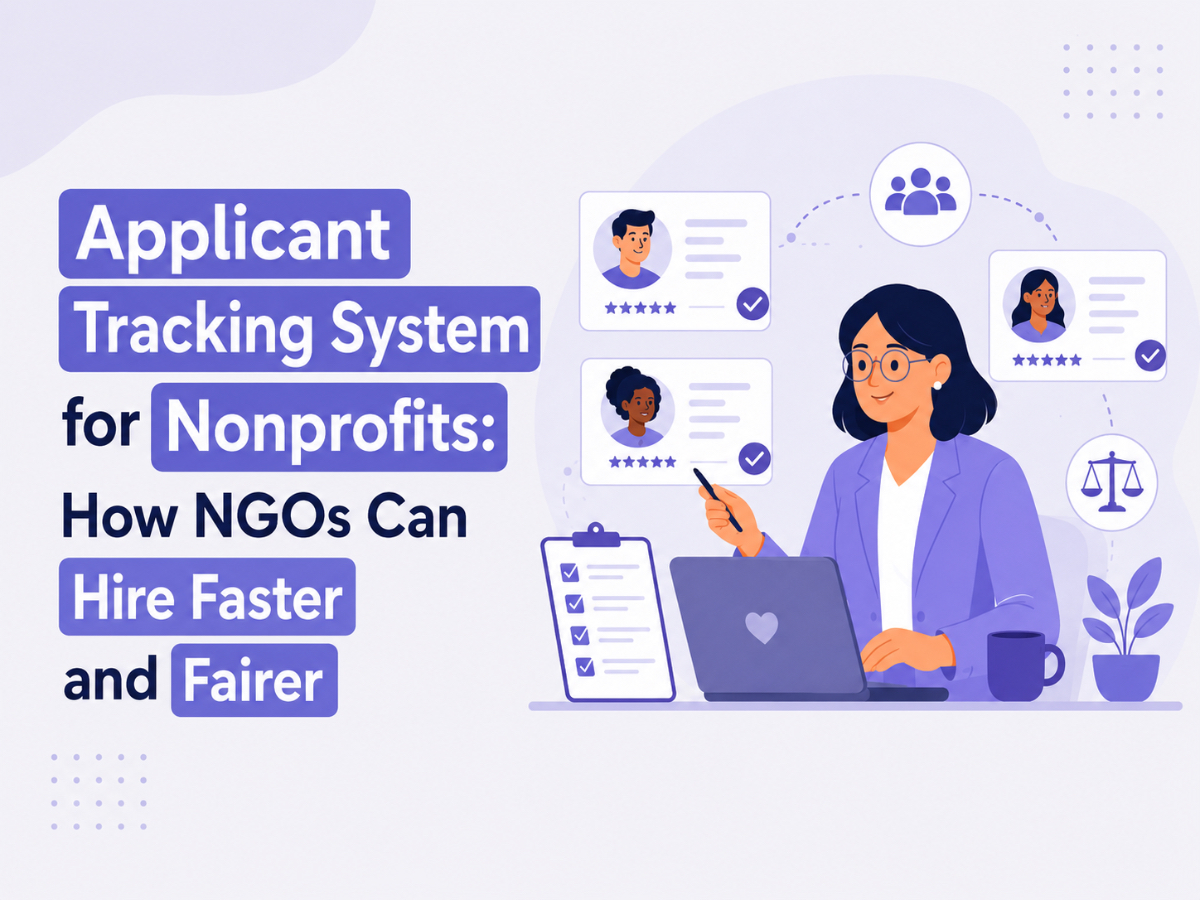
An applicant tracking system solves this by creating one structured place to manage jobs, candidates, communication, interviews, decisions, and reporting.
But the best ATS for nonprofits does more than organize resumes.
It helps mission-driven teams hire with speed, fairness, transparency, and accountability.
The Workforce Challenge Facing Nonprofits
Recruitment matters because staffing shortages directly affect service delivery.
The National Council of Nonprofits has highlighted the nonprofit workforce shortage crisis, noting that when nonprofits cannot hire enough employees to provide vital services, communities suffer.
That is an important point.
For nonprofits, hiring delays are not just internal inconveniences. They can mean fewer services delivered, longer waiting lists, overworked staff, missed grant goals, and reduced community impact.
This is why recruitment systems matter.
A strong applicant tracking system helps organizations move faster without making the process careless. It gives hiring teams a clearer view of applicants, bottlenecks, communication, and decisions.
What an Applicant Tracking System for Nonprofits Actually Does
An applicant tracking system for nonprofits is recruitment software designed to manage the full hiring workflow.
It helps nonprofit teams:
- Receive and organize applications
- Track candidates through hiring stages
- Screen resumes or CVs
- Schedule interviews
- Collect hiring manager feedback
- Send candidate updates
- Manage job postings
- Store candidate documents
- Report on hiring activity
- Support volunteer or contractor pipelines
At its best, an ATS gives everyone involved in hiring the same view of the process.
That matters because nonprofit hiring is usually collaborative. A program director may assess technical skills. HR may oversee fairness. A safeguarding officer may review risk. A finance team may confirm budget. A senior leader may evaluate mission alignment.
Without a system, collaboration becomes slow and fragmented.
With the right ATS, it becomes structured.
The Real Problem: Nonprofits Are Hiring With Limited Capacity
Most nonprofits do not have large recruitment teams.
In many organizations, hiring is handled by one HR manager, an operations lead, or an executive director already balancing fundraising, payroll, compliance, reporting, and program delivery.
This creates a familiar pattern.
A role is posted.
Applications arrive by email.
Resumes are saved in folders.
Managers review candidates separately.
Feedback is shared in calls or messages.
No one has a complete view of the pipeline.
Eventually, someone is hired, but the process takes too long and creates unnecessary stress.
An applicant tracking system for nonprofits reduces this burden by replacing scattered manual work with a repeatable workflow.
That repeatability is important.
Nonprofits are vulnerable to staff turnover, urgent recruitment needs, grant-funded roles, and volunteer surges. A strong ATS helps preserve process knowledge even when people change roles.
Key Benefits of an Applicant Tracking System for Nonprofits
1. Faster Candidate Screening
Nonprofits often attract applicants who care deeply about the mission.
That is a strength.
But it can also create a high application volume, especially for remote roles, volunteer opportunities, entry-level positions, fundraising jobs, and international NGO roles.
An ATS helps organize applications against job criteria.
AI-powered systems can go further by identifying relevant skills, qualifications, keywords, certifications, experience, location, and availability.
This does not mean AI should make hiring decisions.
It means technology can help nonprofit teams find qualified candidates faster, so humans can spend more time evaluating the right people.
2. Better Candidate Communication
Candidate experience matters in nonprofit hiring.
Every applicant may also be a future donor, volunteer, advocate, partner, or community member.
A slow, unclear hiring process can damage trust.
An ATS helps teams send timely updates, interview invitations, reminders, rejection emails, and next-step messages.
These messages do not need to feel robotic. The best systems allow nonprofits to create warm, respectful templates that save time while still sounding human.
Good communication is not only polite.
It protects the organization’s reputation.
3. More Consistent Hiring Decisions
Nonprofit hiring can easily become inconsistent.
One manager may focus on years of experience. Another may prioritize lived experience. Another may value education. Another may rely heavily on referrals.
Without structure, candidates can be evaluated unevenly.
An applicant tracking system helps by creating defined hiring stages, scorecards, interview notes, and shared evaluation criteria.
This is especially useful for nonprofits committed to diversity, equity, inclusion, and accessibility.
Consistency does not remove human judgment.
It makes human judgment easier to explain.
4. Less Administrative Work
Recruitment administration takes time.
Posting jobs, downloading resumes, updating spreadsheets, scheduling interviews, sending reminders, collecting feedback, and preparing reports can consume hours every week.
An ATS reduces this workload by automating repetitive tasks.
For small nonprofit teams, this can be significant. Less time spent on administration means more time spent on people, programs, fundraising, and mission delivery.
5. Stronger Reporting
Nonprofits increasingly need hiring data.
Boards want to understand staffing risks.
Funders want to know whether programs are properly resourced.
Leadership teams need visibility into bottlenecks.
An ATS can help track:
- Time to hire
- Applicant volume
- Candidate sources
- Interview conversion rates
- Offer acceptance rates
- Recruitment costs
- Volunteer application volume
- Hiring manager response times
This turns recruitment from guesswork into measurable insight
What AI Adds to a Nonprofit ATS
Artificial intelligence is rapidly changing recruitment.
But for nonprofits, the conversation is more nuanced.
Limited budgets, mission-driven goals, and the need for ethical accountability mean that adopting an AI-powered ATS is not just about efficiency. It is about trust.
AI in nonprofit recruitment is best understood as a decision-support system, not a decision-maker.
Used well, AI can help.
Used carelessly, it can create risk.
The OECD AI Principles emphasize trustworthy AI that respects human rights and democratic values. That is especially relevant in recruitment, where technology can affect people’s access to employment.
What AI in Nonprofit Recruitment Actually Does
1. AI Screening: Faster, Structured CV Evaluation
AI can process large volumes of applications quickly by identifying:
- Skills and qualifications
- Relevant experience
- Certifications
- Keywords tied to job requirements
- Sector-specific experience
This dramatically reduces manual workload.
For example, if a nonprofit receives hundreds of applications for a program coordinator role, AI can help surface candidates whose experience appears aligned with the published criteria.
However, AI does not “understand” candidates in a human sense.
It matches patterns based on inputs.
That distinction matters.
A candidate with volunteer leadership, grassroots organizing experience, career gaps, or a non-linear career path may bring strong value that is not obvious from keywords alone.
This is why humans must remain involved.
2. Candidate Ranking and Shortlisting
AI-powered systems can rank candidates based on alignment with job requirements.
This helps nonprofits:
- Standardize evaluation
- Prioritize qualified candidates faster
- Reduce manual sorting
- Maintain consistency across hiring cycles
- Support international or high-volume recruitment
This is particularly valuable for NGOs managing multiple roles or volunteer pipelines.
But a ranked shortlist is only a starting point.
It is not a final decision.
3. Automating Repetitive Recruitment Tasks
AI and automation can support tasks such as:
- Interview scheduling
- Application tracking
- Resume parsing
- Candidate reminders
- Job description drafting
- Candidate communication
- Recruitment analytics
The goal is not to remove people from hiring.
The goal is to remove friction from the process so nonprofit teams can focus on human judgment, mission fit, and relationship-building.
4. Enabling Data-Driven Hiring Decisions
AI-powered analytics can help nonprofits understand what is happening inside their recruitment process.
For example:
- Which job boards bring qualified candidates?
- Where do candidates drop out?
- Which roles take longest to fill?
- How quickly do managers provide feedback?
- Are volunteer applications being processed efficiently?
This helps nonprofit leaders improve hiring over time.
What AI in Nonprofit Recruitment Does Not Do
1. AI Does Not Replace Human Judgment
AI cannot fully evaluate:
- Passion for a cause
- Emotional intelligence
- Community trust
- Cultural sensitivity
- Ethical judgment
- Adaptability
- Mission alignment
Nonprofit work is deeply human.
Technology can help identify candidates.
It cannot fully understand why someone is right for a mission.
2. AI Does Not Eliminate Bias Automatically
AI is not automatically objective.
It can reduce bias when it standardizes evaluation and focuses on job-related criteria.
But it can also reinforce bias if the data, design, or assumptions behind the system are flawed.
The U.S. Department of Justice warns that algorithms and AI can lead to disability discrimination in hiring through its guidance on AI and disability discrimination. The EEOC also provides resources on artificial intelligence and the ADA, emphasizing that employers must consider how hiring tools affect applicants with disabilities.
For nonprofits, this is critical.
Mission-driven organizations should not unintentionally create new barriers for the very communities they aim to support.
3. AI Does Not Guarantee Ethical Hiring
Ethical hiring depends on transparency, accountability, human review, and governance.
A responsible nonprofit ATS should make it clear how AI is used, allow human review, support accessibility, protect candidate data, and help hiring teams audit decisions.
Trust is not built by technology alone.
Trust is built by how technology is used.
4. AI Does Not Understand Human Potential
Nonprofit candidates often bring value that is difficult to measure.
A person may have led community work without a formal job title.
A volunteer may have developed strong operational skills outside paid employment.
A candidate may have lived experience directly relevant to the population served.
AI can miss these signals if the system relies too heavily on conventional career markers.
The best hiring systems do not flatten people into keywords.
They help hiring teams see more clearly.
Human Oversight: Where People Must Stay in Control
A balanced nonprofit recruitment process uses AI for support and humans for judgment.
AI should handle:
- Screening support
- Resume parsing
- Workflow automation
- Candidate organization
- Recruitment analytics
- Humans should lead:
- Final hiring decisions
- Interviews
- Mission alignment assessment
- Ethical review
- Accommodation decisions
- Culture and community fit
A useful rule is this:
AI can help answer, “Who appears to match the criteria?”
Humans must answer, “Who should we trust with this mission?”
What to Look for in an Applicant Tracking System for Nonprofits
Before choosing software, nonprofits should define their real hiring needs.
A small charity hiring three people a year does not need the same system as an international NGO recruiting employees, contractors, and volunteers across multiple countries.
Still, the core priorities are similar.
Look for an ATS that offers:
- Easy candidate management
- Clear hiring workflows
- AI-assisted screening with human review
- Candidate communication tools
- Volunteer recruitment support
- Reporting and analytics
- Role-based permissions
- Data privacy controls
- Accessible application processes
- Transparent pricing for nonprofits
The system should be powerful enough to improve hiring, but simple enough for busy teams to use.
If it is too complicated, people will return to spreadsheets.
Where TFY Fits Into the Nonprofit ATS Landscape
From an independent analyst perspective, TFY is relevant because it addresses several nonprofit hiring pain points directly.
TFY’s AI-powered applicant tracking system is designed to centralize recruitment, replace spreadsheets and inbox-based hiring, support faster shortlisting, and help organizations make smarter hiring decisions.
TFY also states that its core ATS is free for NGOs and charities.
That matters.
For nonprofits with limited HR and technology budgets, a free core ATS can reduce the barrier to structured recruitment.
The key value is not simply automation.
It is the combination of:
- AI-powered screening
- Centralized applicant tracking
- Structured workflows
- Faster shortlisting
- Support for NGOs and charities
- Global talent access
- Reduced administrative burden
For nonprofits, the better question is not, “Does the ATS have AI?”
The better question is, “Does the ATS help us hire responsibly while protecting our mission?”
Common Mistakes Nonprofits Should Avoid
Choosing Software Only Because It Is Cheap
Affordability matters.
But the cheapest system is not always the best value.
If the tool is difficult to use, lacks reporting, or creates poor candidate experience, it may cost more in staff time.
Assuming AI Is Always Fair
AI needs oversight.
Nonprofits should never assume that automation automatically improves fairness.
Fairness requires intentional design, monitoring, and human accountability.
Making the Application Process Too Long
Long forms can discourage strong candidates.
Ask only what is necessary at each stage.
Ignoring Volunteers
Volunteer recruitment can be just as important as employee recruitment.
If volunteers are central to the mission, the ATS should support them properly.
Letting Hiring Managers Work Outside the System
If interview notes, decisions, and feedback happen outside the ATS, the organization loses visibility.
The ATS should become the shared source of truth.
FAQs
What is an applicant tracking system for nonprofits?
An applicant tracking system for nonprofits is recruitment software that helps NGOs, charities, foundations, and mission-driven organizations manage applications, screening, interviews, communication, and hiring decisions in one place.
Why do nonprofits need an ATS?
Nonprofits need an ATS to reduce manual hiring work, improve candidate communication, organize applications, support fair evaluation, and create better visibility across recruitment.
Can an ATS help charities recruit volunteers?
Yes. An ATS can help manage volunteer applications, availability, documents, training status, communication, and high-volume recruitment campaigns.
Is an AI-powered ATS suitable for nonprofits?
Yes, if used responsibly. AI can help nonprofits screen candidates faster, automate repetitive tasks, and generate hiring insights. Humans should still make final hiring decisions.
Can AI reduce hiring bias?
AI can help reduce bias when it standardizes evaluation and focuses on job-related criteria. But it can also reinforce bias if poorly designed or used without oversight.
What should nonprofits look for in an ATS?
Nonprofits should look for ease of use, transparent workflows, AI-assisted screening with human review, reporting, data privacy, volunteer recruitment support, and pricing that fits nonprofit budgets.
Conclusion: The Best Nonprofit ATS Supports People, Not Just Processes
An applicant tracking system for nonprofits should not make hiring feel less human.
It should make hiring more organized, transparent, respectful, and fair.
The right ATS helps nonprofits:
- Hire faster
- Reduce administrative work
- Improve candidate experience
- Support better decisions
- Manage volunteers and employees
- Use AI responsibly
- Keep humans in control
For NGOs and charities, the goal is not simply efficiency.
The goal is impact.
And because impact depends on people, better hiring matters.
An ATS will not replace the judgment, empathy, and mission awareness that nonprofit teams bring to recruitment.
But it can give those teams better tools.
Used well, an applicant tracking system becomes more than HR software.
It becomes part of the infrastructure that helps nonprofits build stronger, more mission-aligned teams.