
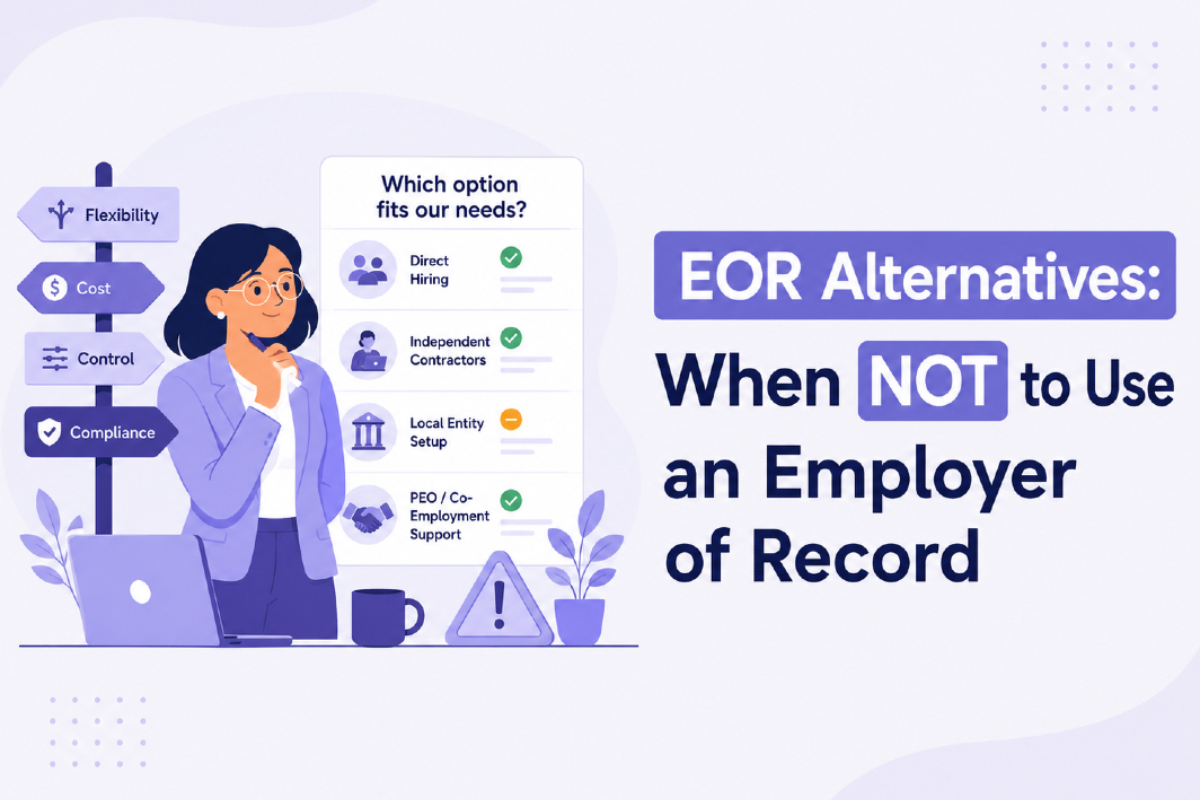
A company finds the perfect candidate in another country.
The hiring manager wants to move fast.
Finance wants predictable costs.
Legal wants to avoid unnecessary risk.
Someone suggests using an Employer of Record.
It sounds like the cleanest answer.
No local entity.
No complex payroll setup.
No immediate need to understand every detail of local employment law.
For many companies, an Employer of Record, or EOR, can be a practical way to hire employees in countries where the business does not have its own legal entity.
But here is the part that often gets missed.
An EOR is not always the right solution.
Sometimes it is too expensive. Sometimes it creates more structure than the relationship needs. Sometimes the worker is not an employee at all. Sometimes the company is already large enough in that country to justify setting up its own entity.
This is why EOR alternatives matter.
The right global hiring model depends on the worker relationship, the country, the duration of work, the level of control, the company’s long-term plans, and the compliance risks involved.
What Is an EOR?
An Employer of Record is a third-party organization that legally employs a worker on behalf of another company.
The client company usually manages the worker’s day-to-day responsibilities, projects, and performance expectations. The EOR handles local employment administration, which may include employment contracts, payroll, statutory benefits, tax withholding, social contributions, and employment compliance.
This model can be useful when a company wants to employ talent in a new country without immediately opening a local subsidiary.
But an EOR is still an employment model.
That distinction matters.
Employment relationships are regulated differently from independent contractor relationships. For example, the IRS explains that worker status depends on the facts of the relationship, including the degree of control and independence between the business and the worker, in its official guidance on independent contractor vs. employee classification.
The U.S. Department of Labor also updated its analysis of employee and independent contractor status under the Fair Labor Standards Act through a final rule effective March 11, 2024, which focuses on the economic reality of the working relationship. Businesses can review the official Department of Labor materials on worker misclassification under the FLSA.
In the European Union, worker status is also receiving more attention, especially in platform work. The EU’s Directive 2024/2831 on improving working conditions in platform work aims to support the correct determination of employment status for people performing platform work.
The point is simple: choosing between an EOR and EOR alternatives is not only an operational decision. It is also a compliance decision.
When an EOR Makes Sense
Before looking at when not to use an EOR, it helps to understand when it does make sense.
An EOR may be suitable when a company wants to:
Hire one or a few employees in a country where it has no entity.
Test a market before committing to local incorporation.
Employ someone who needs full employee status.
Move quickly while staying aligned with local payroll and employment requirements.
Support distributed teams without building a complete local HR function.
For example, a software company in the United Kingdom may want to hire a senior product manager in Spain. It has no Spanish subsidiary and no immediate plan to open one. The role is permanent, full time, and integrated into the company’s operations.
In that case, an EOR may be a practical solution.
But change one or two facts, and the answer may change.
What if the person is a consultant working with several clients?
What if the company plans to hire 50 people in Spain?
What if the work is project-based and will end in three months?
What if local law requires a licensed staffing arrangement instead?
That is when EOR alternatives become important.
When NOT to Use an EOR
1. Do Not Use an EOR When the Worker Is Truly an Independent Contractor
Some workers are not employees.
They run their own business. They set their own schedule. They use their own tools. They negotiate project fees. They work with multiple clients.
In that case, an EOR may be unnecessary.
Using an EOR for a genuine contractor can increase cost and reduce flexibility. It can also create confusion, because the worker is moved into an employment structure even though the commercial relationship may be better handled through a contractor agreement and compliant contractor management process.
A better option may be contractor management, supported by classification checks, contracts, tax documentation, invoicing, and payment workflows.
The key word is “genuine.”
A contractor should not be treated like an employee in disguise. If the company controls how, when, and where the person works, provides continuous supervision, requires exclusivity, and integrates the person into the organization like staff, contractor classification may become risky.
2. Do Not Use an EOR When You Plan to Build a Large Local Team
An EOR is often useful for early-stage market entry.
It is less ideal as a permanent structure for a large workforce.
If a company plans to hire dozens of employees in one country, opening a local entity may become more efficient. A local subsidiary gives the company more direct control over employment policies, benefits, payroll vendors, tax planning, intellectual property arrangements, and long-term workforce strategy.
The trade-off is setup time and administrative responsibility.
A local entity usually requires legal incorporation, tax registration, bank accounts, payroll setup, accounting support, and ongoing filings. That can be slow and expensive at first.
But at scale, it may be more sustainable than paying EOR fees for every employee indefinitely.
A simple rule of thumb: if the country is strategic, the team is growing, and the company expects a long-term presence, entity setup deserves serious consideration.
3. Do Not Use an EOR for Short, Low-Risk Project Work
Not every international work relationship needs an employment structure.
A designer hired for a six-week brand refresh.
A translator engaged for a one-time localization project.
A cybersecurity expert brought in for a short audit.
These arrangements may be better suited to project-based contracting, assuming the person is properly classified and the engagement is structured correctly.
An EOR can be too heavy for work that is short-term, deliverable-based, and independent.
In these cases, companies should focus on:
A clear scope of work.
Defined deliverables.
Payment terms.
Confidentiality.
Intellectual property assignment.
Data protection obligations.
Contractor classification review.
This is not about avoiding compliance. It is about choosing a model that fits the work.
4. Do Not Use an EOR When Local Law Requires a Different Model
Employment rules vary by country.
In some markets, certain types of labor leasing, temporary staffing, or third-party employment arrangements may be restricted, licensed, or subject to special rules. An EOR may not be suitable for every role, every industry, or every jurisdiction.
For example, regulated industries may require direct employment, local licensing, background checks, or sector-specific registrations. Some jurisdictions also place limits on how workers can be assigned to client companies.
This is why global hiring decisions should not be made from a generic checklist.
The same model that works well in one country may create issues in another.
5. Do Not Use an EOR When You Need Full Operational Control
An EOR creates a three-party structure.
The worker performs services for the client company, but the EOR is the legal employer.
For many roles, this works well. For some roles, it may be awkward.
Senior executives, regulated representatives, country managers, finance signatories, and roles requiring legal authority may need to be employed directly by a local entity. The same may apply when the person needs to sign contracts, represent the company before authorities, manage regulated activities, or hold statutory responsibilities.
In those situations, an EOR may not provide the control or legal standing required.
A local entity, branch, subsidiary, or direct employment model may be more appropriate.
EOR Alternatives: Which Option Fits Best?
There is no single best alternative.
There are several.
The right choice depends on the business goal.
Alternative 1: Independent Contractor Engagement
Best for: project-based specialists, consultants, freelancers, and self-employed professionals.
Independent contracting can be efficient when the worker is genuinely independent. It supports flexibility, fast onboarding, and outcome-based work.
The risk is misclassification.
A contract alone does not decide worker status. Authorities often look at the actual working relationship. That includes control, economic dependence, integration into the business, and whether the worker operates as an independent enterprise.
Use this model when the work is clearly independent, the contractor has business autonomy, and the company does not manage the person like an employee.
Alternative 2: Contractor Management Platform
Best for: companies working with multiple freelancers or consultants across countries.
A contractor management platform can help standardize onboarding, contracts, documentation, invoices, payments, and compliance workflows.
This is useful when a business does not need an EOR but still needs more structure than email, spreadsheets, and manual bank transfers.
For example, TFY supports global workforce management use cases where companies need to manage freelancers, contractors, remote workers, documents, payments, and compliance workflows in one place. The value is not only payment automation. It is visibility.
Who has signed the agreement?
Which contractor submitted tax information?
Which country creates classification risk?
Which invoices are approved?
Which payments are pending?
These questions become harder as the workforce grows.
Alternative 3: Local Entity Setup
Best for: long-term expansion, larger teams, strategic markets, and direct control.
Opening a local entity may be the strongest alternative to an EOR when the company is committed to a market.
It gives the company direct employment capability and can support local benefits, HR policies, sales operations, tax planning, customer contracts, and brand presence.
The downside is complexity.
Companies need legal, payroll, accounting, tax, HR, and administrative support. They also need internal capacity to manage compliance over time.
This model is usually not ideal for one experimental hire. It becomes more attractive when the market is strategic and the headcount justifies the investment.
Alternative 4: Professional Employer Organization, or PEO
Best for: companies that already have a local entity but want HR and payroll support.
A PEO is often confused with an EOR.
The difference is important.
A PEO typically supports a company that already has its own legal entity in the country. The company remains the employer, while the PEO helps with HR administration, payroll, benefits, and compliance support.
An EOR becomes the legal employer.
So, if your company already has an entity, a PEO may be more suitable than an EOR.
Alternative 5: Staffing Agency or Temporary Labor Provider
Best for: temporary workers, seasonal roles, shift-based work, and regulated staffing needs.
Staffing agencies can be useful when a company needs temporary labor rather than direct employment or long-term global hiring.
This model is common in sectors such as logistics, customer support, hospitality, manufacturing, healthcare support, and administrative services.
However, staffing is not the same as an EOR. Agencies may be subject to licensing, sector rules, collective bargaining arrangements, and limits on assignment duration.
The benefit is speed and workforce flexibility.
The limitation is that the company may have less control over worker selection, employment terms, and long-term retention.
Alternative 6: Payroll-Only Provider
Best for: companies with an entity that need payroll processing, not legal employment.
Payroll-only services help calculate wages, withhold taxes, process payslips, manage filings, and support statutory payments.
This is not a substitute for an EOR if the company has no local entity.
It is an alternative when the company already employs workers directly and simply needs local payroll infrastructure.
EOR vs EOR Alternatives: A Simple Comparison
| Hiring need |
Better fit |
|
One employee in a new country |
EOR |
|
Genuine freelancer or consultant |
Contractor agreement |
|
Many contractors in multiple countries |
Contractor management platform |
|
Large long-term local team |
Local entity |
|
Existing local entity but limited HR capacity |
PEO |
|
Temporary or shift-based workers |
Staffing agency |
|
Direct employees with payroll support only |
Payroll provider |
The most common mistake is choosing the model based on speed alone.
Speed matters.
But classification, control, cost, and long-term strategy matter too.
How to Choose the Right EOR Alternative
Start with five questions.
1. Is the person an employee or an independent contractor?
Look at the facts, not only the contract.
Who controls the work?
Is the person economically dependent on the company?
Can they work for others?
Do they use their own tools?
Are they paid for outcomes or time?
Is the role permanent and integrated into the business?
If the relationship looks like employment, an EOR or direct employment may be safer than contractor engagement.
2. How long will the relationship last?
A three-month project may not justify an EOR.
A permanent full-time role may.
Duration is not the only factor, but it is a useful signal.
3. How many people will you hire in that country?
One hire may point toward an EOR.
Fifty hires may point toward an entity.
Some companies start with an EOR, then transition to their own entity once the market proves strategic.
4. How much control do you need?
The more control the company needs, the more likely the relationship looks like employment.
High control can also make contractor classification riskier.
5. What are the local rules?
Never assume global consistency.
Worker classification, labor leasing, benefits, termination, tax registration, and payroll rules vary widely. The OECD’s wider employment research, including its Employment Outlook publications, also reflects how labor markets continue to evolve across countries, sectors, and worker groups.
For businesses hiring internationally, this means one structure rarely fits every country.
Why EOR Alternatives Are Becoming More Important
Global hiring is no longer limited to multinational corporations.
Small companies hire across borders. Startups work with remote specialists. Enterprises rely on freelancers, agencies, consultants, and distributed teams.
This creates a more complex workforce.
Not everyone should be hired the same way.
A modern workforce strategy may include:
- Employees hired through local entities.
- Employees hired through an EOR.
- Independent contractors.
- Freelancers.
- Agency workers.
- Advisors.
- Vendors.
- Remote specialists paid across borders.
The challenge is not choosing one model forever.
The challenge is matching each worker relationship to the right legal, operational, and payment structure.
That is where broader workforce management platforms can help. TFY is relevant where companies need to coordinate different worker types, manage documentation, support international payments, and reduce manual administration across global teams.
The point is not that every worker needs an EOR.
The point is that every worker needs the right structure.
Final Thoughts
An Employer of Record can be a powerful tool.
But it is not a universal solution.
Do not use an EOR simply because international hiring feels complicated. Use it when the worker should be an employee, the company lacks a local entity, and the country or role fits the model.
Consider EOR alternatives when the worker is a genuine contractor, the project is short-term, the company already has an entity, the local team is large enough to justify incorporation, or the role requires direct legal control.
The best global hiring strategy is flexible.
Sometimes that means an EOR.
Sometimes it means contractor management.
Sometimes it means a local entity.
Sometimes it means payroll support, staffing, or a PEO.
The smarter question is not “Should we use an EOR?”
It is “What does this specific work relationship require?”
That question leads to better compliance, better cost control, and a better experience for the people doing the work.