
A contractor joins for a specific project.
At first, the arrangement is simple.
They build the dashboard. They redesign the onboarding flow. They help close a compliance gap before a deadline.
Then three months become six. Six becomes twelve.
They are now in team meetings every week. They use your internal systems. Managers rely on them for decisions. New hires ask them questions. Customers know their name.
Nothing dramatic happened.
The relationship just changed.
This is usually the moment when a business should pause and ask a serious question: is this person still truly an independent contractor, or is it time to convert the contractor to employee status?
That question is not only about paperwork. It affects compliance, cost, team continuity, intellectual property, benefits, payroll, management control, and long-term workforce planning.
It also affects the worker.
Some contractors want independence. Others are quietly waiting for stability, benefits, and a clearer role in the company.
The best contractor conversion decisions happen before the arrangement becomes messy.
What Does It Mean to Convert a Contractor to Employee?
To convert a contractor to employee status means moving a worker from an independent business relationship into an employment relationship.
In practical terms, the person usually moves from:
- invoices to payroll
- project fees or hourly contractor rates to salary or wages
- independent control over work methods to employee supervision
- limited benefits to employee benefits eligibility
- a service agreement to an employment contract or offer letter
- tax reporting as a contractor to employee tax withholding
In the United States, for example, the IRS explains that employers generally must withhold income taxes and pay Social Security, Medicare, and unemployment taxes for employees, while independent contractors are generally responsible for their own self-employment taxes. The IRS also says classification depends on the degree of control and independence, including behavioral control, financial control, and the type of relationship.
Other countries use different tests, but the logic is similar.
The label in the contract matters less than the reality of the work.
If the person functions like an employee, regulators may treat them like one.
The Short Answer: When Should You Convert a Contractor to Employee?
You should consider converting a contractor to employee when the work is ongoing, central to the business, closely managed by your team, difficult to separate from employee work, or strategically important enough that you need long-term commitment.
That does not mean every long-term contractor must become an employee.
Some contractors run genuine independent businesses. They serve multiple clients, set their own methods, price their work independently, carry business risk, and deliver defined outcomes rather than simply filling a role.
But when a contractor starts to look like a permanent team member, a contractor-to-FTE conversion becomes more than an HR preference.
It becomes a risk and workforce planning issue.
Signs It Is Time to Convert Contractor to Employee
1. The Work Is No Longer Project-Based
Contractors are often best for defined work.
A campaign. A migration. A design sprint. A market research report. A three-month engineering backlog.
The relationship is easier to justify when there is a clear beginning, deliverable, and endpoint.
The risk increases when the contractor is doing ongoing operational work.
For example:
- handling the same finance tasks every month
- managing customer accounts continuously
- joining daily team operations
- supporting a product as part of the core engineering team
- replacing a role that would normally be staffed by an employee
If the work has no realistic end date, the business should review whether employment is the better structure.
The question is simple: are you buying an outcome, or are you filling a role?
If you are filling a role, it may be time to hire full-time.
2. You Control How, When, and Where the Work Happens
Control is one of the clearest warning signs.
A genuine contractor usually has meaningful independence over how work is performed. They may agree to deadlines and quality standards, but they are not typically managed like employees.
Conversion should be considered when the company starts dictating:
- working hours
- daily schedule
- required attendance at internal meetings
- specific tools and processes
- detailed instructions on how to perform the work
- approval steps similar to employee supervision
- exclusivity or near-exclusivity
The U.S. Department of Labor looks at the “economic realities” of the relationship under the Fair Labor Standards Act. Its Fact Sheet 13 explains that employees are covered by FLSA protections, while independent contractors are in business for themselves.
As of July 22, 2026, U.S. employers should also note that the DOL has a 2026 proposed rulemaking that would rescind the 2024 independent contractor rule and replace it with a streamlined analysis. Because this area changes, employers should check current guidance and local law before making classification decisions.
The practical lesson remains steady: if the company controls the work like it controls employee work, contractor status becomes harder to defend.
3. The Contractor Is Working Like a Full-Time Team Member
Time alone does not decide classification.
A contractor can work many hours for a client and still be independent.
But hours are a useful signal.
If someone works 35 to 40 hours a week for one company, appears on team charts, joins internal planning cycles, and has little time for other clients, the relationship may be drifting toward employment.
In the U.S., full-time status also matters for benefits and health coverage planning. For Affordable Care Act employer shared responsibility rules, the IRS generally defines a full-time employee as someone employed on average at least 30 hours per week or 130 hours per month.
That ACA threshold does not automatically turn a contractor into an employee. Classification still depends on the relationship.
But it does show why hours matter operationally.
Once a contractor is working at near-employee capacity, the company should review classification, benefits implications, cost, and workforce design together.
4. The Work Is Core to the Business
A contractor brought in for occasional specialist advice is different from a contractor doing the company’s core work every day.
A cybersecurity consultant advising a retail company for six weeks may be clearly external.
A software developer building and maintaining the main SaaS product for two years may be much closer to the heart of the business.
A freelance recruiter helping with one executive search is not the same as a recruiter managing the company’s hiring pipeline every week.
When the contractor’s work becomes integral to the business, conversion becomes more likely to make sense.
It improves continuity. It strengthens accountability. It reduces knowledge loss. It can also reduce classification risk in jurisdictions where integration into the business is a factor.
This matters especially for roles that touch:
- product development
- customer relationships
- financial operations
- compliance
- people management
- proprietary systems
- long-term strategy
If losing the contractor would disrupt the business in the same way as losing a key employee, the relationship deserves a closer look.
5. You Need Loyalty, Availability, and Long-Term Commitment
Contractors are independent by design.
That independence is useful when you need flexibility.
It becomes a limitation when you need commitment.
A contractor may have other clients. They may decline work. They may raise rates. They may take on a bigger project elsewhere. That is not a problem, it is part of the model.
But some roles need more stability.
For example, you may want to convert a contractor to employee when you need them to:
- manage confidential internal information
- represent the company to customers
- lead other workers
- own a long-term roadmap
- be available during set business hours
- participate in performance reviews and career planning
- build institutional knowledge
At that point, employment may create a clearer psychological contract.
The worker knows where they stand.
The company knows what it can reasonably expect.
6. The Cost Difference Has Changed
Many companies assume contractors are cheaper.
Sometimes they are.
Sometimes they are not.
Contractor rates are often higher than employee hourly equivalents because contractors cover their own taxes, insurance, benefits, unpaid time, business expenses, and administrative burden.
That can be efficient for short projects.
It can become expensive for long-term needs.
A contractor conversion analysis should compare total cost, not just hourly rate.
Include:
- contractor fees
- expected employee salary
- payroll taxes
- benefits
- paid leave
- equipment
- software licenses
- management time
- recruitment costs if the contractor leaves
- compliance exposure if classification is questionable
- productivity gained from deeper integration
In some cases, contractor-to-FTE conversion increases visible payroll cost but reduces hidden operational cost.
In other cases, keeping an independent contractor is still better.
The point is to calculate rather than guess.
7. The Contractor Wants an Employee Role
Conversion is not only an employer decision.
The worker’s preference matters.
Some contractors choose independent work because they value autonomy, higher project rates, multiple clients, location flexibility, and the ability to shape their own business.
Others become contractors because that was the available entry point.
They may want:
- predictable income
- health benefits
- paid leave
- career progression
- a stronger voice in the team
- immigration or relocation support
- stability for family or financial planning
Before making an offer, talk openly.
A contractor who wants independence may not welcome an employee role. A contractor who wants stability may become more loyal and engaged after conversion.
The right answer depends on both business need and worker preference.
When Not to Convert a Contractor to Employee
Conversion is not always the right move.
You may decide not to convert when the work is genuinely temporary, the contractor serves multiple clients, the contractor controls their own methods, the work is outside your core operations, or the contractor operates through an established independent business.
A contractor may also be the better fit when you need:
- short-term expertise
- project-based delivery
- market testing before hiring
- seasonal capacity
- independent advisory input
- specialized skills that are not needed year-round
The key is consistency.
If you keep the person as a contractor, the working relationship should match that choice.
That means defined deliverables, clear scope, limited control over how work is performed, appropriate invoicing, and documentation showing the independent nature of the relationship.
Contractor to FTE: Business Benefits of Conversion
A good contractor-to-FTE conversion can benefit both sides.
For the company, it can provide:
- stronger retention
- better knowledge continuity
- clearer accountability
- smoother collaboration
- easier workforce planning
- better IP and confidentiality controls
- lower long-term replacement risk
For the worker, it can provide:
- income stability
- employee benefits
- paid leave
- clearer expectations
- career development
- stronger inclusion in team decisions
For managers, it removes the awkward middle ground.
They no longer have to rely heavily on someone they cannot fully manage as an employee.
That alone can make conversion worthwhile.
Contractor Conversion Checklist
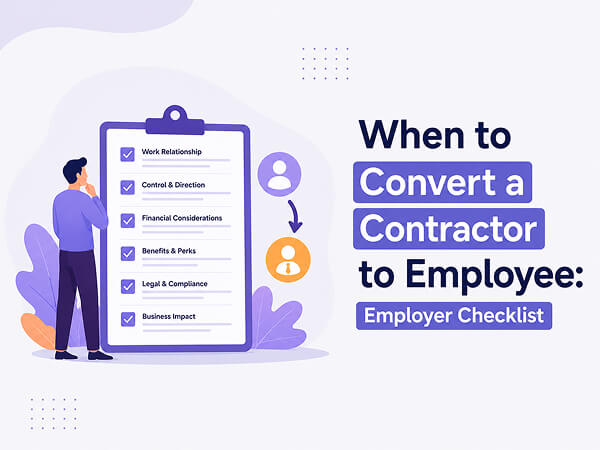
Use this contractor conversion checklist before making a final decision.
1. Review the Current Working Relationship
Ask:
- How long has the contractor worked with the company?
- How many hours do they work each week?
- Do they serve other clients?
- Who controls the way the work is performed?
- Are they using company equipment and systems?
- Are they performing work similar to employees?
- Is the work ongoing or project-based?
- Is the work central to the business?
Document the reality, not just the contract language.
2. Assess Classification Risk
Review the relevant legal tests in each country or state where the worker performs services.
For U.S. tax purposes, the IRS directs businesses to consider the full relationship, including behavioral control, financial control, and relationship factors. If uncertainty remains, businesses or workers can request an IRS determination using Form SS-8.
For UK relationships, GOV.UK explains that employment status affects workplace rights and employer responsibilities, and that tax status and employment rights status may need separate review under UK employment status guidance. UK companies should also weigh IR35 status alongside general employment status.
Global companies should avoid assuming that one country’s classification logic applies everywhere.
It rarely does.
3. Build the Business Case
Estimate the total cost of conversion.
Include salary, payroll taxes, statutory benefits, private benefits, paid leave, equipment, onboarding, HR administration, and any local employer obligations.
Then compare those costs with the current contractor arrangement.
Also consider risk-adjusted cost.
A low monthly contractor fee may not be low cost if the relationship creates misclassification exposure.
4. Define the Employee Role
Do not simply move the contractor onto payroll with the same loose scope.
Create a proper role.
Define:
- job title
- manager
- responsibilities
- performance expectations
- working hours
- location or remote-work terms
- compensation
- benefits eligibility
- probation period, where lawful
- notice period
- intellectual property and confidentiality terms
This step is especially important when converting long-term contractors who have operated with high autonomy.
Employment should bring clarity, not confusion.
5. Check Compensation Fairness
Contractor rates do not translate directly into salary.
A contractor charging $80 per hour does not necessarily expect an employee salary based on $80 multiplied by 2,080 annual hours.
That rate may include self-employment taxes, unpaid leave, insurance, business development time, software, equipment, and risk.
When converting, benchmark against employee roles with similar scope, seniority, location, and market demand.
Be transparent about the total package.
Salary is one part. Benefits, paid leave, bonuses, equity, development, and stability may also matter.
6. Handle Payroll, Tax, and Benefits Correctly
Once converted, the worker should be set up through the appropriate payroll process.
This may include:
- employee tax forms
- payroll withholding
- social security or national insurance registration
- unemployment insurance
- workers’ compensation
- statutory leave
- health coverage or local benefits
- pension or retirement contributions
- employee handbook acknowledgement
- data privacy and HR records
For international hires, the company also needs to determine whether it has a local legal entity, uses an Employer of Record, or hires through another compliant structure.
This is where workforce platforms can be useful.
An independent analyst would not treat any platform as a substitute for legal judgment. But tools such as TFY can help companies manage contractor records, worker classification workflows, global onboarding, payroll coordination, and employer-of-record pathways when conversion crosses borders.
7. Close or Amend the Contractor Agreement
Do not leave the old contractor agreement hanging.
Confirm the final invoice period, payment terms, IP handover, confidentiality obligations, access changes, and the effective employment start date.
The transition should create a clean record.
One relationship ends.
Another begins.
8. Communicate the Change Internally
Tell the right teams.
HR, payroll, finance, IT, legal, procurement, and the hiring manager may all need to update systems.
The worker may need:
- employee email or access changes
- equipment
- benefits enrollment
- onboarding tasks
- manager check-ins
- team announcement
- performance goals
A contractor conversion can fail quietly when everyone assumes someone else has handled the details.
A Simple Decision Framework
If you are unsure whether to convert, use this practical test.
Keep the person as a contractor if the work is limited, outcome-based, independently performed, and clearly temporary.
Convert the contractor to employee if the work is ongoing, supervised, central to the business, and important enough to require long-term commitment.
Hire a new full-time employee instead if the contractor is not the right long-term fit, the role has changed significantly, or the market can provide a better match.
Here is the simplest version:
|
Situation |
Better Fit |
|
Short project with defined deliverables |
Contractor |
|
Ongoing role with fixed responsibilities |
Employee |
|
Specialist advice needed occasionally |
Contractor |
|
Core function managed every week |
Employee |
|
Worker has multiple clients and controls methods |
Contractor |
|
Worker is embedded in your team and managed closely |
Employee |
|
Need long-term retention and availability |
Employee |
|
Need temporary capacity |
Contractor |
Common Mistakes to Avoid
The first mistake is waiting too long.
By the time a contractor has been operating like an employee for a year, the company may already have created avoidable risk.
The second mistake is relying only on the contract.
A contract that says “independent contractor” helps show intent, but regulators usually look at the real working relationship.
The third mistake is converting only for convenience.
Employment should match a genuine business need and a lawful employment structure.
The fourth mistake is ignoring geography.
A contractor in India, the United States, the United Kingdom, Germany, or the Philippines may trigger very different obligations. Local tax, labor, benefits, termination, and social security rules can all matter.
The fifth mistake is treating conversion as a payroll task only.
It is also a management transition.
A person who was once an independent service provider is now part of the organization. That shift deserves care.
Final Thoughts
The decision to convert a contractor to employee status usually starts with a small discomfort.
The arrangement still works, but it no longer feels clean.
The person is too embedded to be temporary. Too important to be peripheral. Too managed to be fully independent.
That is the signal.
A contractor-to-FTE move is not just about reducing compliance risk. Done well, it can improve retention, strengthen teams, protect institutional knowledge, and give the worker a clearer future.
The best employers do not wait until classification becomes a problem.
They review the relationship early, ask practical questions, document the decision, and choose the structure that matches the reality of the work.