
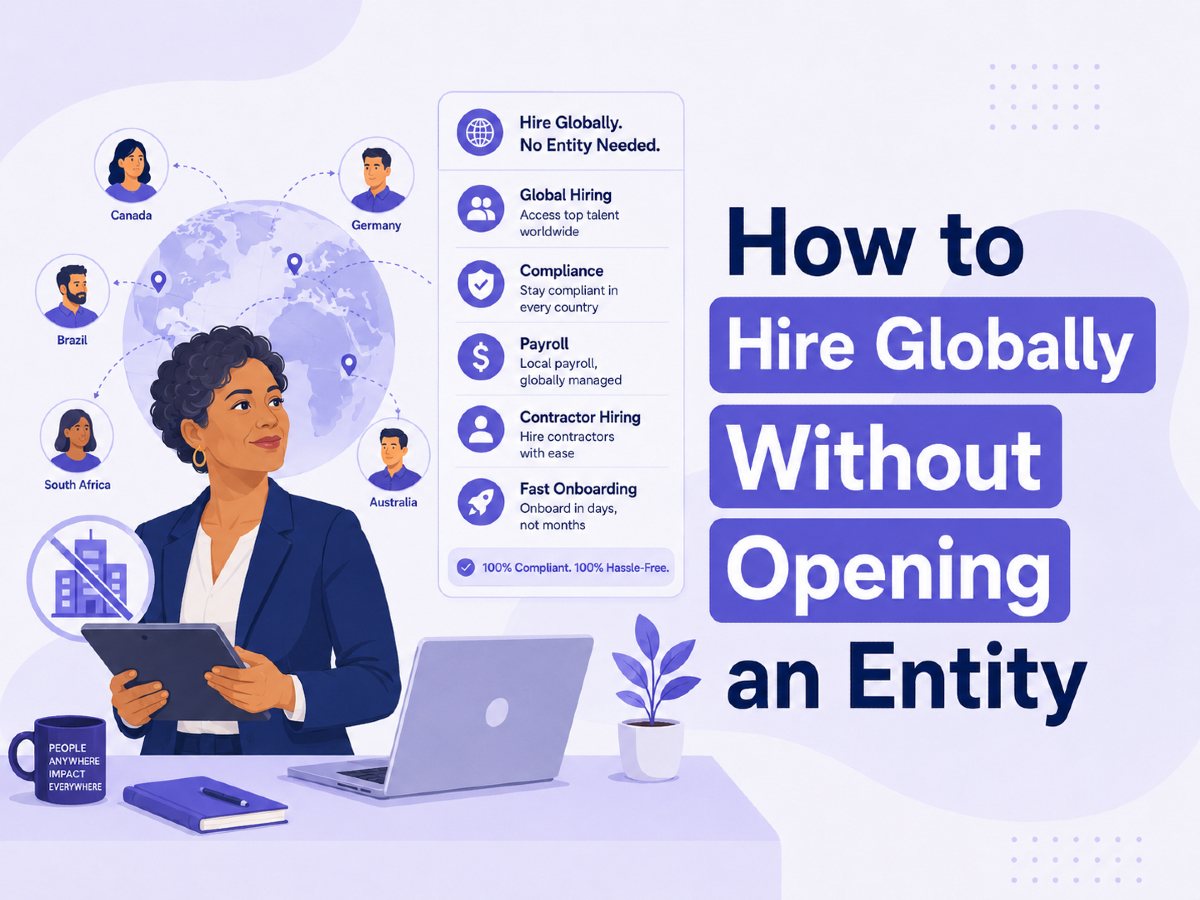
Imagine finding the right candidate in another country.
They have the skills.
They understand the market.
They can start soon.
Then the legal question appears.
Can you hire them if your company does not have a local entity?
For many businesses, the answer is yes, but only if the hiring model is chosen carefully.
Global hiring no longer requires every company to open a subsidiary before working with international talent. Remote work, contractor platforms, Employer of Record services, global payroll providers, and workforce management tools have made cross-border hiring faster and more practical.
But there is a difference between hiring globally and hiring casually.
The first can help a company expand.
The second can create tax, employment, payroll, and compliance risk.
What Does It Mean to Hire Without Opening an Entity?
Hiring without opening an entity means engaging a worker in another country without setting up your own local company, branch, or subsidiary there.
Instead of registering a legal entity, companies usually choose one of three routes:
- Hire the person as an independent contractor
- Hire the person through an Employer of Record, often called an EOR
- Use a staffing, agency, or workforce management partner
Each option serves a different purpose.
A contractor model may work when the person is genuinely independent and delivers a defined service. An EOR model may be better when the person works like an employee, with ongoing responsibilities, manager oversight, regular hours, and local employment protections. A staffing or workforce management partner may help when the company needs temporary, flexible, or project-based teams.
The goal is not to avoid responsibility.
The goal is to choose the right structure before the hire begins.
Why Companies Avoid Opening an Entity Too Early
Opening a local entity can be valuable when a company is committed to a market.
It can also be expensive, slow, and unnecessary for early-stage hiring.
Entity setup may involve company registration, tax numbers, payroll registrations, local bank accounts, accounting support, legal documents, benefit providers, employment policies, and ongoing reporting.
For one hire, this may be too much.
For a market test, it may be too slow.
For a short-term role, it may not make sense.
This is why many companies now use flexible global hiring models first, then open an entity later if the country becomes strategic.
Option 1: Hire an Independent Contractor
Independent contractors are self-employed professionals or businesses that provide services to clients.
This model can work well for consultants, developers, designers, translators, analysts, marketers, and other specialists who control how they work.
The key word is independent.
A contractor should usually decide how the work is delivered, use their own tools where appropriate, work for multiple clients if they choose, and take responsibility for taxes and business expenses.
Problems arise when a contractor starts to look like an employee.
For example, risk increases if the company controls their schedule, requires exclusivity, manages daily tasks, provides all tools, and integrates the person into internal reporting lines.
Worker classification rules vary by country, but the principle is common. The IRS guidance on independent contractor versus employee classification explains that businesses must consider evidence of control and independence when deciding worker status. The International Labour Organization’s Employment Relationship Recommendation also warns that disguised employment relationships can deprive workers of legal protections.
In simple terms:
Calling someone a contractor does not automatically make them one.
Option 2: Use an Employer of Record
An Employer of Record is a third-party organization that legally employs a worker in their country on behalf of a client company.
The EOR typically handles the local employment contract, payroll, employer taxes, social contributions, statutory benefits, leave rules, and certain HR compliance requirements.
The client company manages the worker’s day-to-day role, goals, projects, and performance.
This model is often useful when the company wants to hire someone as a full-time employee but does not have a local entity.
For example, a UK company may want to hire a product manager in Spain. The person will join team meetings, work regular hours, use company systems, and report to a manager. A contractor structure may be risky because the relationship looks like employment. An EOR can provide a more suitable structure.
An EOR is not a magic shield from all compliance obligations, but it can provide a practical route for lawful employment in countries where the company is not yet established.
Option 3: Use a Workforce Management Partner
Some companies need to manage a mixed workforce across several countries.
This may include freelancers, contractors, consultants, agency workers, remote employees, and temporary project teams.
A workforce management partner can help centralize contractor onboarding, contracts, documentation, payments, compliance workflows, and worker records.
This matters because global hiring is not only about signing a contract.
Companies need to know who is working for them, where they are located, which model applies, which documents are missing, how payments are processed, and where compliance risks may exist.
Platforms such as TFY can support international contractor management, workforce compliance workflows, onboarding, and payments, especially for businesses managing distributed teams across multiple markets.
Contractor vs EOR: Which Model Fits Best?
A simple comparison helps.
|
Question |
Contractor May Fit |
EOR May Fit |
|
Is the work project-based? |
Yes | Sometimes |
|
Is the person independent? |
Yes | Not required |
|
Does the company control daily work? |
Risky | Often acceptable |
|
Is the role ongoing? |
Higher risk | Often better |
|
Are benefits and statutory leave expected? |
Usually no | Yes |
|
Is the person part of the internal team? |
Risky | Often better |
Use contractors for independent services.
Use EOR for employment-style relationships.
Use entity setup when the market becomes long-term and strategic.
For a deeper breakdown, see our guide on contractor management vs EOR and the differences between AOR, EOR, and direct contracting.
Key Compliance Risks to Watch
Worker Misclassification
Contractor Misclassification happens when a person is treated as a contractor but legally functions as an employee.
This can lead to back taxes, unpaid benefits, social security liabilities, penalties, disputes, and reputational damage.
Permanent Establishment Risk
Permanent establishment risk arises when a company’s activity in another country creates a taxable local presence.
A remote worker does not automatically create this risk in every case. However, risk may increase if the person negotiates contracts, signs deals, manages local operations, or represents the company commercially. The OECD explains that its Model Tax Convention is widely used as a basis for interpreting cross-border tax treaty issues, including permanent establishment concepts.
Local Employment Rights
Employment law often follows the worker’s location.
Companies may need to consider minimum wage, paid leave, sick pay, working time, notice periods, termination rules, social contributions, and statutory benefits.
In the EU, the European Commission’s guidance on posted workers shows how cross-border work can still trigger host-country employment protections in specific situations.
Payroll and Payments
Global workers expect accurate, predictable payments.
Companies should review payment currency, payroll rules, tax withholding, invoice requirements, FX costs, payment timing, and audit trails. Learning how to pay global contractors in their local currency can help avoid costly FX fees and payment delays.
A slow or unclear payment process can damage trust quickly.
A Practical Hiring Process
1. Define the Role
Before choosing a model, clarify whether the role is temporary or long term, independent or managed, project-based or ongoing, local-market facing or internal, part-time or full-time.
2. Assess the Country
Review local rules on employment, contractor classification, payroll taxes, benefits, termination, work authorization, data protection, and payment requirements.
Do not assume one country’s rules apply elsewhere.
3. Choose the Right Model
Use a contractor agreement for genuine independent work.
Use an EOR for employment-style roles.
Use a staffing or workforce partner for flexible teams.
Open an entity when the country becomes strategically important.
4. Prepare Localized Documentation
Avoid generic templates.
An independent contractor agreement should reflect the worker's status, country, role, payment terms, confidentiality obligations, intellectual property terms, tax responsibilities, and termination rules.
5. Keep Records
Maintain contracts, invoices, tax forms, onboarding documents, classification assessments, payment records, and compliance approvals.
Good documentation protects both the business and the worker.
When Should You Open an Entity?
Opening an entity may become the right choice when you have growing headcount in one country, local revenue, customer contracts, regulated activity, a physical office, visa sponsorship needs, or a long-term market commitment.
Until then, an EOR, contractor model, or contractor management software may provide a more flexible route.
The best approach is often gradual:
- Hire carefully.
- Validate the market.
- Build local knowledge.
- Open an entity when the business case is clear.
Final Thoughts
Companies can hire globally without opening a local entity, but the structure matters.
Independent contractors are useful for project-based, self-directed work. EOR services are better for employment-style roles. Workforce management partners help companies coordinate international teams, documentation, payments, and compliance workflows.
The opportunity is significant.
Businesses can access global talent faster, test new markets, reduce setup costs, and build distributed teams with less administrative friction.
But global hiring should never be treated as a shortcut around local rules.
The companies that succeed will be the ones that combine speed with structure, flexibility with compliance, and international hiring ambition with fair worker treatment.