
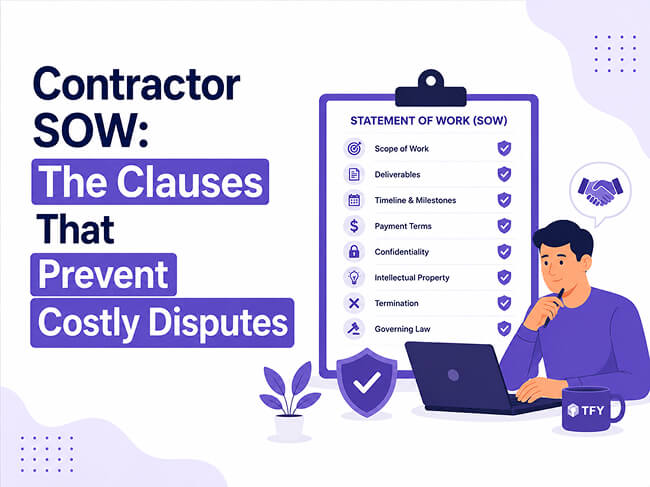
Quick Answer: A contractor SOW should define scope around inspectable results, turn deliverables into dated milestones, set observable acceptance criteria and review deadlines, and tie payment terms to explicit triggers such as delivery, written acceptance, or a valid invoice. It should also document exclusions, client dependencies, authorized reviewers, dispute handling, and written change control. The SOW governs a specific project under the contractor agreement, but it does not determine worker classification.
The project looked simple when everyone joined the kickoff call.
A freelance designer would refresh a product website. The client expected a new homepage, several landing pages, and a handoff within six weeks. The contractor expected timely feedback, two rounds of revisions, and payment when each phase was complete.
Then the gaps appeared.
Was mobile design included? Did a revision mean changing a color, or rebuilding a page? Who could approve the work? What happened if feedback arrived ten days late? Could the contractor invoice after delivery, or only after written acceptance?
Neither side was acting unreasonably.
They were working from different versions of the same project.
A well-written contractor SOW prevents that divergence. It turns a broad commercial promise into an operating agreement: what will be delivered, when it will be reviewed, how completion will be judged, and what event makes payment due.
What Is a Contractor SOW?
A contractor SOW describes the work for one engagement or phase of work. It is narrower than the overall contractor agreement and more authoritative than an informal project plan.
The distinction matters because the documents answer different questions:
|
Document |
Primary purpose | Typical contents |
| Sets the legal framework for the relationship | Status, confidentiality, IP, warranties, liability, termination, governing law, dispute process | |
|
Contractor SOW |
Defines a particular project or workstream | Scope, deliverables, milestones, acceptance, fees, invoicing, dependencies, change control |
|
Project plan |
Coordinates day-to-day execution |
Tasks, meetings, internal owners, working dates, risks, status notes |
If the documents conflict, the agreement should state which one controls. That order of precedence prevents a project brief, purchase order, or email from accidentally rewriting negotiated legal terms.
1. Define Scope Around Results
The scope section should tell a commercially informed reader what success looks like without forcing the contractor to work like an employee. That generally means describing required outcomes, interfaces, constraints, and quality standards, while avoiding unnecessary control over the contractor's daily method.
This results-based approach is also reflected in the U.S. Federal Acquisition Regulation, which advises agencies to describe service work in terms of required results and measurable performance standards. The guidance is written for public procurement, but the drafting principle is useful in commercial contractor SOWs as well. See the official performance work statement guidance.
Start With the Business Objective
The objective explains why the work exists. Keep it short and testable enough to guide decisions when the detailed scope does not address a minor issue.
List Deliverables as Nouns
A deliverable is something the client can inspect. Name the artifact, quantity, format, and required components.
“Support marketing” is an activity.
“A 12-week content calendar in the client’s approved spreadsheet format, including channel, audience, topic, owner, and publication date” is a deliverable.
State What Is Out of Scope
Exclusions are not defensive fine print. They protect the budget and help the client recognize when a new request needs a change order.
Out-of-scope example: Copywriting, stock image licensing, custom illustration, website development, analytics configuration, accessibility remediation after client code changes, and support after the 14-day handoff period are excluded unless added through the change process.
Record Assumptions and Dependencies
Many delays begin outside the contractor’s control. The SOW should name the client inputs required, their due dates, and the effect of delay. Common dependencies include access credentials, source files, brand approvals, data, subject matter experts, security reviews, and consolidated feedback.
2. Turn the Scope Into Milestones
Milestones make progress visible. They are especially useful when work is complex, lasts several weeks, or involves significant client input.
A strong milestone combines a deliverable, a target date, an owner, a review event, and a commercial consequence.
|
ID |
Deliverable | Target | Acceptance evidence | Fee |
|
M1 |
Discovery summary and site map |
Week 1 |
Written approval of site map and requirements log |
20% |
|
M2 |
Homepage and design system |
Week 3 | Approved desktop and mobile layouts; named components included | 30% |
|
M3 |
Remaining page designs |
Week 5 | All listed templates delivered; two revision rounds resolved | 30% |
|
M4 |
Final files and handoff |
Week 6 | Editable source files, export package, and handoff session completed | 20% |
Use calendar dates when both parties can commit to them. Use relative dates, such as “five business days after receipt of approved source data,” when a milestone depends on an earlier event.
Define "business day" and the relevant time zone for cross-border teams.
3. Write Acceptance Criteria Before Work Begins
Acceptance is the bridge between delivery and payment. Name the authorized reviewer, measurable criteria, submission method, review period, and the result of acceptance, rejection, or silence.
Make the Criteria Observable
Avoid standards such as “high quality,” “satisfactory,” or “industry standard” unless the SOW defines what they mean.
Use observable evidence instead: specified files are present, named tests pass, required fields are complete, agreed browser versions display correctly, or an output matches an approved reference.
The concept is simple: rejection should point to a stated requirement, not a new preference.
Formal public procurement rules similarly connect inspection and acceptance to contract requirements and permit correction or reperformance of nonconforming services. The FAR inspection and acceptance clause offers a useful example of that logic, although private contracts need their own jurisdiction-appropriate language.
Create a Closed Review Loop
Illustrative acceptance process: The client will review each submitted deliverable within five business days. The client will either accept it in writing or provide one consolidated written notice identifying each material failure to meet the applicable acceptance criteria. The contractor will correct confirmed nonconformities and resubmit the deliverable within an agreed reasonable period. Requests that change the approved scope will follow the change-control process.
4. Connect Payment Terms to Clear Triggers
A fee is not a complete payment term. The SOW should explain how the amount becomes payable and how money moves from approval to the contractor.
Choose the Pricing Model
Use a fixed or milestone fee when outputs are stable, time and materials when effort is uncertain, or a retainer for recurring capacity.
In every model, state rates, caps, included services, and approval rules.
Define the Payment Trigger
Common triggers include delivery, written acceptance, completion of a service period, or receipt of a valid invoice.
Choose deliberately.
If payment requires both acceptance and an invoice, specify the sequence and the event from which the payment period runs.
Specify the Operational Details
- Fee amount, rate, currency, and whether taxes are included or added where legally required.
- Invoice timing, required supporting documents, recipient, email address, or payment portal.
- Payment period, such as 15 or 30 calendar days after receipt of a valid undisputed invoice.
- Process for disputed amounts, with undisputed amounts paid on time.
Payment law varies by country. In the United Kingdom, for example, official guidance states that agreed dates must usually be within 60 days for business transactions, unless a longer period is fair to both businesses, and statutory rules may apply when no date is agreed.
Review the UK guidance on late commercial payments as an illustration of why global templates require local review rather than a single universal payment clause.
Practical safeguard: If only part of an invoice is disputed, require the client to explain the disputed amount promptly and pay the undisputed balance by the original due date. This keeps a narrow disagreement from freezing the entire project fee.
Add Change Control Before the First New Request
Projects change. A contractor SOW should make change manageable rather than pretending it will not happen.
A simple change process should require a written description of the requested change, its impact on fees and dates, any revised assumptions, and approval by named representatives before changed work begins.
Email approval may be sufficient if the agreement says so; larger changes may need a signed change order.
Illustrative change process: Neither party is required to perform a proposed change until both parties approve its effect on scope, fees, schedule, and dependencies in writing. While a change request is under review, the contractor will continue unaffected work where reasonably practicable.
A Contractor SOW Does Not Decide Worker Classification
Calling someone an independent contractor does not make the classification correct. Authorities generally look at the real relationship, and tests vary by jurisdiction.
For U.S. federal tax purposes, the IRS considers evidence of behavioral control, financial control, and the parties’ relationship. Its independent contractor classification guidance also makes clear that the full relationship matters, not one label in a document.
A results-focused SOW can support a genuine business-to-business engagement, but it is not a compliance shortcut.
Risk can increase when the working reality resembles employment, for example when the client tightly controls daily methods, hours, exclusivity, supervision, or a long-term role embedded in the organization.
Obtain local advice for the countries involved and align day-to-day management with the intended relationship.
What Changes in a Cross-Border Contractor SOW?
Cross-border work adds details that domestic templates often miss: correct legal entities, work location, currency, taxes, withholding, transfer fees, time zone, contract language, data security, IP ownership, governing law, and signature formalities.
Address these across the SOW and master agreement, then localize them for the countries involved.
Electronic signatures can simplify global execution, but the required signature level and formalities depend on the transaction and jurisdiction.
In the European Union, the eIDAS framework gives qualified electronic signatures the equivalent legal effect of handwritten signatures and establishes broader rules for electronic trust services. The European Commission’s eSignature overview is a useful starting point, followed by transaction-specific legal review where needed.
How to Draft a Contractor SOW in Eight Steps
- Confirm the contract structure. Identify the master agreement, the parties, the SOW number, the effective date, and the order of precedence.
- Write the business objective. State the result the engagement is meant to achieve in one short paragraph.
- Inventory deliverables. Give each output an identifier, format, quantity, owner, and required content.
- Draw the boundaries. Record exclusions, assumptions, dependencies, client inputs, and access requirements.
- Sequence milestones. Link dates to deliverables and account for review periods and external dependencies.
- Draft acceptance tests. Name the reviewer, criteria, submission channel, review window, rejection notice, and cure process.
- Map fees to triggers. Specify price, currency, invoice requirements, due date, expenses, disputes, and late-payment treatment.
- Run a consistency review. Check that every priced item has a deliverable or service period, every milestone has an acceptance path, and every accepted item has a payment outcome.
Managing Contractor SOWs at Scale
TFY operates in workforce management and contractor payments. Organizations assessing TFY or another platform should check whether it preserves signed versions, links milestones to invoices, supports local onboarding, controls access, and produces an audit trail while allowing different commercial models.
Frequently Asked Questions About Contractor SOWs
Is a contractor SOW a legally binding contract?
It can be. A signed SOW is often incorporated into a contractor services agreement and becomes part of the parties’ binding contract.
Enforceability depends on the wording, execution, governing law, authority of the signatories, and other facts. Label drafts clearly and obtain legal review for the applicable jurisdictions.
What should a contractor SOW include?
At minimum, identify the parties and master agreement, objective, scope, deliverables, exclusions, schedule, milestones, client responsibilities, acceptance criteria, fees, invoicing, payment terms, expenses, change control, term, and authorized contacts.
Add project-specific security, data, IP, travel, or compliance requirements where relevant.
What is the difference between an SOW and a contractor agreement?
The contractor agreement usually governs the overall legal relationship. The SOW describes a specific project, service period, or workstream under that agreement.
A company may use one master agreement with several sequential SOWs.
Should payment happen on delivery or acceptance?
Either model can work.
Payment on delivery favors speed and fits outputs that are easy to verify. Payment on acceptance gives the client a review right and fits complex deliverables, provided the criteria and review window are clear.
Some projects use an upfront amount, milestone payments on acceptance, and a final payment on handoff.
Final Thoughts
The scope draws the boundary. Milestones make progress visible. Acceptance criteria turn opinion into evidence. Payment terms tell both parties what happens after the work passes review. Change control keeps the agreement useful when the project moves.
The best test is simple: could a new project owner read the document halfway through the engagement and understand what remains, who must act next, and what money becomes due?
Editorial note: This article provides general business information and is not legal, tax, or worker-classification advice. Requirements vary by jurisdiction and engagement.