
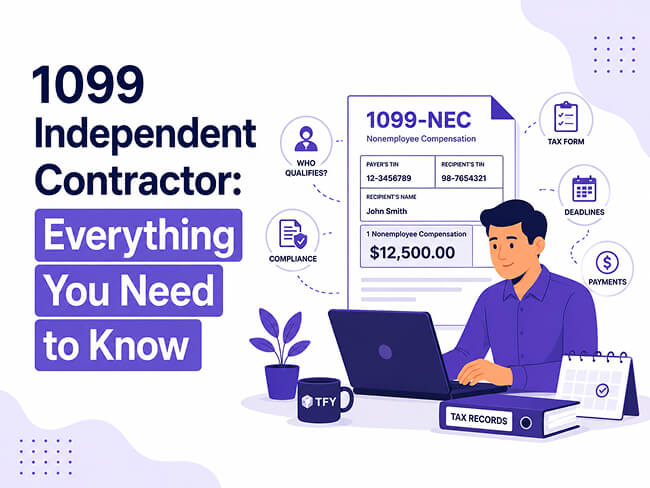
A founder needs help fast.
The company has a product launch in six weeks. The internal team is already stretched. A senior designer is available, but only as a freelancer. A developer can take on a fixed-scope project. A consultant can review the go-to-market plan.
Nobody is asking for a full-time job.
Nobody wants a long hiring process.
So the company says the familiar phrase:
“Let’s bring them on as a 1099 contractor.”
It sounds simple.
Pay the person. Collect an invoice. Send a tax form at the end of the year.
But the phrase “1099 independent contractor” carries more weight than many businesses realize. It is not just a payment label. It touches tax reporting, worker classification, payroll obligations, labor law, contracts, onboarding, and compliance.
Used correctly, contractor engagement gives businesses flexibility and gives skilled professionals more control over their work.
Used carelessly, it can create expensive problems.
What Is a 1099 Independent Contractor?
A 1099 independent contractor is a self-employed person or business that provides services to another business without being treated as an employee for U.S. tax purposes. You can read the IRS definition of an independent contractor.
In plain language, a 1099 contractor is usually someone who:
- Provides services independently
- Controls how the work is performed
- May serve multiple clients
- Uses their own tools, systems, or methods
- Invoices for completed work or agreed milestones
- Handles their own taxes
- Does not receive employee benefits from the client
That is the basic 1099 contractor meaning.
The contractor may be an individual freelancer, a sole proprietor, a single-member LLC, or another business entity.
The label may vary, but the classification question remains the same: Is the worker genuinely operating independently?
What’s a 1099 Contractor, Really?
“What’s a 1099 contractor?” is often asked as if it is mainly a tax question.
It is partly a tax question.
But it is also a control question.
A 1099 contractor is not simply someone a company decides not to put on payroll. The IRS says worker classification depends on the facts and circumstances of the relationship, including behavioral control, financial control, and the relationship between the parties. Its worker classification guidance breaks those categories down clearly.
Think of the difference this way.
An employee is usually integrated into the company’s operations. The company decides when, where, and how the work is done. The employee may receive training, supervision, equipment, benefits, and ongoing work.
A contractor is hired to deliver a result. The business can define the outcome, deadline, quality requirements, and commercial terms. But the contractor typically decides how to perform the work.
That distinction matters.
A business can call someone a contractor in a written agreement and still have an employee relationship in practice.
1099 Contractor vs Employee
The difference between a 1099 contractor and an employee is not just paperwork.
It changes who pays taxes, who controls the work, who carries business risk, and what protections may apply.
Employees
Employees are usually paid through payroll. Employers generally withhold federal income tax, Social Security, and Medicare taxes, and may also pay unemployment taxes and provide benefits depending on law and company policy.
Employees often receive a Form W-2 after year-end.
They may also be covered by wage and hour rules, paid leave laws, unemployment insurance, workers’ compensation systems, and other workplace protections.
1099 Independent Contractors
Independent contractors usually submit invoices and receive gross payments without standard payroll withholding, assuming they provide the correct taxpayer information. The IRS notes that independent contractors are generally considered self-employed and may need to report income on Schedule C and pay self-employment tax if net earnings are $400 or more. See the IRS FAQ on Form 1099-NEC and independent contractors.
Contractors typically receive Form 1099-NEC when payment thresholds are met.
They are responsible for their own tax planning, business expenses, insurance, retirement contributions, and client pipeline.
That independence is valuable.
It also comes with responsibility.
Why the 1099 Form Matters
The 1099 form is an information return. It tells the IRS and the contractor how much nonemployee compensation was paid during the year.
For services performed by someone who is not an employee, businesses generally use Form 1099-NEC.
For payments made after December 31, 2025, IRS guidance reflects a $2,000 reporting threshold for certain Form 1099-NEC payments. The IRS FAQ says businesses report payments of $600, or $2,000 for payments made after December 31, 2025, or more for services to a person who is not an employee.
The IRS 2026 Publication 1099 also lists Form 1099-NEC reporting for payments for services performed for a trade or business by people not treated as employees at $2,000 or more.
This is a significant practical change because many businesses still associate contractor reporting with the older $600 threshold.
A few points matter:
The reporting threshold does not decide whether income is taxable.
A contractor may still need to report income even if no 1099 form is received.
A business may still need accurate records even when payments fall below the filing threshold.
States may have their own reporting rules or requirements.
How Businesses Determine Contractor Status
There is no single magic test.
A contract helps.
An invoice helps.
A business email address, company laptop, required daily schedule, manager approval for every task, and indefinite full-time work can point in the other direction.
The IRS looks at three broad areas.
1. Behavioral Control
Behavioral control asks whether the company has the right to direct how the person does the work.
A business can set goals and deadlines.
But if it controls the person’s daily schedule, work methods, tools, training, location, and process, the relationship may look more like employment.
For example, hiring a designer to deliver a brand guide by a fixed date is different from requiring that designer to work 9 to 5, attend daily internal standups, use only company templates, and get approval for every minor design choice.
The first looks more like a project.
The second starts to look more like a job.
2. Financial Control
Financial control asks whether the worker operates like an independent business.
A contractor may have unreimbursed expenses, invest in tools, market services to multiple clients, set pricing, manage profit and loss, and decide how to staff or complete the work.
An employee is usually paid wages or salary with less financial upside and less financial risk.
This does not mean every contractor must have a large business.
But there should be a genuine commercial relationship, not just payroll without payroll taxes.
3. Relationship of the Parties
The relationship also matters.
Is there a written contract?
Are benefits provided?
Is the work ongoing or project-based?
Is the work a key part of the business?
Do both parties understand the relationship as independent?
The IRS says the determination is based on facts and circumstances, not merely how the worker is paid or whether the work is part-time or full-time.
When the answer is unclear, either the firm or the worker can file Form SS-8 to ask the IRS for a worker status determination.
The Labor Law Layer
Tax classification is only one layer.
Businesses also need to think about wage and hour rules, state law, benefits law, immigration compliance, and local employment standards.
Under the Fair Labor Standards Act, the U.S. Department of Labor has used an “economic reality” analysis to distinguish employees from independent contractors. In February 2026, the DOL announced a proposed rule to revise its analysis and stated that it proposed to rescind the 2024 independent contractor rule, which it said it was no longer applying in investigations. Businesses can review the DOL’s 2026 proposed rule notice.
Why does this matter?
Because a worker can be analyzed under different legal frameworks for different purposes.
IRS tax treatment is important.
But it does not automatically resolve wage and hour status, state law status, benefits eligibility, or other legal questions.
For higher-risk contractor models, legal review is not a luxury. It is part of the operating cost.
Common Examples of 1099 Independent Contractors
- A cybersecurity consultant performs a two-week audit and delivers a report.
- A freelance writer produces four articles per month for several clients.
- A software developer builds a defined integration under a project agreement.
- A fractional CFO supports financial planning for multiple startups.
- A photographer shoots one corporate event and invoices for the assignment.
- A translator completes document localization from their own office.
These examples have something in common.
The business is buying a service or outcome, not managing the person as a regular employee.
By contrast, contractor classification becomes riskier when the person works exclusively for one company, follows a fixed daily schedule, reports to a manager like an employee, performs ongoing core duties, receives company equipment, and has little practical control over how work is done.
None of these facts alone decides the issue.
Together, they tell a story.
What a 1099 Contractor Agreement Should Include
A contractor agreement cannot fix a relationship that functions like employment.
But it can make a real contractor relationship clearer.
A strong agreement usually covers:
- Scope of work
- Deliverables and acceptance criteria
- Project timeline or milestones
- Payment terms
- Invoice process
- Confidentiality
- Data protection
- Intellectual property ownership
- Independent contractor status
- Tax responsibility
- Expenses
- Termination rights
- Non-solicitation or conflict terms, where appropriate
- Compliance with applicable laws
The scope matters more than many companies realize.
A vague agreement that says “provide marketing support as needed” can drift into employee-like work.
A better version defines deliverables:
- Monthly content calendar
- Four campaign landing pages
- Weekly analytics report
- Ad account audit
- Two strategy calls per month
Specificity protects both sides.
The business knows what it is buying.
The contractor knows what they are responsible for.
Tax Responsibilities for 1099 Contractors
For contractors, the biggest surprise is often cash flow.
Employees see taxes withheld from every paycheck.
Contractors are usually paid gross.
That can feel good in January and painful in April.
A 1099 independent contractor may need to:
- Track business income
- Track deductible business expenses
- Set aside money for income tax
- Pay self-employment tax
- Make quarterly estimated tax payments
- Reconcile 1099 forms against actual records
- Report all taxable business income, even without a form
The IRS FAQ notes that self-employed individuals may need to make quarterly estimated tax payments and that the IRS may assess penalties if required estimated payments are not made on time.
Contractors should not treat the 1099 form as their only accounting record.
Clients can make mistakes.
Forms can arrive late.
Some income may not generate a form.
Good bookkeeping is the contractor’s real source of truth.
Responsibilities for Businesses Hiring 1099 Contractors
For businesses, the goal is not just to “issue a 1099.”
The goal is to create a clean, defensible contractor workflow.
A practical process looks like this:
1. Classify Before Onboarding
Do the classification analysis before the person starts work.
Do not wait until year-end.
Ask whether the work is project-based, whether the contractor controls the method, whether they serve other clients, whether the role is ongoing, and whether the business will manage them like staff.
2. Collect Tax Information
Businesses generally collect Form W-9 from U.S. contractors before payment so they have the contractor’s legal name, address, and taxpayer identification number.
This matters because incorrect or missing taxpayer information can create reporting and backup withholding issues.
3. Use a Clear Agreement
The agreement should match the real working relationship, and should be signed cleanly before work begins.
If the company plans to control the worker’s hours, tools, process, and daily priorities, the agreement should not pretend otherwise.
4. Pay Against Invoices or Milestones
Contractor payments are usually tied to invoices, milestones, retainers, or deliverables.
This supports the idea that the contractor is operating independently.
5. Keep Records
Businesses should keep contracts, invoices, payment records, W-9 forms, classification notes, and communications about scope.
If questions arise later, records matter.
6. File Required Information Returns
When reporting thresholds are met, businesses file Form 1099-NEC with the IRS and provide a copy to the contractor by the applicable deadline. The IRS page on reporting payments to independent contractors is the best starting point for current filing guidance.
The Global Contractor Complication
The phrase “1099 contractor” is U.S.-specific.
Global contractor hiring is broader.
A U.S. company may work with a developer in Poland, a recruiter in India, a designer in Brazil, or a consultant in South Africa. These professionals may not receive a U.S. Form 1099 in the same way a U.S. contractor would, but classification, tax documentation, invoicing, currency, local law, and data protection still matter.
This is where contractor management becomes operationally complex.
Workforce platforms, including TFY, can be relevant in this context because they help businesses manage contractor onboarding, documentation, payments, and compliance workflows across borders. The useful point is not that software replaces legal judgment. It does not.
The useful point is that structured workflows reduce chaos.
And contractor chaos is where many compliance issues begin.
Common Mistakes With 1099 Contractors
Some mistakes show up again and again.
Mistake 1: Assuming the Contract Decides Everything
A contract is evidence.
It is not reality.
If the day-to-day relationship looks like employment, the contractor label may not hold.
Mistake 2: Treating a Contractor Like a Manager-Controlled Employee
Requiring fixed hours, daily supervision, mandatory internal processes, and constant approval can weaken contractor status.
The more control the company keeps, the more careful it needs to be.
Mistake 3: Ignoring State Rules
Federal tax rules are only part of the picture.
State labor, tax, unemployment, and workers’ compensation rules can be different. A contractor model that works in one jurisdiction may be risky in another.
Mistake 4: Forgetting That No 1099 Does Not Mean No Income
Contractors sometimes assume that income below the reporting threshold is invisible.
That is wrong.
The IRS says taxpayers must report income from goods or services whether or not they receive a Form 1099-K, and the same practical principle applies more broadly to taxable business income.
Mistake 5: Using Contractors to Avoid Employment Costs
Hiring contractors can be a smart business strategy.
Using contractor labels mainly to avoid payroll taxes, benefits, overtime, or employment protections is a very different situation.
That is where classification risk grows quickly.
Final Thoughts
A 1099 independent contractor is not just a cheaper employee.
That is the wrong starting point.
A 1099 contractor is an independent service provider who controls how work is done, operates with business responsibility, and is generally paid as a nonemployee.
For businesses, the opportunity is real: flexible talent, specialized expertise, faster execution, and access to professionals who may never want traditional employment.
The risk is also real: misclassification, tax exposure, labor claims, poor documentation, and messy year-end reporting.
The best contractor relationships are clear from the beginning.
Define the work.
Respect the independence.
Document the relationship.
Pay properly.
Review classification before it becomes a problem.
That is how the 1099 contractor model becomes what it should be: a practical way for businesses and independent professionals to work together without pretending the relationship is something it is not.