
A hiring manager needs a senior developer for a six-month project.
The role is urgent.
The budget is approved.
The team does not need a permanent employee. They need a specialist who can start quickly, work independently, deliver cleanly, and move on when the project is complete.
So the recruiter opens the applicant tracking system, posts the role, reviews profiles, schedules interviews, and moves the best candidate through the pipeline.
So far, everything looks familiar.
Then the questions begin.
Is this person really an independent contractor?
Who checks the contract?
Where is the tax form stored?
Who verifies identity?
Who approves the statement of work?
Who tracks the end date?
Who manages payment?
Who confirms access is removed when the project ends?
This is where a traditional ATS starts to feel incomplete.
An applicant tracking system is built to manage candidates. Contractor management is built to manage non-employee work. When companies rely on contractors, freelancers, consultants, temporary specialists, and project-based workers, they need both sides of the process to work together.
That is the real value of ATS contractor management.
It connects recruiting with the operational reality that comes after selection.
What Is ATS Contractor Management?
ATS contractor management refers to the use of applicant tracking system workflows, integrations, and workforce management processes to source, screen, engage, onboard, and manage contractors.
A standard ATS helps teams manage:
- Job postings
- Candidate applications
- Resume screening
- Interview scheduling
- Hiring team feedback
- Offer workflows
- Talent pipelines
Contractor management adds another layer:
- Worker classification
- Contract creation
- Statement of work management
- Compliance documentation
- Identity and tax document collection
- Project start and end dates
- Rate management
- Timesheets or milestone tracking
- Payment readiness
- Offboarding
The difference matters because contractors are not simply "employees with shorter contracts."
They are a different workforce category.
In the United States, the IRS explains worker classification by looking at behavioral control, financial control, and the relationship between the parties. The question is not just what the contract says. It is how the working relationship functions in practice.
That means contractor hiring needs more than fast recruiting.
It needs careful governance.
Why Standard ATS Workflows Often Break Down for Contractors
Most applicant tracking systems were designed around permanent hiring.
That design assumption shows up everywhere.
A candidate becomes an employee. An offer letter becomes an employment relationship. HR creates an employee record. Payroll begins. Benefits may apply. The person joins the organization.
Contractors follow a different path.
A contractor may be selected by a hiring manager, approved by procurement, reviewed by legal, onboarded by operations, and paid through accounts payable or a workforce management platform. The worker may never become an employee record in the HRIS.
This creates gaps.
The ATS Captures the Candidate, but Not the Engagement
A recruiter may know which contractor was selected, but the ATS may not capture the scope of work, payment terms, deliverables, or renewal date.
That makes it harder to answer simple questions later:
- Who is currently working on this project?
- Which contractors are nearing the end of their engagement?
- Which contract terms were approved?
- Which workers need renewed documentation?
- Which contractors should be considered again for future work?
Compliance Data Lives in Too Many Places
Contractor files often spread across email inboxes, shared folders, procurement tools, spreadsheets, and finance systems.
That creates risk.
If the company needs to show why a worker was treated as an independent contractor, the documentation should be easy to find. The U.S. Department of Labor’s independent contractor materials show how classification rules can evolve, which is one reason companies should avoid casual or poorly documented contractor engagement.
Recruiters Lose Visibility After Selection
Recruiting teams often build relationships with contractors before anyone else in the company does.
But after selection, the process may disappear into procurement or legal.
The recruiter cannot easily see whether the contractor was onboarded, paid on time, extended, released, or marked as available for another project.
That weakens future talent planning.
ATS vs Contractor Management Software: What Is the Difference?
An ATS and a contractor management platform can overlap, but they are not the same system.
Applicant Tracking System
An ATS is strongest at managing the hiring funnel.
It helps organizations manage the working relationship, documentation, compliance, payments, and lifecycle of non-employee workers.
For contractors, an ATS is useful when the company needs to:
- Build contractor talent pools
- Source project-based candidates
- Track applications for contract roles
- Manage hiring manager feedback
- Compare specialist profiles
- Re-engage previous contractors
Contractor Management Software
Contractor management software is strongest after selection.
It helps organizations manage the working relationship, documentation, compliance, payments, and lifecycle of non-employee workers.
It is useful when the company needs to:
- Collect contractor documents
- Manage contracts and statements of work
- Track project dates and milestones
- Support classification workflows
- Approve timesheets or deliverables
- Coordinate payments
- Maintain audit-ready records
- Offboard contractors properly
The Better Approach: Connected Workflows
The strongest model is not always “ATS or contractor management.”
It is often ATS plus contractor management.
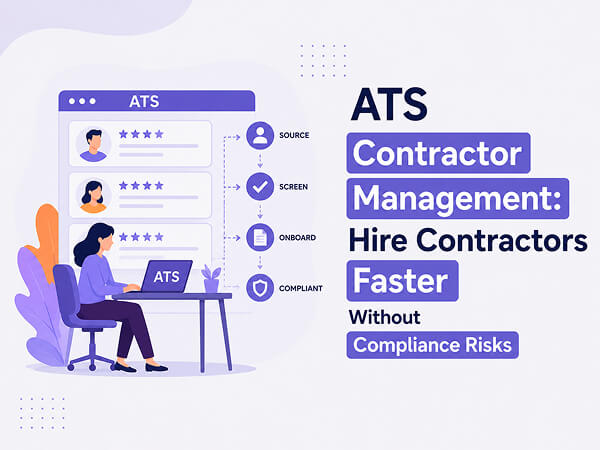
The ATS handles sourcing and selection. The contractor management system handles engagement and lifecycle operations. When the two are connected, the business gets a clearer view of the full journey.
Candidate becomes selected contractor.
Selected contractor becomes onboarded worker.
Onboarded worker becomes active project contributor.
Active contributor becomes alumni talent for future work.
That continuity is where the value sits.
Why ATS Contractor Management Matters More in 2026
Contractor hiring is no longer limited to occasional overflow work.
Companies use contractors for software development, marketing, design, finance, compliance, customer support, implementation, consulting, data work, and specialized operations.
There are practical reasons for this.
Skills are changing quickly. The World Economic Forum’s Future of Jobs Report 2025 found that employers expect a significant share of workers’ core skills to change by 2030, with skills gaps seen as a major barrier to transformation. When businesses need skills faster than they can build them internally, contractors often become part of the answer.
But flexibility brings complexity.
A business can move quickly and still create risk if it does not manage contractor hiring carefully.
The question is no longer:
“How do we find contractors?”
The better question is:
“How do we find, engage, manage, pay, and retain contractors without losing control?”
Key Features to Look for in ATS Contractor Management
A good ATS contractor management setup should support the entire contractor journey. Not every company needs the same configuration, but several key features to look for in an ATS matter consistently.
Not every company needs the same configuration, but several features matter consistently.
1. Contractor-Specific Talent Pools
Contractors should not be buried inside a permanent candidate database.
A strong freelancer management system lets teams segment by:
- Skill
- Location
- Availability
- Rate
- Project history
- Compliance status
- Past performance
- Preferred engagement type
This makes re-engagement easier.
A contractor who completed a three-month data migration project may be exactly the right person for another project nine months later. Without structured records, that knowledge often stays in someone’s inbox.
2. Role and Project-Based Requisitions
Permanent roles and contractor projects are different.
A contractor requisition should capture:
- Project scope
- Expected duration
- Budget
- Rate range
- Location or remote status
- Required deliverables
- Hiring manager
- Approval chain
- Engagement type
This reduces confusion early.
It also helps prevent a common mistake: hiring a contractor into what looks, feels, and operates like a permanent employee role.
3. Classification Support
No software can magically decide classification for every jurisdiction.
But good workflows can help teams ask better questions and preserve better records.
For example, a contractor intake process can prompt the business to consider:
- Who controls how the work is performed?
- Does the worker provide services to other clients?
- Is the engagement project-based or open-ended?
- Who provides equipment and tools?
- Is the worker paid by milestone, project, or time?
- Are benefits involved?
- Is the worker integrated into normal employee management structures?
These questions echo the practical concerns reflected in IRS guidance on behavioral control, financial control, and the relationship between the worker and the business.
The point is not to replace legal review.
The point is to avoid informal decisions with no paper trail.
4. Document Collection and Storage
Contractor onboarding usually requires documents.
Depending on the country and engagement model, these may include:
- Signed agreements
- Statements of work
- Tax forms
- Identity verification documents
- Business registration details
- Insurance certificates
- Bank or payment details
- Confidentiality agreements
- Data protection addenda
- Compliance attestations
These records should be attached to the worker profile or engagement record, not scattered across email.
5. Compliance and Audit Trails
Recruiting and workforce records are not just administrative details.
They can become evidence.
In the United States, the EEOC requires employers to keep certain employment records for specified periods. Federal contractors may also face applicant recordkeeping obligations under rules such as the OFCCP Internet Applicant rule, which applies to certain electronic expressions of interest.
Not every contractor process will trigger the same obligations, and legal advice should guide specific policies. Still, the principle is clear.
If hiring decisions are made digitally, records should be managed deliberately.
6. Data Protection Controls
Contractor hiring involves personal data.
Names, addresses, resumes, tax identifiers, identity documents, payment details, and background checks may all pass through the workflow.
For companies hiring across borders, privacy rules matter. The European Commission’s data protection guidance explains that EU data protection rules include safeguards for personal data transfers outside the EU. The UK Information Commissioner’s Office also provides guidance on recruitment and selection data protection.
An ATS contractor management workflow should support:
- Role-based access
- Data minimization
- Retention rules
- Candidate consent where appropriate
- Secure document storage
- Deletion or anonymization workflows
- Vendor data processing controls
Contractor data should not be treated casually because the worker is “not an employee.”
7. Onboarding Automation
Contractors often need to start fast.
A slow contractor onboarding process can turn a two-week urgent project into a four-week delay.
Automation can help by triggering:
- Contract review
- Document requests
- Tax form collection
- Identity checks
- System access requests
- Security training
- Project kickoff tasks
- Payment setup
The goal is not to remove human review.
It is to stop basic handoffs from getting lost.
8. Payment Readiness
Recruiting does not end when the contractor signs.
If payment setup fails, the relationship starts badly.
A practical ATS contractor management process should ensure that payment information, contract terms, tax documentation, and approval workflows are complete before work begins.
This is where platforms like TFY may be relevant for organizations managing international contractors, payroll, EOR arrangements, and workforce compliance. The important point is not that every company needs the same vendor. It is that contractor hiring should connect to the systems that actually manage payment and compliance after the candidate is selected.
9. End Date and Renewal Tracking
Contractor engagements should not run forever by accident.
A good system tracks:
- Start date
- End date
- Renewal date
- Budget consumed
- Deliverables completed
- Extension approvals
- Offboarding tasks
This protects both sides.
The company avoids uncontrolled scope creep. The contractor gets clearer expectations.
10. Contractor Alumni Management
The best contractor database is not just a list of applicants.
It is a living network.
When a contractor finishes a project, the system should capture:
- Skills used
- Project outcome
- Manager feedback
- Rehire eligibility
- Availability notes
- Rate changes
- Compliance status
- Preferred future work
This turns contractor hiring from a one-time scramble into a repeatable talent strategy.
What a Strong Contractor Hiring Workflow Looks Like
A mature ATS contractor management workflow usually follows a clear sequence.
Step 1: Define the Work
Before sourcing begins, the company defines the project.
What outcome is needed?
What skills are required?
How long will the work last?
What budget is available?
Who approves the engagement?
This prevents a vague “contractor role” from becoming a disguised permanent job.
Step 2: Source and Screen Contractors
The ATS supports sourcing, applications, screening, interview notes, and hiring team feedback.
At this stage, recruiter experience still matters.
Contractors often care about clarity, speed, payment reliability, scope, and decision timelines. A slow or vague process can push strong independent talent elsewhere.
Step 3: Review Classification and Engagement Model
Before selection becomes engagement, the company reviews whether the proposed setup is appropriate.
This may involve HR, legal, procurement, finance, or an external workforce partner.
The review should be documented.
Step 4: Issue Contract and Statement of Work
The agreement should reflect the actual engagement. It should define deliverables, payment terms, confidentiality obligations, intellectual property expectations, termination terms, and project boundaries.
For global contractors, local law and tax considerations may apply.
Step 5: Complete Onboarding
The contractor receives only the access, training, and information needed for the project.
This is a subtle but important distinction.
Onboarding should help the contractor work effectively, but it should not accidentally treat them like a permanent employee where that creates classification risk.
Step 6: Manage Work and Approvals
The system tracks milestones, timesheets, invoices, or deliverables depending on the engagement model.
Managers should know what they are approving.
Finance should know what it is paying.
The contractor should know what happens next.
Step 7: Offboard and Retain the Relationship
At the end of the project, access should be removed, final payment should be processed, documentation should be retained according to policy, and the contractor profile should be updated for future opportunities.
A good ending makes the next engagement easier.
Common Mistakes in ATS Contractor Management
Treating Contractors Like Permanent Candidates
Contractors often do not want a long recruitment process.
They want clear scope, fast decisions, and credible payment terms.
A five-stage interview process for a short project may signal that the company does not understand independent work.
Ignoring Classification Until After Selection
Classification should not be an afterthought.
If the business defines the work poorly, then asks legal to bless it at the end, delays are almost guaranteed.
Using Spreadsheets as the System of Record
Spreadsheets can help with planning. They are weak as long-term compliance systems. They break down when multiple teams need access, approvals, reminders, audit trails, and document control. A dedicated contractor management software solves this by centralizing records.
Forgetting Offboarding
Contractor offboarding is often less formal than employee offboarding.
That is a problem.
System access, confidential files, equipment, final invoices, and future eligibility should all be handled deliberately.
Measuring Only Time to Fill
Time to fill matters, but it is not enough.
For contractors, useful metrics include:
- Time to onboard
- Contract approval time
- Payment setup completion
- Project completion rate
- Renewal rate
- Contractor satisfaction
- Rehire rate
- Compliance exception rate
- Hiring manager satisfaction
These metrics show whether the contractor program is actually working.
ATS Contractor Management for Global Hiring
Global contractor hiring adds another layer of complexity.
A company may source a contractor in India, engage a designer in Poland, work with a consultant in Brazil, and pay a software engineer in the Philippines.
Each engagement may raise questions about:
- Local tax forms
- Worker classification
- Currency
- Payment method
- Data protection
- Intellectual property
- Contract enforceability
- Withholding obligations
- Permanent establishment risk
A standard ATS does not usually solve these issues on its own.
That is why global contractor management often requires integrations with workforce management, payroll, compliance, payment, or Employer of Record platforms.
The ATS remains valuable, but it should not be asked to do everything.
How to Choose an ATS Contractor Management Setup
The right setup depends on company size, hiring volume, risk tolerance, geography, and contractor use cases.
A small company hiring five local freelancers may need a lightweight process.
A global company engaging hundreds of contractors across countries needs stronger controls.
This is where an ATS buyer's guide can help frame the right questions. When evaluating tools, ask:
- Can contractor roles be separated from employee requisitions?
- Can the system capture project scope, rate, duration, and engagement type?
- Does it support contractor talent pools?
- Can it integrate with contract, payroll, finance, or workforce platforms?
- Are audit trails easy to retrieve?
- Can documents be stored securely?
- Can access be limited by role?
- Are retention and deletion workflows configurable?
- Can hiring managers see contractor status without emailing HR?
- Can the system support global workflows?
The best system is not always the most complex one.
It is the one that makes the right behavior easy.
Where TFY Fits in the Conversation
TFY operates in workforce management, global hiring, EOR, payroll, contractor management, diversity hiring, and HR technology. In the context of ATS contractor management, TFY is most relevant where companies need to connect talent acquisition with compliant engagement and payment workflows.
That distinction matters.
An ATS helps find and select talent. A workforce management platform helps manage what happens after selection. For companies hiring contractors across borders, the connection between these layers can reduce manual work and improve visibility.
The strongest approach is editorially simple:
Use the ATS for candidate flow.
Use contractor management for worker lifecycle control.
Connect both where handoffs create risk.
Final Thoughts
Contractor hiring used to be informal in many companies.
A manager knew someone. A recruiter found a specialist. A contract was emailed. Finance handled payment later.
That approach does not scale well.
Modern contractor work touches recruiting, compliance, legal, procurement, security, finance, payroll, and workforce planning. When those functions operate in separate systems, the company may move fast at first, then spend months cleaning up the operational mess.
ATS contractor management solves a practical problem.
It turns contractor hiring into a structured workflow.
It helps companies find the right specialists, document the right decisions, onboard workers faster, manage engagements clearly, and preserve contractor relationships for the future.
The business still gets flexibility.
But the flexibility comes with control.