
A hiring manager opens a blank document.
The role is urgent.
The team is stretched.
Someone says, “Let’s just use the old job description and update the title.”
So they do.
A few responsibilities are copied from another department. A few buzzwords are added. The requirements list grows longer because nobody wants to miss anything. The post goes live.
Then the applications arrive.
Some candidates are unqualified.
Some are overqualified.
Some clearly misunderstood the role.
And the people who would have been a strong fit never apply at all.
This is the quiet problem with many job descriptions: they describe a vacancy, but they do not convert the right candidate.
A good job description is not just an internal HR document. It is a decision tool. It helps candidates quickly answer three questions:
- Can I do this job?
- Do I want this job?
- Is this company worth my time?
That is why learning how to write a job description matters. A clear, credible, candidate-centered JD can improve application quality, reduce screening friction, and help hiring teams explain the role consistently.
Below are 10 proven formulas for writing a job description that attracts candidates, supports fair hiring, and gives the role a much better chance of reaching the right people.
What Makes a Job Description Convert?
A converting job description does not simply get more applicants.
It gets better-matched applicants.
That distinction matters.
A vague job post may attract volume, but volume alone creates more work for recruiters. A strong job posting that attracts candidates sets expectations early, alongside career pages built to attract top talent. It explains the work, the outcomes, the requirements to look for, the environment, and the value exchange.
It is also easy to scan.
That is not a cosmetic detail. Nielsen Norman Group’s research on web writing has long shown that users prefer content that is concise, scannable, and objective. Candidates behave the same way when reading job posts. They scan first, then decide whether to invest attention.
So the goal is not to sound impressive.
The goal is to be useful quickly.
Formula 1: Start With the Candidate’s Situation
Most job descriptions begin with the company.
“About us. We are a fast-growing, innovative, global leader…”
Candidates rarely start there.
They begin with their own situation: “Is this role relevant to me?”
A stronger opening speaks to the work and the candidate’s likely motivation.
Instead of:
“We are looking for a dynamic Sales Manager to join our growing team.”
Try:
“You will lead a regional sales team, improve pipeline visibility, and help account executives close larger enterprise deals.”
This immediately tells the candidate what the role is about.
The formula:
Role purpose + core ownership + business impact
Example:
“As a Customer Success Manager, you will own onboarding, retention, and expansion for mid-market clients using our workforce management platform.”
This is especially useful for roles in HR technology, payroll, EOR, staffing, recruitment, and global hiring, where job titles can mean very different things across companies.
Formula 2: Use a Clear Job Title, Not an Internal Nickname
A job title is not the place to be clever.
“Revenue Ninja” may sound energetic internally, but candidates search for “Sales Development Representative,” “Account Executive,” or “Revenue Operations Manager.”
Search engines and job boards also rely on recognizable role language. Google's guidance for job posting structured data emphasizes clear, accurate job information, including the job title and relevant details that help search systems understand the posting. Employers can review Google's job posting structured data guidelines when publishing jobs on their own websites.
Use the title candidates actually search for. Then clarify level and scope. Like this:
- Senior Payroll Specialist
- Remote Customer Support Representative
- Global Mobility Manager
- Employer of Record Operations Lead
Avoid titles that are vague, inflated, or culturally specific.
A “Head of People” at a 12-person company may be a generalist. At a 500-person company, it may be an executive leadership role. The description should remove that ambiguity.
Formula 3: Lead With Outcomes, Then List Tasks
Many job descriptions are just task inventories.
“Manage reports. Attend meetings. Coordinate stakeholders. Prepare documents.”
That may be accurate, but it is not very persuasive.
Candidates want to know what success looks like.
The outcome-first formula works like this:
In this role, you will be successful if you can achieve X by doing Y.
Example:
“You will be successful in this role if you can reduce onboarding delays, improve document accuracy, and help international contractors move from offer acceptance to active engagement without confusion.”
Then list the recurring work.
This helps candidates connect daily responsibilities to business value.
Before:
"Responsible for contractor onboarding and compliance documentation."
After:
“You will help new contractors start work smoothly by collecting required documents, coordinating approvals, and keeping onboarding records complete across multiple countries.”
The second version is more human. It also gives a clearer picture of the work.
Formula 4: Separate Must-Haves From Nice-to-Haves
This is one of the most important JD best practices.
Long requirement lists discourage qualified candidates, especially when the post does not distinguish between essentials and preferences.
A better job description template separates requirements into two sections:
- Required qualifications
- Preferred qualifications
Required qualifications should include only what is genuinely necessary on day one.
Preferred qualifications can include skills that are useful but trainable, context-dependent, or helpful for faster ramp-up.
Example:
Required:
- 3+ years of payroll operations experience
- Working knowledge of multi-country payroll workflows
- Strong attention to documentation and deadlines
Preferred:
- Experience with contractor payments
- Experience in HR technology or EOR services
- Familiarity with payroll compliance across multiple regions
This structure helps candidates self-assess more accurately. It also helps hiring teams avoid screening out people for skills that are not truly essential.
For occupational research, employers can use resources such as the U.S. Department of Labor’s O*NET database, which describes occupations by tasks, work activities, skills, knowledge, and abilities. It is a useful reference when teams need to define role requirements more precisely.
Formula 5: Write Responsibilities as Action Statements
Responsibilities should not sound like policy documents.
They should describe what the person will actually do.
Use action verbs.
Weak:
“Ownership of client communication.”
Stronger:
“Respond to client questions, explain onboarding requirements, and coordinate follow-up with payroll and compliance teams.”
Weak:
“Support recruitment activities.”
Stronger:
“Screen applications, schedule interviews, update candidate records, and help hiring managers maintain timely communication.”
The formula:
Verb + object + purpose
Examples:
- “Build weekly hiring reports so managers can track pipeline health.”
- “Review contractor documents to identify missing information before onboarding deadlines.”
- “Coordinate with finance to resolve payment exceptions before payroll cut-off.”
This makes the role easier to understand and easier to evaluate during interviews.
Formula 6: Show the Work Environment Honestly
Candidates are not only evaluating the job.
They are evaluating the conditions around the job.
Remote, hybrid, office-based, shift-based, travel-heavy, client-facing, asynchronous, high-volume, regulated, seasonal, cross-functional: these details matter.
A job posting that attracts candidates does not hide friction. It explains it plainly.
For example:
- “This is a remote role, but you will need to overlap with Central European working hours at least four days per week.”
- “This role involves high-volume candidate coordination during seasonal hiring periods.”
- “You will work with sensitive employee and contractor data, so accuracy and confidentiality are essential.”
This does two things.
It attracts people who are comfortable with the environment.
It helps people opt out when the setup does not fit their life.
That is not a failure. That is better matching.
Formula 7: Add Compensation and Benefits Where Possible
Pay transparency is increasingly expected by candidates and, in some jurisdictions, required by law.
Even where it is not legally required, compensation information can improve trust. Candidates want to understand whether the opportunity is realistic before entering a process.
A clear compensation section may include:
- Salary range or hourly rate
- Bonus or commission structure
- Equity eligibility, if applicable
- Benefits
- Paid time off
- Remote work support
- Learning budget
- Payroll frequency
- Contractor or employee classification
For global roles, classification matters. A contractor role, employee role, or Employer of Record arrangement can create different expectations around benefits, taxes, working hours, and legal responsibility.
Platforms such as TFY, which operate in workforce management, EOR, contractor management, and global payroll, sit in this broader context. The job description still needs to explain the practical arrangement clearly, rather than assuming candidates understand the employment model.
Formula 8: Make Compliance and Inclusion Practical
Inclusive hiring starts before the interview.
It starts in the language of the job description.
In the U.S., the Equal Employment Opportunity Commission advises employers to ensure recruitment and hiring decisions are not based on protected characteristics such as race, color, religion, sex, national origin, disability, age, or genetic information. Employers can review the EEOC’s guidance on recruiting, hiring, and promotion practices for more detail.
For job descriptions, this means avoiding language that may unintentionally narrow the applicant pool.
Be careful with phrases such as:
- “Recent graduate”
- “Digital native”
- “Young and energetic”
- “Native English speaker,” unless legally and operationally justified
- “Must be able-bodied”
- “Work hard, play hard”
Inclusive language is not about making the job sound soft.
It is about making the requirements accurate.
Instead of:
“Must be a native English speaker.”
Use:
“Must be able to communicate clearly in written and spoken English with clients and internal teams.”
Instead of:
“Looking for a young, energetic team player.”
Use:
“Looking for someone who can collaborate across teams, manage competing priorities, and communicate proactively.”
Specific language is usually more inclusive than vague personality language.
Formula 9: Use a Simple Job Description Template
A strong job description template keeps the hiring team disciplined.
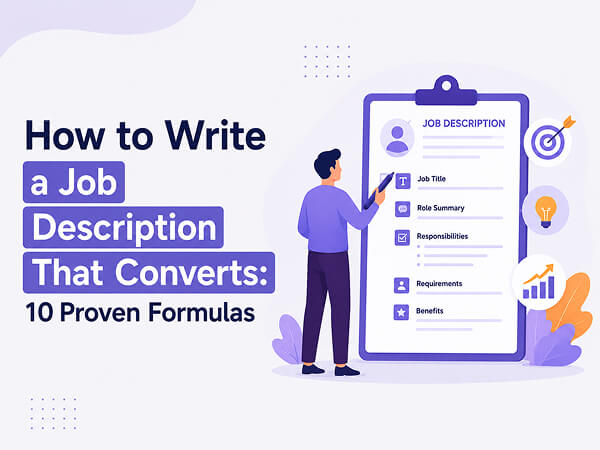
Here is a practical structure:
Job Title
Use the candidate-facing title.
Example:
“Senior Talent Acquisition Specialist”
Role Summary
Explain the role in 3 to 5 sentences.
Include the purpose, team, scope, and business impact.
Key Responsibilities
Use 6 to 10 bullet points.
Start each bullet with a clear action verb.
Required Qualifications
List true must-haves only.
Keep this section focused.
Preferred Qualifications
Add useful but non-essential experience.
Make it clear that these are not mandatory.
Work Setup
Explain location, remote or hybrid expectations, working hours, travel, and tools.
Compensation and Benefits
Include a range where possible.
Clarify employment type and major benefits.
Hiring Process
Tell candidates what happens next.
Example:
“Application review, recruiter screen, hiring manager interview, practical task, final conversation.”
Equal Opportunity Statement
Use clear, legally reviewed language appropriate to the company and jurisdiction.
This template works because it answers candidate questions in the order they usually arise.
What is the job?
Can I do it?
Would I want it?
What happens if I apply?
Formula 10: End With a Clear Call to Apply
Many job descriptions fade out.
They list requirements, add a generic equal opportunity statement, and stop.
A stronger ending helps the right person take action.
Example:
“If this role matches the kind of work you want to do next, we encourage you to apply, even if your experience does not match every preferred qualification.”
This kind of ending is useful because many strong candidates hesitate when they do not meet every bullet. The wording should be honest, not manipulative. Do not imply that must-have qualifications are optional if they are not.
A good final section can also reinforce the role’s mission.
Example:
“You will help build a smoother hiring experience for candidates and managers across multiple countries. If that kind of operational clarity motivates you, this role is worth considering.”
The candidate should leave with a clear sense of the work and a clear next step.
Before and After: A Job Description Rewrite
Here is a simple example.
Before:
“We are seeking a motivated HR Coordinator to support our busy HR team. The ideal candidate will be a self-starter with excellent communication skills and the ability to work in a fast-paced environment. Responsibilities include onboarding, employee records, reporting, and other duties as assigned.”
This is common.
It is also too vague.
After:
“As an HR Coordinator, you will help new hires move from signed offer to first productive week. You will collect onboarding documents, update employee records, schedule orientation sessions, and coordinate with payroll, IT, and hiring managers. This role is a good fit for someone who enjoys organized processes, clear communication, and detail-heavy work that affects the employee experience.”
The second version is not longer for the sake of being longer.
It is clearer.
It tells the candidate what the job actually feels like.
Common Mistakes That Stop Job Descriptions From Converting
Some job descriptions fail because they are too thin.
Others fail because they try to say everything.
The most common mistakes include:
- Using internal jargon candidates do not understand
- Listing too many “required” skills
- Hiding salary and work setup details
- Writing responsibilities as vague nouns instead of actions
- Overusing personality traits instead of describing behavior
- Copying an old JD without checking whether the role has changed
- Using inflated titles that do not match the work
- Forgetting to explain the hiring process
A job description is not just an announcement. It is the first structured conversation between employer and candidate.
If that conversation is confusing, the best candidates may quietly leave.
Final Checklist: JD Best Practices
Before publishing, review the job description against this checklist:
- The title matches what candidates search for
- The opening explains the role’s purpose
- Responsibilities are specific and action-based
- Must-have and nice-to-have qualifications are separated
- The work setup is clear
- Compensation is included where possible
- The language is inclusive and legally reviewed
- The post is easy to scan on mobile
- The hiring process is explained
- The call to apply is clear and encouraging
If the job is posted on the company website, also check technical publishing details, including structured data, location fields, and expiration dates. Google’s job posting documentation is a useful starting point for teams that want their roles to be eligible for enhanced search visibility.
Final Thoughts
Learning how to write a job description is not about finding the perfect wording.
It is about creating clarity.
The best job descriptions help candidates understand the work, evaluate their fit, and decide whether to apply. They also help recruiters and hiring managers align around what the role truly requires.
That alignment saves time.
It improves candidate experience.
It reduces mismatched applications.
And in a labor market where strong candidates have choices, clarity is one of the most practical advantages an employer can have.
A job description that converts does not try to impress everyone.
It helps the right person say, “Yes, this sounds like me.”