
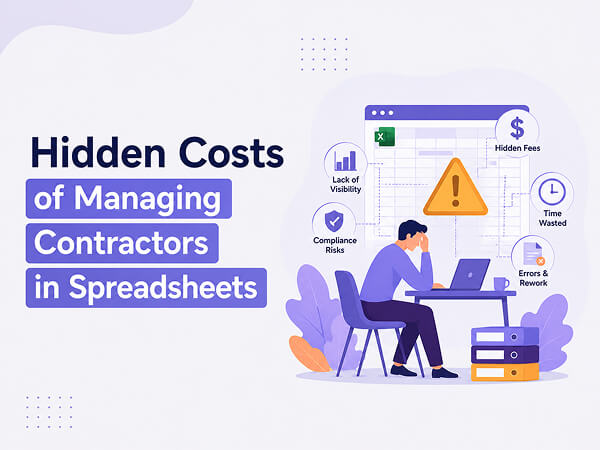
A contractor sends an invoice on Friday afternoon.
The project manager approves it in one spreadsheet. Finance checks another. HR opens a third file to confirm the contract dates. Someone notices the bank details were updated last month, but nobody is sure whether the payment tracker reflects the change.
So the team waits.
Then someone sends a message.
Then someone checks an email thread.
Then someone updates a cell.
Nothing looks expensive yet.
That is why spreadsheets are so tempting for contractor management. They feel flexible, familiar, and free. For a small team with three contractors, they may be enough.
But once a company works with 20, 50, or 200 contractors across countries, spreadsheets quietly become an operating system for work they were never designed to manage.
The cost is not the spreadsheet license.
The cost is everything around it.
Why Contractor Spreadsheets Feel Cheap at First
Spreadsheets work well when the process is simple.
One contractor. One invoice. One payment cycle. One country. One person responsible.
The problem begins when contractor management becomes cross-functional. HR needs contracts and onboarding records. Finance needs payment details, tax forms, invoice status, and cost centers. Legal may need classification evidence. Project managers need start dates, end dates, deliverables, and approval history.
A spreadsheet can store this information.
It cannot reliably govern it.
That distinction matters.
A spreadsheet is a document. Contractor management is a process.
When the process lives inside static files, every update depends on human memory, manual checks, and informal coordination.
The Admin Time Cost: The “Free” System Starts Billing You
Let’s quantify the time cost.
Assume a company manages 50 contractors. Each month, the team spends time on:
- Updating contractor records
- Checking invoice amounts
- Confirming approvals
- Following up on missing documents
- Reconciling payments
- Correcting spreadsheet versions
- Answering contractor payment questions
If each contractor requires just 45 minutes of spreadsheet-related administration per month, that becomes 37.5 hours monthly.
That is nearly one full workweek.
Now attach a labor cost. The U.S. Bureau of Labor Statistics reported that human resources specialists earned a median wage of $35.05 per hour in May 2024. Broader employer cost data shows that private industry compensation averaged $46.60 per hour worked in March 2026, including wages and benefits.
Using $46.60 as a rough loaded hourly cost:
37.5 hours x $46.60 = $1,747.50 per month
That is $20,970 per year in internal administration, before considering finance, legal, manager time, or error correction.
For 100 contractors, the same model reaches $41,940 per year.
And this assumes only 45 minutes per contractor per month. Many teams spend more when invoices are late, contracts change, currencies differ, or approvals are unclear.
The Error Cost: Small Cells, Real Money
Spreadsheet errors are not rare edge cases.
Research into operational spreadsheets has found high error rates in real business spreadsheets. One audit of operational spreadsheets, published through the Tuck School of Business, found that 86% of audited workbooks contained errors that produced wrong results, using a restrictive definition.
That does not mean every contractor payment spreadsheet is wrong.
It means spreadsheet-based processes deserve skepticism when money, compliance, and worker records depend on them.
In contractor management, errors often appear in ordinary ways:
- A rate is copied from the wrong row
- A contractor is paid in the wrong currency
- A contract end date is missed
- A tax form status is marked complete too early
- A duplicate invoice is approved
- A bank detail update is entered in one file but not another
Now imagine a company with $150,000 in monthly contractor spend.
A 1% payment error exposure is $1,500 per month.
Some of that may be recovered. Some may only create temporary reconciliation work. But even temporary errors cost time, create contractor frustration, and reduce trust in the payment process.
If the team spends another 10 hours per month investigating payment issues, that adds roughly $466 per month at the same $46.60 hourly cost.
The true cost is not only the incorrect payment.
It is the investigation, the delay, the apology, the reapproval, the correction, and the second payment run.
The Compliance Cost: Spreadsheets Do Not Prove Much
Contractor management is not just payment tracking.
It is also classification, documentation, and auditability, plus local compliance.
For U.S. classification, the IRS explains that businesses should examine behavioral control, financial control, and the relationship of the parties when determining whether a worker is an employee or independent contractor. The IRS provides this in its independent contractor guidance.
The U.S. Department of Labor also states in its FLSA employment relationship fact sheet that worker status depends on the economic realities of the relationship, not simply the label used in an agreement.
This matters because spreadsheets can show what someone typed.
They rarely show a defensible process.
Can the company prove who reviewed classification? When? Against which criteria? Was the contractor’s scope reviewed when the relationship changed? Were approvals documented? Were records retained after offboarding?
A spreadsheet may contain a “Yes” in a compliance column.
That is not the same as an audit trail.
The hidden cost appears when legal, finance, or HR has to reconstruct decisions from old files, Slack messages, email chains, and outdated folders.
The Visibility Cost: Nobody Trusts the Number
As contractor use grows, leadership starts asking basic questions:
- How many active contractors do we have?
- How much are we spending this month?
- Which contracts expire in the next 30 days?
- Which contractors have missing documents?
- Which teams are using external talent most heavily?
If the answers require three spreadsheets and two people to interpret them, the business does not have visibility. It has fragments.
This becomes more serious as contingent workforce use expands. Deloitte has noted that contingent workers can represent 30% to 50% of an overall workforce in some organizations.
At that scale, contractor data is not administrative clutter. It is workforce intelligence.
Poor visibility affects budgeting, hiring, compliance, project planning, and vendor negotiations. Companies may keep hiring contractors while failing to see duplicated roles, inactive accounts, overlapping scopes, or avoidable payment fees.
A Simple Cost Model for Spreadsheet-Based Contractor Management
Here is a practical way to estimate the hidden cost, similar in spirit to a global contractor cost calculator.
1. Monthly Admin Cost
Number of contractors x admin minutes per contractor x loaded hourly cost
Example:
50 contractors x 45 minutes = 37.5 hours
37.5 x $46.60 = $1,747.50 per month
2. Error Correction Cost
Number of payment or data issues x average hours to fix x loaded hourly cost
Example:
8 issues x 1.25 hours x $46.60 = $466 per month
3. Delay Cost
This is harder to measure, but very real.
Delayed contractor payments can lead to repeated follow-ups, rushed exception payments, damaged relationships, and lower willingness to accept future work.
A senior engineer, consultant, or creative specialist may not leave because of one late payment.
But they remember it.
4. Compliance Review Cost
If HR, finance, and legal spend 40 hours preparing records for an audit or internal review, that can easily exceed $2,000 in internal time before outside counsel is involved: a cost that quickly erodes any ROI contractors were expected to deliver.
The spreadsheet looked free.
The review was not.
When Spreadsheets Become Too Expensive
Spreadsheets are not bad tools. They are just often stretched beyond their proper role.
A spreadsheet may still work when contractor volume is low, payment cycles are simple, and all contractors are in one jurisdiction.
It becomes risky when:
- Multiple departments edit different versions
- Contractor payments cross borders
- Classification decisions need documentation
- Contracts renew frequently
- Invoice approvals depend on email
- Leadership needs real-time spend visibility
- Contractor records are scattered across files
- Payment errors are becoming normal
At that point, the organization is not saving money by using spreadsheets. It is shifting cost into manual labor, rework, and risk.
Where Workforce Platforms Fit
A contractor management platform does not automatically solve every workforce problem. Processes still need ownership, clear policies, and good data hygiene.
But a structured workforce management platform can reduce the work spreadsheets create.
For example, workforce management platforms such as TFY are designed to centralize contractor onboarding, documentation, payments, compliance workflows, and workforce records. The value is not simply “automation.” The value is having one governed system of record instead of a collection of files that require constant human interpretation.
That can matter most for companies managing international contractors, mixed workforces, freelancer payments, or recurring compliance checks.
Final Thoughts
The hidden costs of managing contractors in spreadsheets usually appear slowly.
First, it is a few extra minutes.
Then a duplicate invoice.
Then a late payment.
Then a missing document.
Then a leadership report nobody fully trusts.
The spreadsheet was never the expensive part.
The expensive part is the operational drag that forms around it: manual administration, avoidable errors, weak audit trails, slow payments, and unclear workforce visibility.
For companies using contractors as a serious part of their growth strategy, the better question is not, “Can we keep using spreadsheets?”
It is, “How much are spreadsheets already costing us?”