
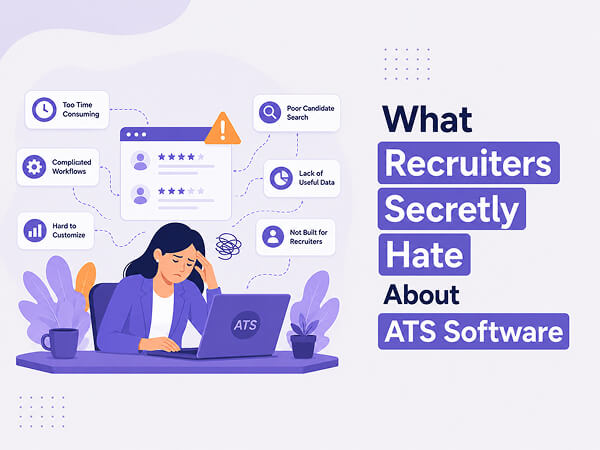
A recruiter opens their dashboard on Monday morning.
There are 427 applicants for one role.
Some are qualified. Some are not. Some used AI to tailor their resumes. Some have the right experience, but used different words than the job description. Some look perfect on paper, but are not a fit at all.
The hiring manager wants a shortlist by tomorrow.
The candidates want updates.
The company wants speed.
The ATS promises control.
And still, the recruiter feels stuck.
Applicant tracking systems were built to make hiring easier. They collect applications, store resumes, manage workflows, support reporting, and help employers keep records. In theory, that sounds efficient.
In practice, recruiters often experience something different.
They do not always hate the ATS itself.
They hate the ATS problems that come with poor setup, rigid workflows, weak data, and automation that makes hiring feel less human.
What Is an ATS?
An applicant tracking system, or ATS, is software that helps employers manage recruitment from job posting to candidate selection. It usually supports job requisitions, resume storage, candidate screening, interview stages, recruiter notes, compliance records, and reporting.
This matters because hiring is not only an administrative process. It is also a judgment process.
Recruiters need to understand skills, motivation, context, location, salary expectations, communication style, and hiring manager priorities. A useful ATS supports that work. A poorly designed one turns it into box-checking.
That is where frustration begins.
The First ATS Problem: Too Many Applicants, Not Enough Signal
One of the biggest ATS problems is not a lack of applicants.
It is too many applicants with too little relevance.
Online job boards, remote work, and AI-generated applications have made it easier than ever to apply for roles at scale. A recruiter may receive hundreds of applications and still struggle to find five strong candidates.
The dashboard looks full.
The shortlist is thin.
This is why many recruiters feel overloaded even when their technology appears to be working. The ATS captures volume, but volume is not the same as quality.
Recruiting research from SHRM on talent acquisition trends shows that hiring teams continue to face recruiting difficulty, competition for talent, and candidate quality challenges. An ATS can organize the process, but it cannot magically create better matches. Choosing the right ATS software matters precisely because volume without relevance is not progress.
The Second ATS Problem: Good Candidates Get Buried
Recruiters know that great candidates do not always use perfect keywords.
A job description may say “customer success.”
A candidate may write “client retention.”
A role may ask for “B2B SaaS.”
A candidate may describe “enterprise software subscriptions.”
A human can usually connect the dots. A rigid search filter may not.
This is one reason recruiters quietly dislike keyword-heavy screening. It may help narrow the pile, but it can also hide people with relevant experience. Better collaborative hiring and keyword indexing practices can reduce how often strong candidates fall through the cracks.
The risk is even higher for career changers, caregivers returning to work, veterans, people with disabilities, older workers, and candidates from nontraditional backgrounds. Research from Harvard Business School on hidden workers found that many qualified people are excluded by hiring systems that are too rigid or overly focused on exact criteria.
Recruiters do not want to miss talent.
But the ATS can make talent harder to see. This is also where predictive hiring in ATS can help recruiters spot strong matches that keyword filters would otherwise miss.
The Third ATS Problem: Resume Parsing Creates Messy Data
Resume parsing sounds simple.
The candidate uploads a resume. The ATS reads it. The system extracts name, contact details, work history, education, skills, and dates.
But resumes are not standardized.
Candidates use columns, tables, icons, graphics, PDFs, different headings, and different languages. International candidates may use CV formats that differ from local expectations.
The result can be messy.
Job titles appear in the wrong field. Dates disappear. Skills get duplicated. Education sections look incomplete. A strong candidate can suddenly look weak because the system misunderstood the resume.
Recruiters hate this because bad data creates extra work. Instead of evaluating people, they spend time correcting profiles, searching manually, or opening original resumes to check what the system missed. Knowing the key features to look for in an ATS upfront can help hiring teams avoid this trap altogether.
For global employers, this is especially important. A hiring process that works for one country may not work well for candidates across Europe, Asia, Latin America, or Africa.
The Fourth ATS Problem: Candidate Experience Feels Cold
Candidates often describe the ATS as a black hole.
They apply.
They receive an automated confirmation.
Then nothing.
Recruiters know this is bad. Most do not enjoy leaving candidates without updates. But ATS workflows often make communication feel robotic or slow.
Templates sound impersonal. Status updates are delayed. Hiring managers do not provide feedback on time. Rejection emails go out in batches. Personalized messages take extra effort.
The company thinks it has a process.
The candidate feels ignored.
That gap damages employer brand. Even rejected candidates remember how they were treated. In competitive talent markets, candidate experience and employer brand are not a soft issue. It affects whether people apply again, accept offers, refer others, or speak positively about the company.
The Fifth ATS Problem: Hiring Managers Break the Workflow
Recruiters are often blamed for slow hiring.
But many delays begin with hiring managers.
The ATS may include scorecards, interview notes, ratings, feedback forms, and approval steps. On paper, that should keep everyone aligned.
In reality, hiring managers may give feedback in chat, email, or hallway conversations. Some write “not a fit” without explaining why. Others change the role requirements after seeing candidates. Some ask for more resumes without clarifying what was missing.
The ATS tracks stages.
It does not always create alignment.
This is one of the most frustrating ATS problems because recruiters cannot fix it alone. A better hiring process needs clear role requirements, structured feedback, realistic timelines, and accountability from hiring managers.
The Sixth ATS Problem: Reports Look Cleaner Than Reality
Executives love recruiting dashboards.
Time to fill. Source of hire. Candidate conversion. Interview pass rate. Offer acceptance rate. Diversity pipeline data.
These numbers are useful, but only when the data is reliable.
Recruiters know the hidden problems. Candidates may be duplicated. Sources may be missing. Rejection reasons may be selected only because the system requires a dropdown. Feedback may live outside the ATS. Stages may be updated late.
The report looks precise.
The process behind it is messy.
This becomes risky when companies use ATS reports to judge recruiter performance or hiring efficiency. If the workflow is inconsistent, the metrics may tell a partial story.
The Seventh ATS Problem: Automation Can Become a Black Box
Recruiters want automation that saves time.
They do not want automation that removes judgment.
Scheduling reminders, duplicate detection, workflow nudges, and candidate status updates can be helpful. But unexplained ranking, opaque scoring, or automated rejection logic can create real concerns.
Employment decisions need oversight. The EEOC guidance on AI and employment tools warns employers that automated systems can create discrimination risks if they are not designed and monitored carefully. The NIST AI Risk Management Framework also emphasizes governance, measurement, and risk controls for AI systems. This is why understanding what an AI ATS actually is, and how to evaluate an AI ATS before you buy, matters more than ever.
Recruiters feel this tension directly.
They are expected to move faster with technology.
They are also expected to defend fair hiring decisions.
That is difficult when the system cannot clearly explain why one candidate was prioritized over another.
What Recruiters Actually Want From an ATS
Recruiters do not want to go back to inbox chaos and spreadsheets.
They want better systems.
A strong ATS should help recruiters:
- Find relevant candidates quickly.
- Search beyond exact keywords.
- Keep candidate data clean.
- Communicate in a timely and human way.
- Push hiring managers to give structured feedback.
- Produce reports that reflect reality.
- Use automation with transparency and control.
The best ATS does not replace recruiter judgment. It protects it. This is a big part of why so many teams are turning to AI-powered recruiting tools that support recruiters instead of sidelining them.
For companies hiring internationally, the system also needs to connect recruitment with the next stages of workforce management. A candidate may become an employee, contractor, consultant, or remote worker in another country. That means hiring decisions eventually connect to onboarding, compliance, payroll, classification, and workforce operations.
This is where platforms such as TFY can be relevant, especially for businesses managing global hiring, Employer of Record needs, contractor and vendor management, and workforce compliance. The ATS should not be an isolated database. It should fit into the wider talent lifecycle, connecting to tools like a full HR management system and, for contractors specifically, a Contractor of Record model that keeps global hiring compliant.
Final Thoughts
Recruiters do not secretly hate ATS software because they dislike technology.
They hate ATS problems that make hiring slower, colder, and less accurate.
They hate when qualified candidates are hidden by keywords.
They hate when resume parsing creates bad data.
They hate when hiring managers ignore the process.
They hate when dashboards look clean, but reality is messy.
Most of all, they hate being asked to deliver human hiring outcomes through systems designed mainly for administrative control.
The ATS is not the enemy.
Bad design is.
A better hiring system helps recruiters move faster without losing context. It keeps employers compliant without becoming rigid. It improves candidate experience without creating more manual work. Resources like a proper ATS buyer's guide can help teams choose wisely from the start.
In a labor market shaped by remote work, AI-generated applications, skills shortages, and global hiring, companies cannot afford to ignore ATS problems.
They decide who gets seen.
They decide who gets missed.
And they shape whether recruiters can do the work they were actually hired to do.