A company publishes a remote job vacancy on Friday.
By Monday morning, 1,000 people have applied.
A recruiter cannot carefully review every CV before the strongest candidates start accepting interviews elsewhere. An AI recruiting tool can screen the applications within minutes.
It identifies 30 promising candidates.
But one applicant is missing.
She does not have the expected job title. Her career path is unusual. Yet she has spent five years solving almost exactly the problems the employer needs help with.
The system rejects her.
An experienced recruiter might not.
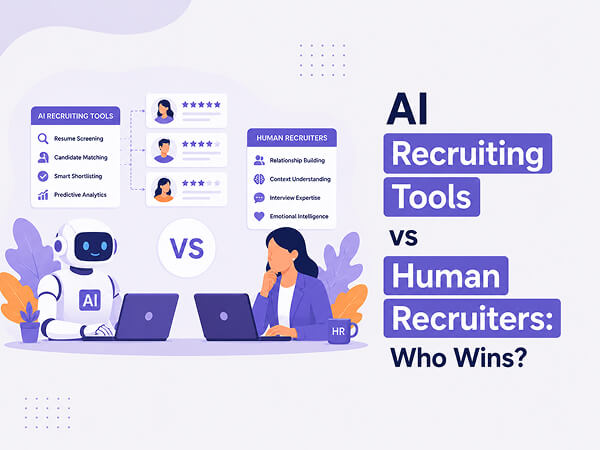
This is why the debate about AI recruiting tools vs. human recruiters cannot be reduced to one question: Which is better?
The more useful question is:
Who wins at what?
AI is faster, more scalable, and better at repetitive processing.
Human recruiters are better at context, trust, persuasion, and difficult judgment calls.
The strongest recruitment process combines both.
What Do AI Recruiting Tools Actually Do?
AI ATS platforms now supports many stages of recruitment, including:
- Writing job descriptions
- Searching candidate databases
- Screening CVs
- Matching skills to vacancies
- Scheduling interviews
- Answering routine questions
- Summarizing interview notes
- Analysing recruitment data
The OECD’s research on AI and labour-market matching shows how these systems are increasingly used to source, shortlist, assess, and communicate with applicants.
Some applications are relatively low risk. Automatically arranging an interview time saves administrative work.
Others are more consequential. A system that ranks or rejects applicants can directly influence who receives access to employment.
That distinction matters.
Round One: Processing Large Applicant Volumes
Winner: AI recruiting tools
AI is particularly useful when employers receive hundreds or thousands of applications.
A system can quickly search for:
- Required qualifications
- Languages
- Technical skills
- Certifications
- Work authorization
- Location or availability
It can apply the same initial rules to every candidate without becoming tired or distracted.
This makes AI valuable for graduate schemes, seasonal recruitment, remote hiring, staffing platforms, and other high-volume hiring campaigns.
However, speed does not guarantee quality.
If the job description is unrealistic or the screening criteria are poorly chosen, AI simply makes the wrong decision faster.
AI wins at processing volume.
Humans still need to decide what the system should look for.
Round Two: Recognising Unconventional Potential
Winner: Human recruiters
Real careers rarely match job descriptions perfectly.
People change industries. Job titles vary across countries. Freelancers may gain deep experience without following a conventional corporate path. Career gaps can reflect caregiving, illness, relocation, or education rather than a lack of ability.
Human recruiters can interpret these situations.
They can ask:
- What work did this person actually perform?
- Are their skills transferable?
- Is the missing qualification genuinely essential?
- Does the hiring manager’s ideal candidate realistically exist?
AI systems can identify related skills, but they often depend on historical data or predefined patterns. If previous successful hires shared similar backgrounds, the system may favour more of the same.
This does not mean AI must reject unconventional candidates. It means the outcome depends heavily on how the tool is designed, trained, and monitored - one reason it's worth asking the right questions before evaluating an AI ATS.
Round Three: Scheduling and Administration
Winner: AI recruiting tools
Recruiters create little strategic value by exchanging several emails to arrange one interview.
AI can handle routine tasks such as:
- Calendar coordination
- Interview reminders
- Application confirmations
- Frequently asked questions
- Document collection
- Status notifications
This can improve candidate experience.
An immediate automated confirmation is often better than receiving no response for several days.
The system should still provide access to a person when the situation becomes sensitive. Questions about disability accommodations, compensation, discrimination, relocation, or employment gaps require more than a standard chatbot response - a gap many recruiters already feel in what they secretly hate about ATS software.
Round Four: Building Candidate Trust
Winner: Human recruiters
Recruitment is not only about filtering people.
It is also about convincing the right person to join.
Strong candidates may have questions about management, job security, career progression, workload, remote work, or company culture.
A recruiter can notice hesitation, ask follow-up questions, and adapt the conversation. They can also explain rejection decisions with empathy and useful context.
Candidate attitudes suggest that human involvement still matters. According to Pew Research Center’s study of public attitudes toward AI in hiring, many people are uncomfortable with AI making final employment decisions and worry that technology may overlook the human side of an applicant.
Candidates may appreciate fast digital processes.
They are less likely to appreciate unexplained automated rejection.
Round Five: Consistency and Bias
Winner: Neither without oversight
AI can apply the same criteria to every applicant.
Human recruiters may interpret CVs differently, ask inconsistent interview questions, or be influenced by first impressions.
Consistency is therefore one of AI’s strongest advantages.
But consistency is not automatically fairness.
A system can consistently penalise career gaps, unfamiliar universities, international qualifications, or nonstandard job titles. The rule may be applied equally while still producing unfair outcomes.
Humans also bring biases related to age, accent, background, education, gender, or personal similarity.
The solution is not blind trust in either technology or human intuition.
Responsible recruitment requires:
- Job-related selection criteria
- Structured interviews
- Accessible assessments
- Outcome monitoring
- Documented human review
- A way for candidates to challenge errors
The UK government’s guidance on responsible AI in recruitment highlights risks including discriminatory targeting, digital exclusion, and the reproduction of historical bias.
Round Six: Final Hiring Decisions
Winner: Human-led decision-making
AI can organise evidence and identify patterns.
It should not become an unquestioned decision-maker.
Employment decisions involve context, uncertainty, legal responsibility, and consequences for real people. Employers must understand what a recruitment system measures, which data it uses, and how mistakes can be corrected.
The US Equal Employment Opportunity Commission has made clear that existing employment discrimination rules still apply when employers use AI.
The European Union also treats certain recruitment technologies as high risk under the EU AI Act, creating expectations around documentation, risk controls, monitoring, and human oversight.
A recruiter clicking “approve” without examining an automated recommendation is not meaningful oversight.
The human reviewer needs the information, training, time, and authority to challenge the system.
AI vs. Human Recruiters: The Scorecard
|
Recruitment task |
Winner |
|
Screening large applicant volumes |
AI |
|
Scheduling and reminders |
AI |
|
Searching candidate databases |
AI |
|
Applying structured criteria |
AI |
|
Interpreting unusual careers |
Human |
|
Building candidate relationships |
Human |
|
Negotiating and persuading |
Human |
|
Executive or specialist search |
Human |
|
Reducing bias |
Neither alone |
|
Final hiring decisions |
Human-led |
|
Recruitment analytics |
AI and human |
Why the Hybrid Model Wins
The best recruitment process gives AI structured, repetitive work while keeping people responsible for interpretation and consequential decisions.
A practical model looks like this:
- Humans define the role and essential skills.
- AI supports sourcing, administration, and initial organisation.
- Recruiters review unusual profiles and borderline cases.
- Humans conduct important candidate conversations.
- Decisions are documented using job-related evidence.
- Outcomes are monitored for errors, exclusion, and bias.
The NIST AI Risk Management Framework supports this broader approach by encouraging organisations to govern, measure, and manage AI risks throughout a system’s lifecycle.
For global employers, this balance is especially important. Qualifications, job titles, employment laws, CV conventions, and cultural expectations vary between markets, which is part of why the global tech hiring market is quietly changing.
Platforms such as TFY can help connect global recruitment with contractor onboarding, workforce management, compliant hiring in foreign markets, Employer of Record services, and international payments. Technology can simplify the infrastructure, but people remain responsible for the decisions that affect workers.
Final Verdict
AI recruiting tools win at speed, scale, searching, scheduling, and structured processing.
Human recruiters win at context, relationships, persuasion, and recognising potential that does not fit a standard pattern.
Neither wins at fairness automatically.
AI can accelerate a poor recruitment process. Humans can make an unstructured process inconsistent.
The strongest employers do not ask technology to replace recruiters.
They use it to remove repetitive work, giving recruiters more time to understand candidates, advise hiring managers, and make accountable decisions.
AI wins the tasks that look like processing.
Humans win the tasks that require judgment.
Recruitment works best when organisations know the difference.